The Ayatollah's Channel: How Khamenei Uses Telegram to Speak to Two Audiences at Once
An analysis of the Supreme Leader's Telegram channel reveals a communication strategy calibrated to serve two distinct constituencies simultaneously — and what that tells us about how authoritarian states weaponise religious content.
On the morning of 6 May 2026, the English-language Telegram account belonging to Iran's Supreme Leader, Ayatollah Khamenei, posted three items in quick succession: a campaign invitation titled "A word to my martyred Leader," a daily Quran recitation reading for page 356 of the holy text, and an excerpt attributed to the "Martyr Imam" expressing the view that no day should pass in the Islamic world without engagement with the Quran. Within a span of two hours, the channel had addressed its followers in the language of devotion, sacrifice, and scholarly obligation. Nothing in the posts was explicitly political. Everything about them was political.
The channel, operating under the handle Khamenei_en, has functioned for years as the Supreme Leader's direct line to an audience that extends well beyond Iran's borders. It is a curated communications architecture, not a spontaneous feed. Every post is deliberate. Every piece of content serves at least one communicative function — and often several at once.
The Architecture of the Address
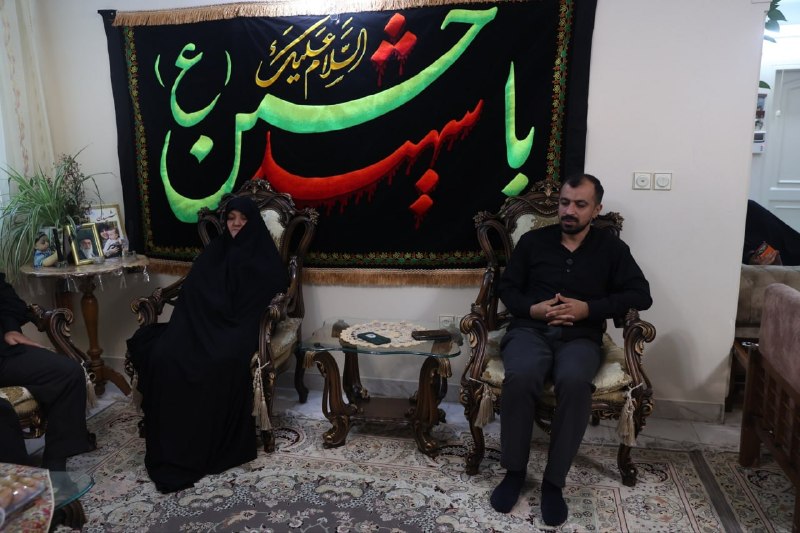
The three posts published on 6 May illustrate the layering with precision. The campaign titled "A word to my martyred Leader" invites participants to compose messages of loyalty to Khamenei himself, framed in the Quranic language of covenant and faithfulness. The word "martyred" in the title is doing significant work: it aligns Khamenei with the Shi'a tradition of Imam Hussein and the Karbala paradigm of righteous suffering, placing the Supreme Leader's political authority inside a narrative of sacred sacrifice. The campaign is participatory — it invites followers to produce content, not merely consume it — which deepens engagement and transforms passive readers into active agents of the regime's messaging apparatus.
The daily Quran recitation post is structurally identical to what a mosque bulletin board might carry: a passage reference, a Surah citation, a devotional encouragement. The difference is context. The post appears on the channel of a head of state who also holds the title of Supreme Religious Authority. The reader — whether Iranian, Pakistani, British Muslim, or American convert — is receiving a message that frames Khamenei as both political leader and spiritual guide. The dual role is not incidental. It is the product being sold.
The third post, quoting the "Martyr Imam" on the necessity of Quranic engagement, reinforces the pattern. The quotation from the late Ayatollah — delivered in the third person, as received wisdom rather than contemporary political speech — extends the sacred authority backward in time and forward into the present. The implication is that the Islamic world has a spiritual debt to discharge: daily engagement with scripture, modelled by the Supreme Leader's own example.
Reading the Dual Audience
The strategic logic becomes clearer when the content is viewed through the lens of audience segmentation. The English-language Telegram channel is not primarily aimed at Iranian citizens, who receive Persian-language content through separate channels. The English feed is calibrated for three external constituencies: Shia communities across the Middle East and South Asia, Muslims in the West who consume religious content in English, and international observers — journalists, analysts, diplomats — who monitor Khamenei's communications as a policy input.
For Shia believers in Iraq, Lebanon, Yemen, or Bahrain, the channel delivers religious content that positions Iran as the guardian of Islamic scholarship. For Western Muslims seeking Arabic-language Quranic material in translation, the channel offers devotional continuity with an established clerical authority. For analysts, the posts function as a barometer: their tone, frequency, and framing reveal regime priorities without requiring the analyst to engage directly with state-controlled television or official press releases.
This is not unique to Iran. North Korean state media has long published content in multiple languages designed for external consumption. Russian state outlets operate separate English and Russian feeds with different registers and emphases. The technique is standard autocratic communications practice: speak to each audience in the register that audience finds most persuasive, without reconciling the frames internally. The English-language Khamenei feed is careful, measured, spiritually inflected. The Persian feed can be more direct, more bellicose, more concerned with domestic political consolidation. The audience determines the register.
Why the Religious Frame Persists
The Islamic Republic has governed Iran since 1979. Across that span of nearly five decades, the regime has faced sanctions, diplomatic isolation, domestic unrest, and two major waves of protest — the 2009 Green Movement and the 2022 Mahsa Amini protests. Each crisis tested the regime's capacity to communicate legitimacy. Each time, the religious infrastructure proved durable.
The Quran recitation programme is one element of a broader theological communications infrastructure. The "Martyr Imam" framing — which connects the current Supreme Leader to the deceased Ruhollah Khomeini through the concept of sacred succession — provides continuity across generations of leadership. The language of service and sacrifice resonates with audiences for whom clerical authority is not a bureaucratic abstraction but a lived spiritual relationship.
Western communications strategists tend to treat religious content as a secondary or peripheral element of authoritarian messaging — something bolted on to secular nationalist appeals. The Khamenei channel suggests the opposite hierarchy: the religious content is primary, and the political authority derives from it. The Supreme Leader does not invoke Islam to legitimise politics. He invokes politics to demonstrate the relevance of Islam. The distinction matters for how external audiences receive the messaging.
What the Channel Cannot Do
The channel's strength — its ability to project spiritual authority across linguistic and national boundaries — is also its limitation. The English-language Telegram feed reaches perhaps a few hundred thousand active subscribers globally. That is a meaningful audience for niche religious content, but it is not a mass communications platform. The channel does not compete with Al Jazeera, BBC Arabic, or Turkish state media for regional influence.
More significantly, the channel's credibility depends on the broader credibility of the Islamic Republic's institutional claims. As Iran faces ongoing economic pressure from sanctions, internal dissent among younger Iranians who have increasingly turned away from clerical authority, and geopolitical complications in its support for proxy groups across the region, the spiritual messaging becomes harder to separate from the political reality it is meant to sanctify. The Quranic verses about justice and compassion appear on the same channel as statements defending a government under international sanctions for its nuclear programme and its support for armed groups in Lebanon, Yemen, and Iraq.
The 6 May posts make no direct mention of any of these tensions. That is precisely the point. A communication strategy built on sacred language and devotional rhythm can sustain an audience precisely by avoiding the topics that generate controversy. The channel offers a space of spiritual continuity — the same content, the same cadence, the same framing — regardless of what is happening in Tehran, Vienna, or Washington. For some subscribers, that predictability is the product.
The Khamenei Telegram feed is not a news channel. It is a devotional companion wrapped in the branding of a heads-of-state communications operation. Understanding it requires setting aside the question of whether its content is factual and asking instead what kind of authority it is trying to establish, for whom, and by what means. On those questions, the posts published on 6 May are unusually transparent.
—
This analysis is based on the English-language Telegram channel operated by the office of Iran's Supreme Leader. Iranian state media was not contacted for this article, which focuses on the communicative architecture of the channel rather than on verification of its theological content.
Wire provenance
This editorial synthesis draws on the following public wire/social posts:
- https://t.me/Khamenei_en/15768
- https://t.me/Khamenei_en/15766
- https://t.me/Khamenei_en/15767