Mon Rocket Festival Tests Sacred Tradition Against Modern Thailand's Secular Turn
Temples across Thailand gathered on 5 May 2026 for the annual Look Noo rocket festival, reviving an ancient Mon tradition at a moment when questions about religious modernisation are reshaping the country's spiritual landscape.
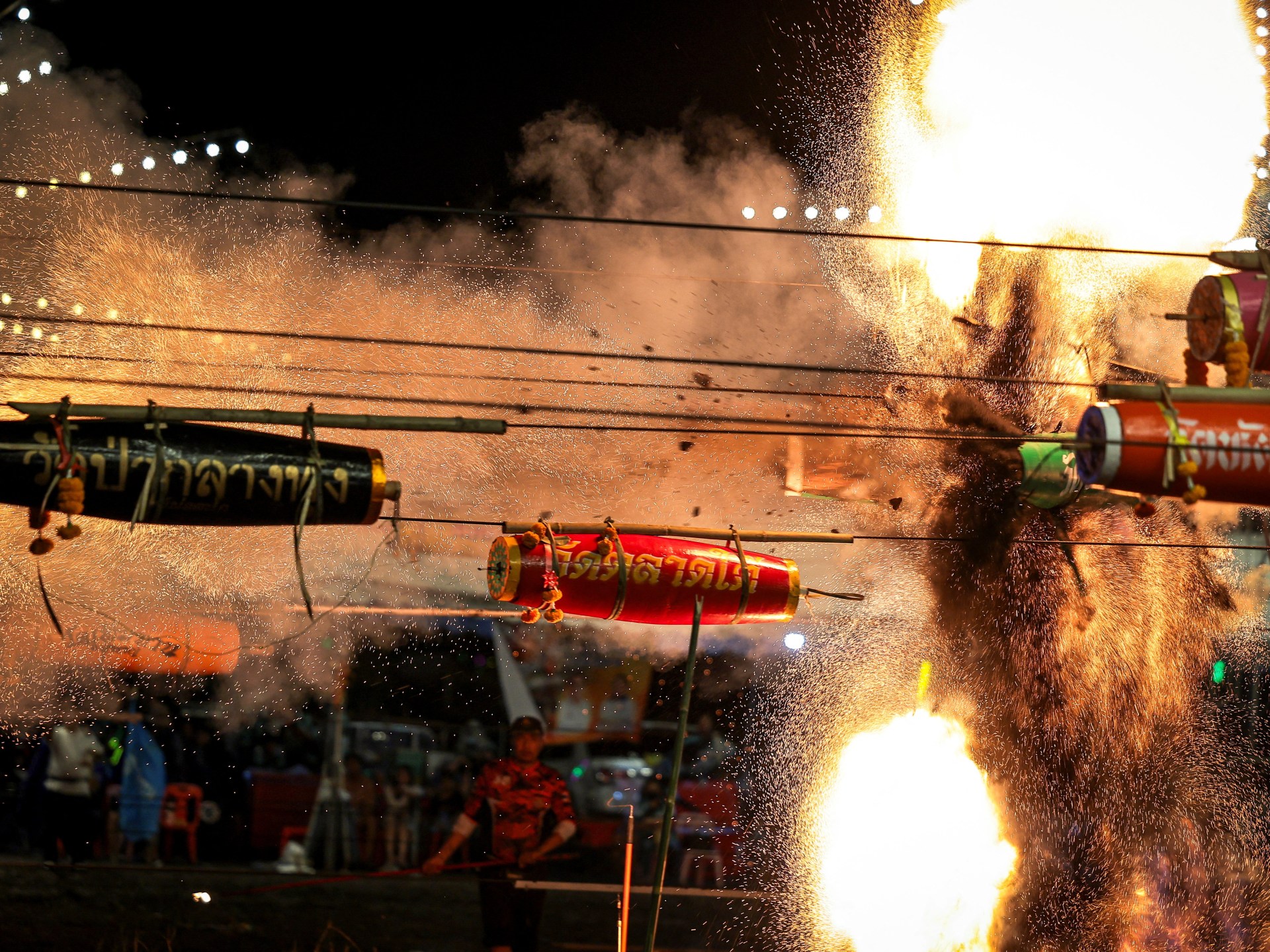
The bamboo rockets went up before noon on 5 May 2026, as they have for centuries. Temples across central Thailand marked the annual Look Noo festival — a Mon tradition that blends Buddhist merit-making with older agricultural rites — in what participants described as both a friendly contest between communities and a collective act of faith. The Al Jazeera Breaking News wire reported temples gathering for the event, part of a calendar that anchors the Mon minority in Thailand's cultural mainstream even as assimilation pressures reshape daily life in the provinces.
What looks from the outside like a colourful spectacle is, for those inside the Mon communities, something more consequential. The rocket launch carries a layered purpose: soliciting blessings for the coming rice season, demonstrating communal solidarity, and preserving a Mon identity that pre-dates the Thai nation-state by well over a millennium. The question the festival raises — one the wire report does not answer directly — is whether that identity can survive the pressures of a Bangkok-centric development model that often treats peripheral cultures as scenery rather than substance.
Ancient Rite, Modern Stage
The Look Noo festival belongs to the Mon people, an Austroasiatic-speaking community whose kingdoms once dominated lower Burma and central Thailand before Thai migration waves reshaped the region from the thirteenth century onward. Mon Theravada Buddhism predates its Thai neighbour by several centuries, and Mon literary and artistic traditions fed into what later became identified as Siamese high culture. Today, roughly 800,000 Mon live in Thailand, concentrated in Suphan Buri, Kanchanaburi, and Nakhon Pathom provinces — communities that have historically occupied an ambiguous position between integration and marginalisation.
The festival itself involves bamboo rockets — sometimes called extit{look noo} — filled with incense, flowers, and talismans rather than pyrotechnic payload. The rockets are launched skyward as offerings to the Nāga serpent spirits and the deities of wind and rain, a practice that traces back to pre-Buddhist agricultural rites adapted over centuries into a Buddhist merit-making event. At the temple level, monks administer blessings; at the community level, rival temple groups compete to see whose rocket travels highest, an element that gives the festival its athletic, carnival dimension.
The 2026 iteration followed this pattern, according to the Al Jazeera report, which described temples gathering for what it characterised as "friendly festival rivalry." The wire framing is accurate as far as it goes — but it undersells the cultural freight the ritual carries. For Mon participants, the festival is one of the few annual occasions where their distinct heritage becomes visible at the national level rather than dissolved into a generic Thai Buddhist observance.
When Tradition Becomes Folklore
The risk for minority cultural practices in Southeast Asia is not active suppression — Thailand has no official policy of Mon erasure — but something subtler: absorption into the national brand. National geographic features, culinary traditions, and religious festivals get packaged for tourist consumption, their local particularity flattened into a colour photograph of smiling faces and exotic customs. The Mon rocket festival has occasionally appeared in Thai tourism promotion, which gives it visibility while stripping away the ethnic-specific meaning.
A visitor to this year's festival who encounters only the launch spectacle and the merit-making donations might come away thinking they have witnessed an authentic Thai Buddhist custom. They would not be wrong — the practice is authentically Buddhist — but they would be missing the Mon dimension entirely. The festival is not just a regional variant of a national tradition; it is a specific expression of Mon cultural survival, and its continued practice by Mon temples rather than Thai Buddhist institutions more broadly is evidence of that specificity.
The counter-framing is worth stating clearly: perhaps the categorisation does not matter. Buddhist practice in Thailand has always been syncretic, absorbing local spirits, regional calendar systems, and ethnic traditions into a flexible orthopraxy that resists rigid boundary-setting. What matters is that the practice continues, not who claims exclusive ownership of it. This is a defensible position, and it is one that many Thai religious authorities implicitly adopt when they describe the rocket festival as simply a regional Buddhist tradition.
But the Mon communities themselves tend to disagree. Their leaders have consistently argued that cultural distinctiveness is not a barrier to national belonging — it is a contribution to it. The Look Noo festival, in this reading, is not a curiosity preserved in amber; it is a living practice whose continued vitality depends on maintaining the ethnic and linguistic context that gives it meaning.
The Structural Dimension
Southeast Asian nations have long managed the tension between national cohesion and cultural pluralism. The Thai model has historically been relatively permissive toward minority languages and religious practices, provided they do not become politically mobilisationist. Mon communities have largely accepted these terms, staying clear of separatist politics and integrating into the Thai administrative and economic system. The cost of that integration, however, has been cultural attrition: younger Mon are more likely to identify primarily as Thai citizens, to conduct daily life in central Thai rather than Mon, and to view the rocket festival as an ancestral custom rather than a living practice.
The demographic pressure is real and not unique to Thailand. Across the region, minority communities with pre-colonial roots — the Karen, the Hmong, the Acehnese, the Dayak — all face some version of the same dynamic: integration offers material benefits, but at the cost of cultural distinctiveness that erodes across generations. The festivals that survive are often those that achieve enough public visibility to generate pride among their own participants, or enough tourism value to justify official support, or enough entanglement with national religious institutions to receive institutional patronage.
Look Noo occupies an uncertain position in all three categories. It has public visibility during the festival window; it attracts some outside visitors; but it remains Mon-led rather than nationally institutionalised, and the Thai Sangha (Buddhist clerical establishment) has historically shown limited interest in amplifying Mon-specific observances.
What Follows From Here
Whether the Look Noo festival retains its vitality in ten or twenty years depends on several variables. Community leadership in Suphan Buri and Kanchanaburi will need to transmit the cultural knowledge — the ritual meanings, the Mon-language recitations, the history of the practice — to younger generations who have the option of disengaging. The temples will need resources to maintain the rocket-making traditions and the ceremonial expertise. And the broader Thai political environment will need to remain permissive enough that Mon cultural distinctiveness does not become a casualty of nationalist consolidation.
That last condition is the most uncertain. Thailand's political landscape has shifted in recent years toward a more centralized, Bangkok-focused model, and peripheral communities — including ethnic and religious minorities — have felt the effects in reduced provincial budgets and reduced political attention. The 2026 festival went ahead without disruption, but the conditions that support it are not guaranteed going forward.
For the Mon communities that launched their rockets on 5 May 2026, the stakes were clear without requiring editorial framing: preservation of a tradition, demonstration of communal vitality, and a collective prayer for the rains that the rice season depends on. Whether the outside world attaches the same weight to those stakes is a separate question — one the Al Jazeera wire, for all its accuracy, did not answer.
This publication covered the Mon rocket festival through the lens of ethnic-cultural preservation rather than as a generic Thai Buddhist observance. The wire framing was accurate but culturally thin; this desk attempted to restore the Mon-specific dimension that the default national frame tends to dissolve.
Wire provenance
This editorial synthesis draws on the following public wire/social posts:
- https://en.wikipedia.org/wiki/Mon_people
- https://en.wikipedia.org/wiki/Bun_Bang_Fai
- https://en.wikipedia.org/wiki/Thai_government