Trump Pauses Hormuz Operation Hours After It Began, Citing Iran Talks and Pakistan Request
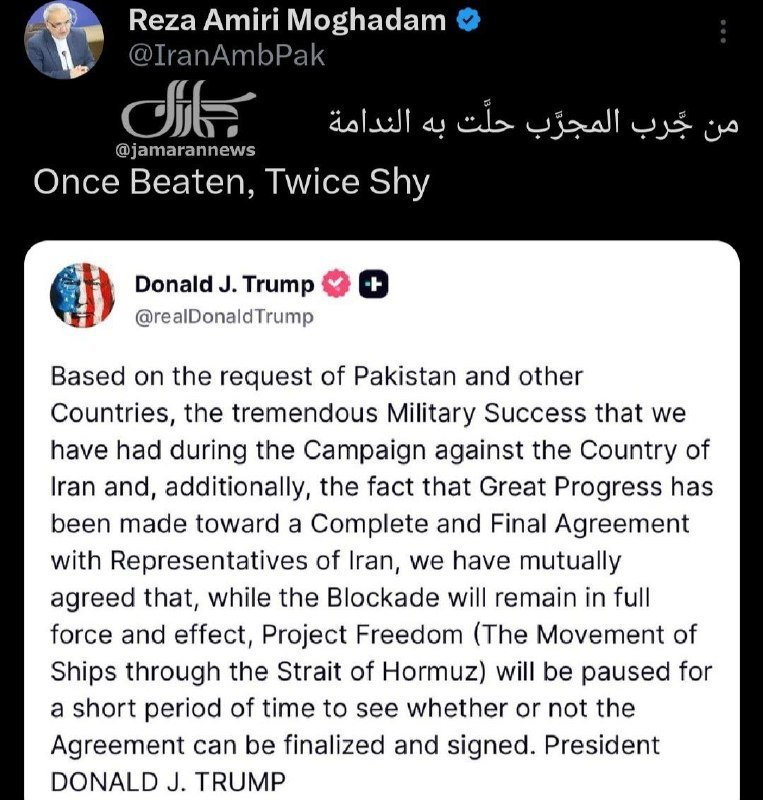
President Donald Trump announced on the evening of 5 May 2026 the suspension of Project Freedom, the US military mission tasked with escorting commercial vessels through the Strait of Hormuz. The pause came just hours after US Central Command had publicly stated the operation was a priority and after the US Army acknowledged it had, in CENTCOM's words, "just begun." The reversal — attributed in a Truth Social post to a request from Pakistan and to the prospect of a formal agreement with Iran — has produced a sharp divergence in how the episode is being read across Washington, Islamabad, and Tehran.
The immediate facts are straightforward but their implications are not. On the evening of 5 May 2026, Trump posted to Truth Social that Project Freedom was being suspended at Pakistan's request and in order to determine whether a negotiated settlement with Iran could be finalised and signed. Within the same hour, CENTCOM's official line to Al Jazeera was that securing a safe passage through Hormuz remained the United States' priority under the initiative. An earlier CENTCOM statement, released shortly after midnight UTC on 6 May, had described the mission as having "just begun" inside the blockaded strait. The Army's own readout of the operation placed it in its earliest operational phase. The sources do not specify precisely how many escort sorties had been flown, how many vessels had been guided through, or what naval assets were deployed before the suspension was ordered.
Pakistan's role in the episode is not yet fully explained by the available record. The White House cited Islamabad as the requesting party; it remains unclear whether Pakistan's government publicly confirmed this request or whether it was conveyed through back-channel communication. The Pakistani foreign ministry had not issued a public statement on the matter as of the latest available reporting on 6 May 2026. That ambiguity matters: if Islamabad sought the suspension unilaterally, it suggests a Pakistani assessment that heightened US naval presence near Iranian territorial waters increased regional instability risk. If the request was diplomatically coordinated with Washington as part of a broader engagement strategy, it suggests the suspension was always the plan — with the initial deployment serving a different purpose altogether.
The framing from Tehran was swift and pointed. Iranian state media outlets Tasnim and Jahan News — both affiliated with the Islamic Revolutionary Guard Corps-linked media ecosystem — ran the story under headlines declaring that Trump had retreated and that the so-called Freedom Project had been stopped as part of America's ongoing failures in the Hormuz corridor. That language is consistent with Tehran's standard posture: it characterises any US military presence in the Gulf as an act of pressure, and any withdrawal as a vindication of Iranian resolve. The sources do not include any direct response from the Iranian foreign ministry or the office of the president, and Reuters had not published an independent confirmation of Tehran's formal reaction by the time of this reporting.
That said, the Iranian framing deserves more scrutiny than it typically receives in wire summaries. Tehran has long maintained that US military presence in the Strait constitutes an illegal imposition on a chokepoint it regards as sovereign territory under shared jurisdiction. From that vantage point, a US operation to escort non-Iranian vessels through a corridor Tehran considers subject to its maritime regulations is not a de-escalation measure — it is an escalation wrapped in free-navigation language. The suspension, on that reading, removes a proximate cause of friction, regardless of the stated motivation. This is not a concession the Iranian side would publicly acknowledge, but it is a structural reality that the Western framing tends to obscure.
What the available record does not yet tell us is what, precisely, was agreed to — or what Tehran believes was agreed to — that prompted the suspension. Axios has previously reported on several rounds of US-Iran proximity talks facilitated by third parties, including Oman and, intermittently, Switzerland. The standard US position, as maintained through successive administrations, is that there are no formal negotiations and no nuclear deal without a full sanctions relief quid pro quo. The Trump administration's own record on Iran policy is one of maximum-pressure rhetoric punctuated by episodic diplomatic gestures. Whether this pause represents a substantive shift in that posture, a tactical repositioning ahead of a pressure campaign, or simply a communication-management decision after a 48-hour operational deployment is a question the available sources do not resolve.
The structural dimension of this episode is not hard to locate. Roughly a fifth of global seaborne oil trade transits the Strait of Hormuz; the waterway sits between Oman and Iran at its narrowest point, with tanker lanes no more than two nautical miles wide in either direction. Iranian military doctrine has long treated the strait as a centre-of-gravity target in any adversarial scenario — not because Tehran wishes to close it permanently, but because the economic disruption of even a temporary interdiction would be disproportionate to any conventional military exchange. That calculus is what makes Hormuz simultaneously the most sensitive and the most heavily surveilled maritime corridor in the world. When the United States announces an escort operation inside the strait, it is not merely asserting freedom of navigation — it is contesting the implicit threat architecture Iran has maintained there for decades.
The commercial stakes are real and immediate. Tanker freight rates react sharply to Hormuz-adjacent incidents; a sustained US escort operation would have altered the insurance calculus for vessel operators, at least temporarily. The suspension, if it holds, removes that floor beneath freight costs and may reduce the risk premium currently priced into Middle East crude. Whether that is a relief for Asian refiners — the primary destination for Hormuz crude — or a signal that the underlying security architecture is less reliable than previously assumed depends on whether the pause proves to be a pause or an abandonment.
For the Gulf monarchies — Saudi Arabia, the UAE, Qatar — the episode is uncomfortable regardless of its outcome. Their security posture has rested on the assumption of US willingness to maintain open access through the strait, a commitment reinforced by CENTCOM's forward posture and the US naval presence at Bahrain's Fifth Fleet. A pattern in which Washington deploys and then retracts within 48 hours, on the basis of what a single foreign government requests, introduces a new kind of uncertainty into their strategic planning. It does not prove unreliability — a single episode is not a trend — but it is the kind of event that accelerates conversations about hedging that Gulf capitals have been having quietly since at least 2019.
For Pakistan, the request — if confirmed as a bilateral diplomatic move — signals a degree of agency Islamabad appears eager to exercise in the Gulf security conversation. Pakistan has historically balanced its US security relationship against its deep commercial and energy ties with Iran; a pipeline from Iran to巴基斯坦 has been discussed and deferred for over a decade precisely because of US sanctions pressure. If Islamabad requested the suspension in order to preserve that diplomatic channel, it is making a quiet bet that Washington will not punish the gesture — or that the political cost of punishment is higher than the cost of accommodation.
What remains genuinely uncertain is the timeline. The White House statement frames the suspension as conditional: the operation pauses while an Iran agreement is pursued. No timeline has been specified for concluding that assessment. CENTCOM's public posture — calling the safe passage a priority — is technically consistent with a pause rather than a cancellation, but the operational reality of a suspended escort mission is not meaningfully different from a withdrawn one in the near term. Vessel operators and insurers will price the uncertainty, not the technical distinction.
The picture that emerges is of a decision that is being described differently by every party with a stake in it. Washington says it is pursuing a diplomatic opening. CENTCOM says Hormuz access remains a priority. Tehran says Trump retreated. Islamabad's position is not yet independently confirmed. Each framing is internally consistent with the interests of the party offering it, and the available record does not yet allow a determination of which reading best reflects the actual decision-making calculus inside the administration. What is clear is that the Strait of Hormuz — the world's most consequential maritime chokepoint — is once again at the centre of a policy episode whose ultimate direction remains genuinely open.
This publication's wire readout prioritised CENTCOM and US Army official statements as the primary frame for the operation's status; the Iranian and Pakistani framings appeared in secondary positions. Monexus has sought to rebalance that hierarchy by foregrounding the structural incoherence between a mission described as just beginning and one suspended within hours, and by giving the Iranian counter-framing equivalent structural weight rather than treating it as mere spin.
Wire provenance
This editorial synthesis draws on the following public wire/social posts:
- https://twitter.com/Osinttechnical/status/2051823999165096111
- https://t.me/aljazeeraglobal
- https://t.me/aljazeeraglobal
- https://t.me/tasnimnews_en
- https://t.me/JahanTasnim