Trump Tells Tehran: Take the Deal or Face Intensified Strikes
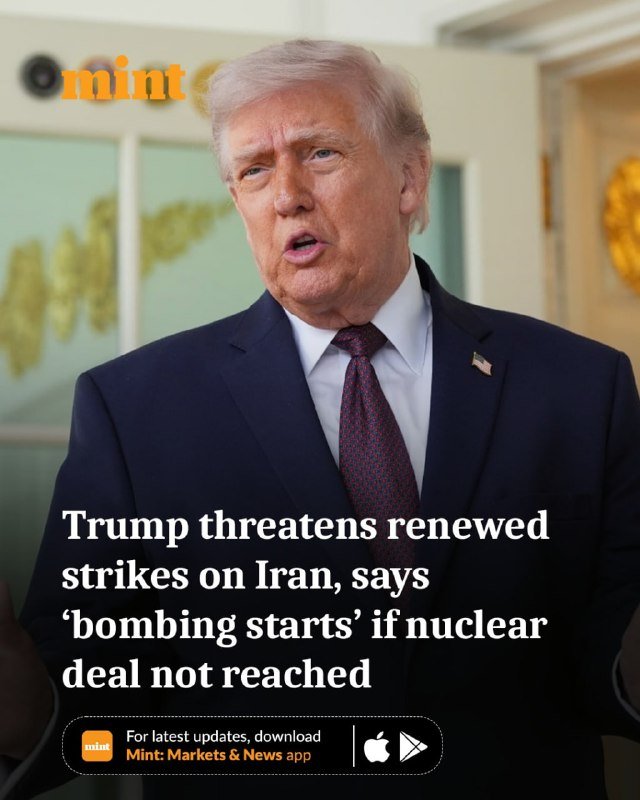
President Donald Trump on 6 May 2026 gave Iran a blunt ultimatum: accept a negotiated settlement or face airstrikes at a scale that "would be much higher level and intensity than it was before." The warning, delivered publicly and amplified through state-linked channels in Beijing and Caracas, came as Iranian officials said they were still evaluating the US proposal and after a temporary pause in the Hormuz Strait mission had briefly lowered regional temperatures.
The dual-track posture — negotiating table and runway both lit — has produced a bifurcated picture in the market. Polymarket, the prediction market platform, registered a 77% probability on 6 May for a permanent US-Iran peace deal by year-end, its highest reading since hostilities escalated. Yet the same day, Trump told reporters aboard Air Force One that it was "too soon to prepare for" a signing ceremony, a statement that muddied the signal and drew sharp reactions from Gulf allies watching the Hormuz corridor closely.
The Hormuz question — shipping lanes and sovereignty
The Strait of Hormuz is the world's most consequential oil chokepoint, carrying roughly 20% of global crude shipments on any given day. Its control has been a thread running through every US-Iran negotiation since the 1979 revolution. The current framework reportedly includes a commitment from Tehran to guarantee safe transit for commercial vessels — an offer Iranian authorities framed on 6 May as contingent on Washington ending its "threats" against the Islamic Republic. The implication is that the strait operates as a negotiating chip: open it, get the deal; keep the bomber posture, keep the bottleneck.
The market has priced this dynamic. US oil exports hit a record 8.2 million barrels per day in the week ending 2 May 2026, according to customs data cited by wire services on 6 May. That figure, up sharply from previous months, reflects a structural shift in US export capacity that would cushion — though not eliminate — a Hormuz disruption. Brent crude prices eased on 6 May as reports surfaced that Washington was actively seeking a reopening of the strait. American producers, facing softening domestic demand, have found eager buyers in Asia and Europe; a sustained export surge makes the Gulf shipping lanes more, not less, important as a diplomatic pressure point.
Polymarket odds for Trump granting Iran the right to charge tolls in the strait stand at just 6% — an indication that Washington is not contemplating formal control rights for Tehran. What remains on the table is de facto coexistence: Iranian silence on tanker transits in exchange for sanctions relief and a verified nuclear freeze. Whether that satisfies the supreme leader's conditions is the question no US official has publicly answered.
What Iran has — and what it is willing to trade
Iran's leverage in this negotiation is not primarily military. It is navigational. The Islamic Revolutionary Guard Corps Navy has practiced bottleneck control in the Gulf for decades; its anti-ship missile systems and drone swarms can make transit dangerous without a single mine laid. Iran's civilian leadership has consistently maintained that it does not seek to close the strait — only to be treated as a sovereign state, not a pariah under maximum pressure.
Tehran's stated position as of 6 May, as reported by CubaDebate, is that it is still "evaluating the US proposal." This is not a rejection. It is a deliberate pause — a procedural signal to domestic audiences that the supreme leader is not capitulating. Iranian state media, when covering the negotiations, has been careful to frame any agreement as a product of resistance, not concession. That framing matters: any deal that looks like surrender to a sitting US president could destabilize the current government.
The structural constraint on Iran's position is economic. Five years of sectoral sanctions have contracted oil revenues, restricted banking access, and suppressed living standards in ways that the Iranian public has absorbed with a notable absence of street-level revolt. The government can hold out — but not indefinitely. The pressure for a deal, from business networks and provincial officials, is real.
The China angle — sequencing and leverage
A significant subtext running through the 6 May reporting is the relationship between the Iran file and Trump's anticipated visit to China. A new Polymarket event asks whether a permanent US-Iran deal is signed before Trump meets Beijing. The historical parallel is deliberate: China's role as a major Iranian oil customer and a Security Council veto-holder gives it informal leverage over the outcome. Washington knows this. Tehran knows Washington knows it.
The sequencing question matters because China has its own interests in Gulf stability — not because it wants a US-Iran accord, but because Chinese imports of Gulf crude are enormous and the Hormuz route is the arterial line for tankers heading east. A war that closes the strait is a Chinese economic problem as much as a US one. Beijing has quietly signalled that it does not want escalation, which gives it a potential back-channel role — one that Washington may be using, or may be about to use.
The 6% Polymarket odds on Iran charging strait tolls suggests the market does not expect Trump to formalize any Iranian control rights. But the deal's actual substance — what the administration is actually prepared to accept — remains opaque. The negotiating team has kept the technical details close; the public statements have oscillated between war-footing and peace-optimism in ways that seem designed to keep all parties off-balance.
Stakes — and the uncertainty that remains
If a deal is signed, the winners are clear: Asian energy consumers get stable shipments, US exporters maintain their record volumes, and Trump gets a signature diplomatic win before a China visit that has already attracted significant media attention. Iran wins sanctions relief — partial, conditional, but real. The losers include the hardliners in both governments who invested in the confrontation posture.
If the talks collapse, the costs fall unevenly. Iran's economy contracts further; the regime faces its hardest domestic test in years. The global oil market absorbs a supply shock that US export capacity can only partially offset — and only if the Gulf remains navigable. American military assets in the region face a sustained threat environment that degrades readiness and raises the risk of an incident that escalates beyond anyone's intended scope.
What the sources do not resolve is whether Tehran's "evaluation" of the US proposal amounts to a genuine negotiating pause or a stalling tactic designed to run out the clock. Nor is it clear what the US has offered on the nuclear side — whether the freeze is temporary, whether IAEA inspections are included, and whether the sunset clauses that plagued the 2015 JCPOA have been addressed. The 77% Polymarket probability is a market signal, not a diplomatic fact. Until a text is on the table, the strait remains the world's most consequential pinch point.
This article is based on wire reports from BBC, CGTN, LiveMint, CubaDebate, and Polymarket market data as of 6 May 2026.
Wire provenance
This editorial synthesis draws on the following public wire/social posts:
- https://t.me/CubaDebate/89432