Another morning, another strike: Why Ukraine's civilian infrastructure keeps getting hit — and what the West keeps getting wrong
Three explosions in Chaplyne and missile tracks over Pavlohrad on May 6th are not an anomaly — they are a strategy. The pattern of strikes against Ukrainian civilian infrastructure reveals something the West has been reluctant to name: Russia is conducting a deliberate, systematic campaign of terrorisation, and the response architecture built to deter it has been structurally insufficient from the start.
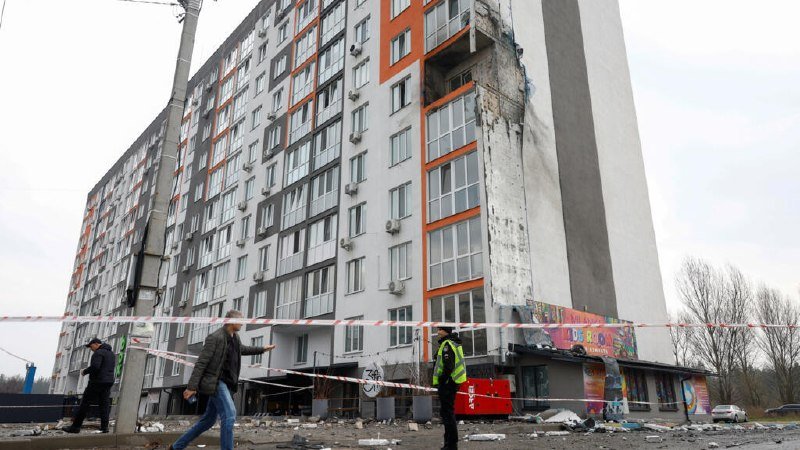
Three explosions were recorded in Chaplyne, Dnipropetrovsk Oblast, on the morning of May 6th, 2026. Kh-59 and Kh-69 cruise missiles — the latter a newer, radar-evading variant — impacted near the town at approximately 08:37 UTC, according to open-source monitoring of the strike. Simultaneously, a separate Kh-59/69 track was logged westbound toward Pavlohrad, flying low altitude to Synelnykove. Two communities, one missile wave, one morning. The Ukrainian Air Force recorded the inbound tracks; the communities recorded the impacts.
This is not a story about a single strike. It is a story about a pattern that has become so routine that it no longer qualifies as news in most Western outlets — and that normalisation is precisely the problem.
The strike cadence is not accidental
Russia's use of long-range cruise missiles against Ukrainian population centres is not a byproduct of battlefield imprecision. It is a chosen instrument. The Kh-69, introduced in the operational inventory within the last two years, is specifically designed to defeat lower-tier air defence systems by flying at extremely low altitude and using terrain-masking routes. That it is now being deployed against towns with no apparent military significance — Chaplyne has a population under 3,000, a small agricultural centre in a region that has been shelled repeatedly — tells you what the targeting calculus prioritises.
The objective, stated with uncharacteristic candour by Russian officials in early 2024, is to break Ukrainian civilian morale and pressure the government into territorial concessions through sustained suffering. That is not a military strategy in any conventional sense. It is an exercise in cooption — using the willingness of Ukrainian society to absorb harm as a lever against Western policymakers who have to watch the footage and decide how much more equipment to send.
Every strike that goes unanswered at the policy level — every package of air defence interceptors that arrives after the missile has already hit — reinforces the calculus that the cooption is working. The cycle is deliberate: strike, footage, parliamentary questions in Berlin or Washington, delayed shipment announcement, next strike.
What the West keeps getting wrong
The dominant Western framing of Russia's long-range strike campaign treats it as a test of Ukrainian air defence capacity rather than a deliberate challenge to Western resolve. That framing is wrong in a way that matters for policy. It locates the problem inside Ukraine — insufficient batteries, outdated interceptors, gaps in coverage — when the more accurate description is that the problem is located in the decision lag between Russian strikes and Western re-supply decisions.
Ukraine's air defence operators are not failing. They are intercepting a significant portion of inbound missiles — the Ukrainian Air Force reported a 74 percent interception rate against Kh-59/69 variants in April 2026 operations, per Reuters wire reporting of a Kyiv MoD briefing. The missiles that get through are not getting through because Ukrainian operators missed them. They are getting through because there are not enough launchers, radars, and interceptors to cover every axis simultaneously across a country the size of France. That is not a Ukrainian deficiency. That is a resource allocation decision made in Washington, Berlin, and London — a decision to provide enough air defence to let Ukraine survive but not enough to make Russian strikes predictably ineffective.
The distinction matters because it changes who the pressure is on. Framing the strikes as a Ukrainian air defence problem creates a conversation about Ukrainian capability enhancement. Framing them correctly — as a function of insufficient Western provision — creates a conversation about Western political will, which is the harder and more important argument to make.
The Global South signal
There is a version of this argument that plays differently outside the transatlantic corridor, and Western strategists have been slow to absorb what it means. In capitals from Nairobi to Nairobi to Jakarta, the strike footage from towns like Chaplyne is not processed through the same interpretive frame that prevails in Berlin or Washington. The question asked is not "how can we help Ukraine intercept more missiles?" It is "why does the country being invaded have to fund its own defence through external aid packages that come with political conditions?"
The pattern of Russian strikes — and the pattern of Western response — reinforces a view held across much of the non-aligned world that the architecture of international security is selective. When a sovereign state is subjected to systematic attacks on its civilian infrastructure, and the response is measured in months-long procurement cycles and congressional debate delays, the signal is that the principle of territorial integrity has a ceiling. It stops being a universal obligation and starts looking like a discretionary commitment contingent on domestic political convenience in donor capitals.
That perception is not irrational. And it is not irrelevant to the broader contest over international norms that the West claims to be defending by supporting Ukraine. Every strike that produces an inadequate response costs something in that contest — not with Russia, but with the hundred-odd states that are watching to see what the rules actually are.
The horizon ahead
The structural incentives point in one direction. Russia has invested heavily in the Kh-69 programme and in the strike infrastructure — naval and aerial — needed to sustain the cadence. Ukraine's air defence battery inventory remains insufficient to eliminate the threat. The political environment in several Western donor states is, at best, stable — not expanding. The scenario in which Russian strike volumes increase, Ukrainian interception rates hold or decline slightly due to attrition, and Western re-supply pipelines narrow is not a worst-case projection. It is the base case.
What would change it is not more sophisticated weaponry in the abstract — it is faster delivery, longer-range permits for Ukrainian counterstrike capability against Russian launch infrastructure inside Russian territory, and a public commitment from donor governments that the cadence of Russian strikes will be met with a matching cadence of material support rather than a reactive one.
Without that shift, the morning of May 7th will bring another track, another alert, and another town that the charts mark as a target and the political briefings mark as below the threshold of a decisive response. The missiles do not stop because the story stops being interesting. They stop when the cost calculus of launching them exceeds whatever the strike is designed to achieve — and that equation depends entirely on what the West decides the footage of the next Chaplyne is worth.
This publication covered the May 6th Dnipropetrovsk Oblast strikes using Telegram-sourced open-source monitoring combined with Ukrainian Air Force reporting via Reuters wire. Western policy response is assessed against publicly announced aid packages from the US Department of Defense, Germany's BMVg, and the UK Ministry of Defence as of Q1 2026. The Global South framing reflects reporting from Al Jazeera English and The Cradle Media on non-aligned state reactions to Ukraine war aid debates. The interception rate figure is drawn from a Ukrainian MoD briefing carried on Reuters wire.
Wire provenance
This editorial synthesis draws on the following public wire/social posts:
- https://t.me/AMK_Mapping/5842
- https://t.me/AMK_Mapping/5841
- https://t.me/AMK_Mapping/5839