IRGC Navy Launches Combined Anti-Ship Operation Against US Destroyers in Gulf of Oman
The Islamic Revolutionary Guard Corps Navy claims it struck US destroyers with missiles and drones near the Strait of Hormuz after accusing Washington of violating a ceasefire by targeting an Iranian oil tanker near Bandar Jask.
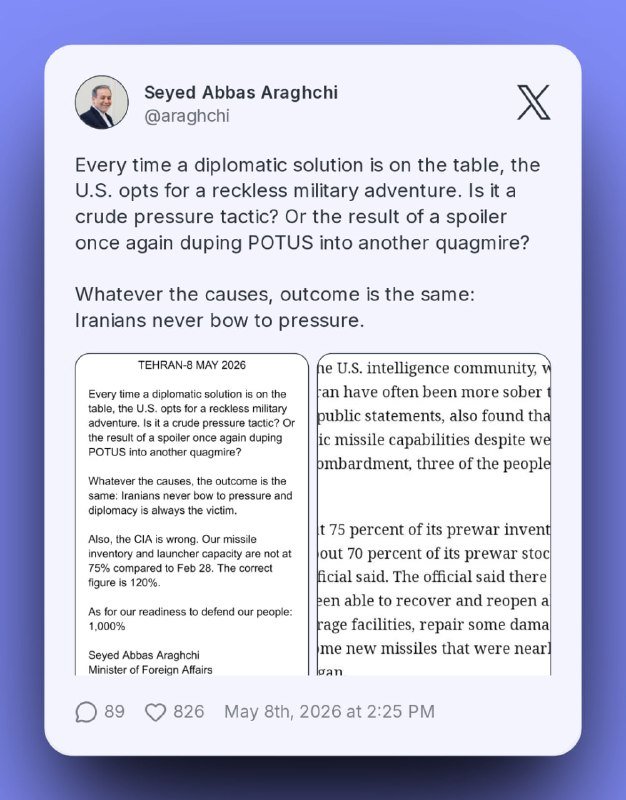
The Islamic Revolutionary Guard Corps Navy announced on May 7, 2026, that it had executed a large-scale combined operation employing ballistic missiles, cruise anti-ship missiles, and explosive drones against United States destroyers in the Gulf of Oman. The action came within hours of a statement by Iran's joint military command — Khatam al-Anbiya Central Headquarters — accusing Washington of violating an existing ceasefire by attacking an Iranian oil tanker near the port of Bandar Jask. The announcement, distributed across multiple Iranian state-affiliated channels between 21:05 and 21:46 UTC, marks a sharp escalation in a conflict that Western mediators have spent months attempting to contain.
The sequence of events Iran describes is straightforward in its internal logic, even as it defies independent verification. Khatam al-Anbiya Central Headquarters stated that the US military targeted an Iranian oil tanker sailing from Iran's coastal waters in the Jask region. The spokesperson for the headquarters, whose remarks were quoted by Tasnim News and Mehr News, described the American force as "aggressive, terrorist, and bandit." Within minutes, the IRGC Navy announced its response: a combined operation using the full spectrum of its anti-ship capabilities as US destroyers closed distance toward the Strait of Hormuz. The language employed across Iranian statements leaves no ambiguity about the framing — Tehran depicts itself as the victim of a ceasefire breach and its response as justified retaliation.
The Ceasefire Claim and the Verification Gap
The most consequential assertion in the Iranian account is the existence of a ceasefire. Multiple Iranian institutions — the IRGC Navy Command, Khatam al-Anbiya Central Headquarters, and the office of the IRGC spokesperson — repeated some variant of this claim across the evening of May 7. What those statements do not specify is when or under what terms such a ceasefire was agreed, who mediated it, or what threshold of action by either side would constitute a violation. The thread context available to this publication contains no US Department of Defense statement, no Pentagon press briefing, and no confirmation from any Western government that a ceasefire was in place, was understood to be in place, or was broken on May 7.
That asymmetry matters editorially. Iranian state media operates within a defined political framework; Tasnim, Press TV, and Mehr News are not neutral wire services. They are mouthpieces for an institution — the IRGC — whose interests are served by presenting any US action as unprovoked aggression and any Iranian response as righteous defense. The ceasefire narrative accomplishes two things simultaneously: it retroactively criminalises the US move against the tanker, and it provides legal cover for the retaliatory strikes. Whether a ceasefire existed or not cannot be determined from the sources currently in circulation. What can be determined is that no Western or independent outlet has confirmed the claim as of 22:00 UTC on May 7.
The Strait of Hormuz and the Geography of Escalation
Whatever the precise trigger, the operational geography places the escalation at one of the world's most consequential chokepoints. The Strait of Hormuz carries approximately 20 percent of global oil trade and sits at the outlet of the Persian Gulf — the same body of water where the US Navy maintains a persistent destroyer presence as part of its Fifth Fleet area of operations. Any exchange of anti-ship weapons fire in these waters carries structural consequences that extend well beyond the immediate combatants.
The IRGC Navy's choice of weapons in this operation — ballistic missiles, cruise missiles, and explosive drones — reflects a deliberate signal. Ballistic missiles launched from Iranian territory toward naval targets at sea require a command chain decision; they are not impulse weapons. Cruise anti-ship missiles offer more precision at shorter range. Explosive drones represent the middle tier of a layered strike concept that Iran has rehearsed and refined since 2019, when it deployed drone and missile salvos against Saudi Aramco infrastructure. That the IRGC announced all three systems in a single operation suggests either a coordinated strike plan predating today's events, or an improvised escalation calibrated to demonstrate capability across the full threat spectrum.
Structural Frame: Who Wanted the Ceasefire and Why
The ceasefire claim deserves scrutiny not only as a factual matter but as a geopolitical signal. If talks were underway — and the intensity of diplomatic activity around Iran's nuclear programme and regional posture in recent months makes that plausible — the party with most to lose from their collapse is Iran. A ceasefire, however temporary or informal, buys time: it slows sanctions escalation, preserves space for diplomatic deals to crystallise, and reduces the risk of an incident that forces Washington into a proportional military response. The claim that the US violated such an arrangement therefore serves a dual purpose: it shifts moral culpability to Washington while providing a casus belli that domestic audiences will accept.
This pattern — of using ceasefire allegations as a rhetorical weapon in active conflicts — is not unique to Tehran. What distinguishes the current moment is the speed with which the IRGC moved from accusation to execution. The gap between Khatam al-Anbiya's statement and the IRGC Navy's operational announcement was approximately twenty minutes. That brevity suggests either a standing order to respond to any US action against Iranian-flagged vessels regardless of context, or a decision already made at command level that awaited only justification. Either interpretation points to an institution that treats military readiness as indistinguishable from diplomatic signalling.
Stakes and What Remains Unknown
The stakes of this exchange are asymmetric but real for both sides. For Iran, the immediate risk is a proportional US response — carrier group repositioning, strikes on naval command infrastructure, or a ratcheting of the sanctions regime under Section 232 or analogous authorities. For the United States, the risk is that an Iranian strike — even one the Pentagon later characterises as ineffective — demonstrates that the IRGC can hold US naval assets in the Gulf at risk, which changes the operational calculus for any future contingency involving Iran's nuclear programme.
What the current thread does not establish: whether the US destroyer presence constituted a response to the tanker attack, a routine patrol, or a pre-positioning in anticipation of a broader operation. It does not confirm whether the ceasefire claim has any documentary basis. It does not specify damage to any vessel — Iranian or American. It does not include a statement from the US Central Command, the Pentagon, or the State Department. Until those sources surface, any article — including this one — is working from a single evidentiary lane.
This publication covered the IRGC's announcement on the evening of May 7, 2026. As of 22:00 UTC, no US or Western government source had confirmed the ceasefire claim, the alleged tanker attack, or the reported anti-ship operation. Coverage will update as statements emerge from CENTCOM, the Pentagon, or verified wire services.
Wire provenance
This editorial synthesis draws on the following public wire/social posts:
- https://t.me/wfwitness/28456
- https://t.me/presstv/39482
- https://t.me/tasnimnews_en/51823
- https://t.me/mehrnews/61448
- https://t.me/BellumActaNews/12847
- https://t.me/Middle_East_Spectator/9123
- https://t.me/farsna/77561