Israeli Airstrikes Near Nabatieh Hospital Draw Hezbollah Drone Response as Cross-Border Violence Escalates
Israeli airstrikes near a hospital in southern Lebanon killed at least one person on 7 May 2026, triggering a Hezbollah drone attack on an Israeli artillery position further north. The exchange marks a significant uptick in hostilities along a frontier that has seen sustained but contained conflict since the Gaza war began.
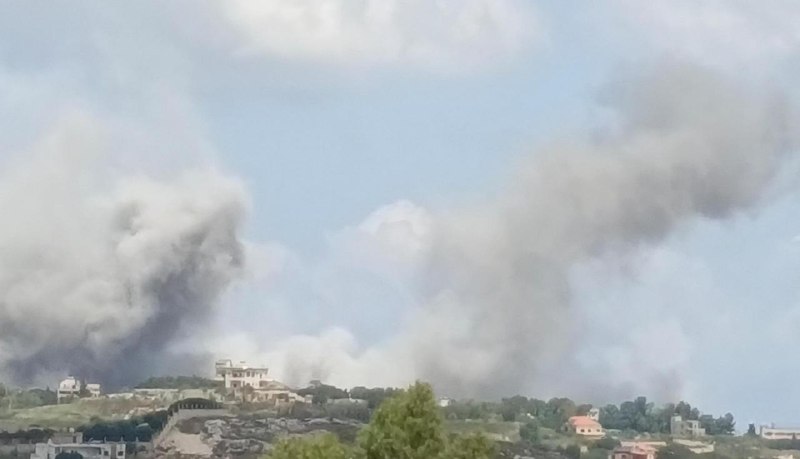
Israeli forces struck an area adjacent to a hospital in Nabatieh, southern Lebanon, on the morning of 7 May 2026, according to initial reports. Civil defence personnel who arrived at the scene found themselves targeted in what witnesses described as a secondary strike, according to a social media account tracking the incident.
The Israel Defense Forces had not issued a formal statement at the time of initial reporting, a routine lag that characterises much of the public communication around strikes in populated areas. Lebanese emergency services confirmed at least one fatality from the episode, though the full scope of casualties remained unclear as responders continued operations into the late morning hours.
Within hours, Hezbollah released footage purporting to show its fighters deploying a squadron of attack drones against a newly established Israeli artillery position near the town of Rab al-Thalathin, roughly five kilometres further north along the frontier. The precision of the drone release — filmed and distributed via the group's media arm — carried the hallmarks of a calculated response timed to coincide with the Nabatieh strike, suggesting a deliberate escalation calculus rather than opportunistic retaliation.
The Geometry of the Hospital Strike
Nabatieh sits in the Nabatiyeh Governorate, one of the most heavily contested stretches of the Lebanon-Israel frontier. The city hosts several medical facilities, and strikes near hospitals carry distinct legal and reputational weight under international humanitarian law. The proximity of the Israeli strike to a functioning medical centre — whether intentional or coincidental — almost invariably generates an inquiry from international humanitarian organisations and complicates the messaging calculus for both sides.
The IDF has historically maintained that it takes extensive precautions to avoid civilian harm and that proximity to protected sites is sometimes unavoidable in densely populated conflict zones. Critics of Israeli targeting practices have long argued that such explanations are invoked too readily, and that the pattern of strikes near hospitals, schools, and residential buildings in Gaza and Lebanon suggests something more systematic than incidental collision with civilian infrastructure.
The available footage from the civil defence scene, posted on the morning of 7 May, shows responders moving through debris with limited protective equipment. Whether the secondary engagement — if confirmed — constitutes a direct attack on medical personnel is a question that will likely surface in any formal investigation. The IDF did not comment on the nature of targets in the immediate area.
Hezbollah's Drone Campaign and the Artillery Problem
Hezbollah's publication of drone footage targeting an Israeli artillery position in Rab al-Thalathin is analytically significant in ways that transcend the immediate tactical picture. The group has invested heavily in unmanned aerial capabilities over the past two years, a shift away from its historical reliance on rockets and anti-tank missiles. The footage shows a coordinated swarm of multiple drones — a departure from the improvised, single-axis strikes that characterised the earlier phase of the exchange.
Israeli artillery positions along the northern frontier have been a persistent Hezbollah target, partly because they enable monitoring and partly because their suppression allows deeper probing of Israeli defensive lines. The establishment of a new position near Rab al-Thalathin — itself a signal of forward Israeli intent — did not go unobserved.
The drone release from The Cradle Media, a Hezbollah-adjacent outlet, should be treated with appropriate sourcing caution. The material is self-described and unverified by independent means. However, the publication of such footage follows a pattern in which Hezbollah publicises strikes that it considers operationally successful, while remaining silent on those that are not. The absence of Israeli confirmation or denial about the Rab al-Thalathin position makes independent corroboration difficult in the near term.
Escalation Dynamics and the Ceasefire Fiction
The exchange on 7 May sits within a broader arc of sustained cross-border violence that has persisted since October 2023, despite periodic efforts to negotiate a ceasefire framework. The standard characterisation — that both sides are carefully managing escalation below a threshold that would trigger full-scale war — faces increasing strain as the casualty count on both sides of the frontier accumulates.
The structural logic here is straightforward: each side interprets restraint as weakness and interprets retaliation as normalisation of deeper strikes. Israeli forces have expanded their targeting grid across southern Lebanon over the past eighteen months, placing artillery and drone installations further north than the original engagement zones. Hezbollah has responded by extending its own targeting range. The result is a slow-motion re-drawing of the frontier that no ceasefire proposal has yet managed to stabilise.
The question observers in the region are beginning to ask is not whether a wider war will begin — both sides have an interest in avoiding one — but whether the managed conflict has become structurally irreversible, a permanent low-intensity state dressed in the language of temporary containment.
Stakes and What Comes Next
For Israel, the stakes are those of a northern front that cannot be quieted without either a ground incursion whose costs are deemed too high or a negotiated settlement whose terms are deemed unacceptable. The IDF has publicly stated that restoring security in the north is a war objective, not merely a border management exercise. The gap between that stated objective and the reality on the ground is a source of mounting frustration within the government.
For Lebanon, the stakes are those of a state with limited sovereignty over its southern territory, a functioning army that cannot contest Hezbollah's operational decisions, and a population that bears the human cost of every exchange without the agency to end it. The death confirmed on 7 May is not an abstraction — it is a person whose fate is now part of the ledger of a conflict that neither side currently appears willing to resolve.
The sources reviewed for this article do not yet provide casualty confirmation beyond the single fatality reported by emergency services, nor do they contain formal statements from either the IDF or Hezbollah's media relations apparatus. Monexus will update this report as verified information becomes available.
This article was published on 7 May 2026. Monexus led with initial social media reports from Nabatieh, supplemented by The Cradle Media's Hezbollah footage. Wire services had not published a formal brief at the time of filing.
Wire provenance
This editorial synthesis draws on the following public wire/social posts:
- https://x.com/boweschay/status/1930331054875222018
- https://x.com/middleeasteye/status/1930321054875222018
- https://t.me/TheCradleMedia/19432
- https://t.me/thecradlemedia/19433