Trump Welcomes Lula to the White House as Brazil Positioned Between Dollar Order and Multipolar Shift
President Donald Trump hosted Brazilian President Luiz Inácio Lula da Silva at the White House on Wednesday, a meeting that laid bare the tensions at the heart of Brazil's attempt to play bridge between a US administration committed to dollar dominance and a resurgent Global South pushing for alternatives to dollar-denominated trade.
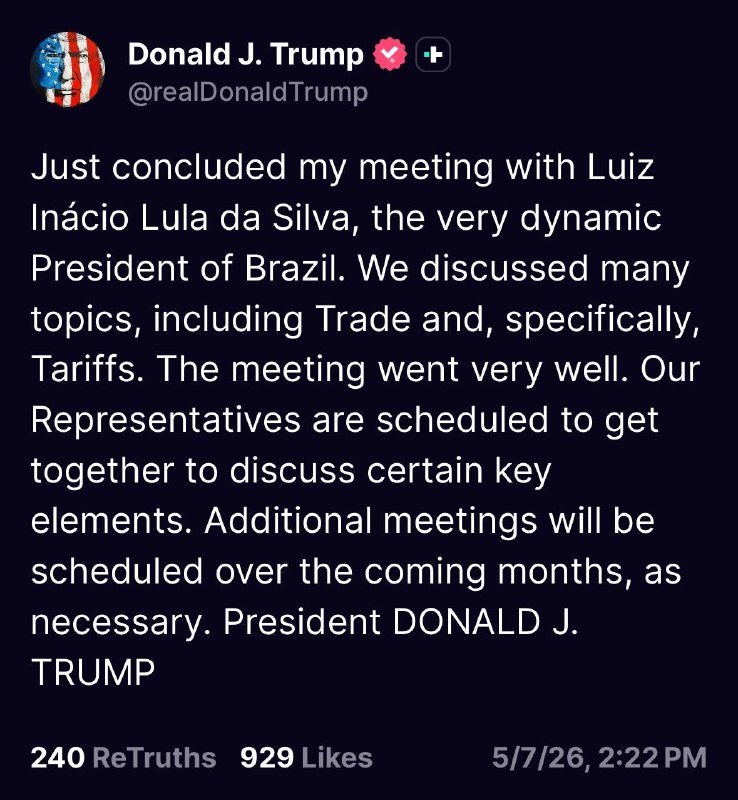
President Donald Trump welcomed Brazilian President Luiz Inácio Lula da Silva to the White House on Wednesday, 7 May 2026, a meeting that laid bare the tensions at the heart of Brazil's attempt to position itself as a diplomatic bridge between a US administration committed to preserving dollar hegemony and a resurgent Global South exploring dollar-independent trade architecture.
The meeting arrives against a backdrop of escalating trade confrontation. Washington has placed substantial tariffs on a range of trading partners, and Beijing has responded in kind. The knock-on effects have rippled through commodity markets and supply chains that matter acutely to Brasília, where agricultural exports form the spine of the economy. Lula, a veteran of two presidential terms and a political figure who has never hidden his affinity for the developing world, entered the White House with both a bilateral agenda and a broader strategic calculation: can Brazil extract concessions from Washington while simultaneously maintaining credibility with the BRICS contingent that now counts Beijing as its most powerful voice?
Trade War Shadow Over the Bilateral Agenda
The most immediate backdrop to Wednesday's meeting is the turbulence in global trade. The Trump administration's tariff regime has unsettled markets from Brussels to Beijing, and Brazil — as a major agricultural exporter — sits squarely in the crossfire of retaliatory measures and counter-retaliation that have disrupted commodity flows and pricing. Brasilia has publicly voiced concern about the collateral damage to its own export sectors, even as it has sought to remain above the direct US-China dispute.
For Lula's government, the goal at Wednesday's talks was reportedly to secure some relief or at least predictability for Brazilian agricultural shipments caught in the crossfire of Washington's trade offensive. That is a narrow but consequential ask. The agricultural lobby in Brazil is powerful, and the government's ability to hold its domestic coalition depends in part on demonstrating that its diplomatic activism — Lula's frequent-flyer foreign policy — translates into tangible market access.
The sources do not specify what specific trade commitments, if any, emerged from Wednesday's session. What is clear is that the framing of the meeting was bilateral goodwill — handshakes, Oval Office optics — while the structural pressures underneath are far less tractable. Trump has made clear that tariff relief for allies is conditional on their willingness to align with US strategic priorities. Brazil's position on China makes that calculus complicated.
Lula's Bridge Act: Between Washington and Beijing
Lula has been unusually explicit about his ambitions. In recent months, the Brazilian president has praised the BRICS grouping — Brazil, Russia, India, China, South Africa, and an expanding roster of new members — as a vehicle for recalibrating global economic governance. He has endorsed discussions about trade denominated in local currencies and alternative settlement mechanisms that sidestep the dollar. That is not fringe positioning: it reflects a view held across much of the developing world that the dollar-denominated financial architecture is an instrument of US structural power, and that alternatives have become more viable as Chinese capital, infrastructure financing, and trade relationships have deepened across the Global South.
China, for its part, has made no secret of its interest in drawing Brazil closer into its orbit. Beijing is Brazil's largest trading partner, and the economic relationship has grown more textured — and more politically significant — with each passing year. Lula met with Chinese President Xi Jinping in Beijing earlier this year, a visit framed in Brazilian official communication as a strategic deepening of the partnership. The optics of that trip and Wednesday's White House visit are not coincidental: Brasília is deliberately signalling that it belongs to no single great-power framework.
That is a coherent strategy. It also carries risk. The US — under an administration that has treated dollar dominance as a core national interest rather than a neutral feature of the global economy — is watching closely. If Brazil is perceived in Washington as drifting toward Beijing, the diplomatic warmth on Wednesday could cool fast. Lula's bridge act requires that he never lean too heavily on either side.
What the Dollar Question Actually Means
The framing of Lula's foreign policy as merely ideological misses something structural. The dollar's role as the world's reserve currency and the dominant denomination for global commodity trade is not a technical feature — it is a source of power. Countries that transact in dollars are subject to US regulatory reach: sanctions, export controls, banking access restrictions. For nations that have experienced that reach — Russia after 2014 and especially after 2022, Iran under decades of secondary sanctions — the lesson is concrete, not theoretical.
Brazil has not experienced those sanctions. But Lula has watched allies in the BRICS face them, and he has watched China invest heavily in payment infrastructure — the CIPS system, bilateral currency swap agreements, yuan-denominated trade deals — that reduces exposure to that leverage. Brazil's advocacy for local-currency trade within the BRICS is not nostalgia; it is hedge-building. The question is whether the concrete benefits — reduced transaction costs, less exposure to FX volatility, genuine optionality — outweigh the diplomatic cost of antagonising a US administration that has shown it treats de-dollarisation as a threat to its national interest.
Stakes: Who Wins, Who Loses, and Over What Horizon
If Brazil successfully positions itself as a credible bridge — extracting trade concessions from Washington while maintaining its BRICS commitments — it wins on both flanks. It retains access to US markets and the dollar-denominated financial system while deepening economic ties with Beijing and building credibility with a coalition of developing nations that increasingly see dollar-centric institutions as instruments of a bygone era.
If it fails — if Washington reads Lula's BRICS activism as alignment with China — the costs are asymmetric. The US has far more leverage over the Brazilian economy through the financial system than Beijing does through trade alone. A deterioration in US-Brazilian relations would be felt acutely in credit markets, in the cost of dollar-denominated Brazilian sovereign debt, and in the political credibility of a president who staked considerable capital on his diplomatic standing.
For Trump, Wednesday's meeting was also a test of his theory of reciprocity: that multilateral relationships should produce concrete concessions, and that allies who hedge toward competitors should not expect the same warmth as those who fully align. Lula, whatever his ideological leanings, is a large, strategically located country with significant resources and a seat at every table that matters — G20, BRICS, the hemispheric system. Treating Brazil as a prize worth competing for is rational. What remains unclear is whether Washington's definition of alignment — the terms it would require Brazil to meet — is compatible with Lula's own theory of Brazilian autonomy.
That question was not answered on Wednesday. But it structured every word spoken in the room.
This article was filed at 16:09 UTC on 7 May 2026. Monexus covered the Trump-Lula meeting with primary emphasis on the structural tensions in Brazil's multipolar hedging strategy — the bilateral trade noise versus the dollar-hegemony question — whereas most wire services led with the diplomatic warmth and tariff-specific concessions. The structural frame, which wire coverage largely bracketed, is where this publication believes the durable story lies.
Wire provenance
This editorial synthesis draws on the following public wire/social posts:
- https://twitter.com/Osint613/status/2052415575616365017
- https://t.me/BellumActaNews/31431
- https://t.me/BellumActaNews/31432
- https://t.me/ClashReport/98721