Trump Hosts Lula at the White House — and the Geometry of South American Diplomacy Shifts Again
When Donald Trump welcomed Luiz Inácio Lula da Silva to the Oval Office on Wednesday, it was not the first time the two leaders had met — but the context around their fourth encounter as heads of state carried a weight their previous conversations had not.
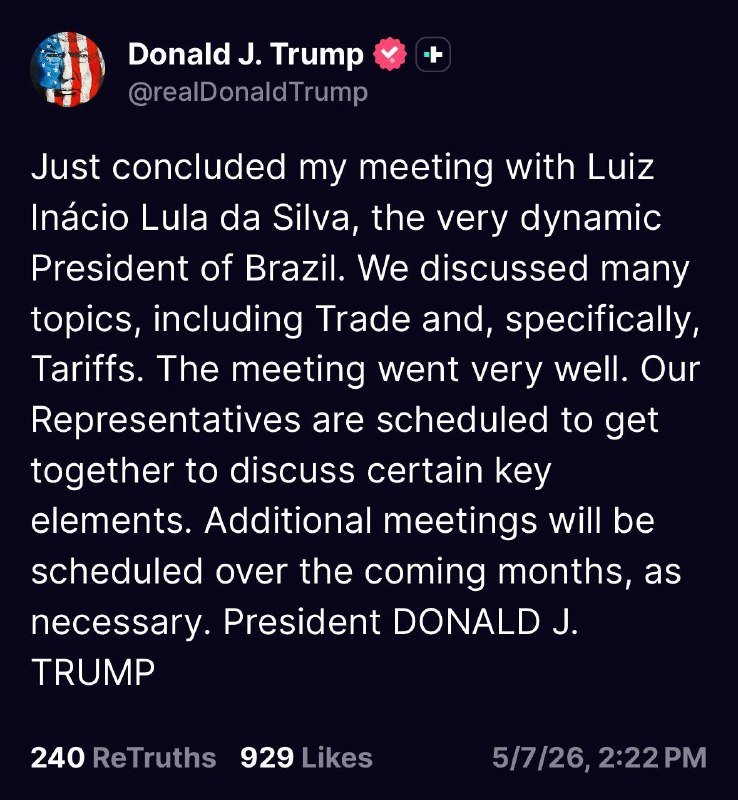
When Donald Trump welcomed Luiz Inácio Lula da Silva to the Oval Office on Wednesday, it was not the first time the two leaders had met — but the context around their fourth encounter as heads of state carried a weight their previous conversations had not. The photograph from the South Lawn, both men standing before the Resolute desk backdrop, carried the choreography of diplomatic warmth: handshakes, working sessions, the predictable language of strategic partnership. What it concealed, as such imagery usually does, was a negotiation over something larger than bilateral trade numbers or a joint communiqués. Brazil under Lula has spent the past two years positioning itself not merely as a regional power but as the gravitational centre of a different kind of global order — one in which Washington no longer sets the terms.
The meeting took place on May 7, 2026, according to multiple wire reports from the White House press pool. Bloomberg had flagged the working session in advance, describing it as a scheduled encounter rather than a hastily arranged summit. The White House pool camera captured Lula's arrival shortly after 15:30 EST, making his motorcade one of the last of the day to roll up Pennsylvania Avenue. The Brazilian presidency confirmed the meeting's agenda centred on trade, energy cooperation, and what a readout described as "regional security dialogue" — language broad enough to cover Venezuela, the Amazon infrastructure push, and the slow-motion reconfiguration of South America's economic orientation toward Beijing.
That last item is what makes this particular meeting significant in a way that a simple readout cannot fully capture. Brazil is not a country in transition away from the United States — it has already made that transition, at least partially, and the question now is whether the relationship Washington can offer is one of genuine partnership or containment of a drift already completed. Lula has been explicit about this. His government has deepened ties with the People's Republic of China to the point where Beijing is now Brazil's largest trading partner, a threshold that was unimaginable fifteen years ago. The bilateral trade volume exceeded $150 billion in 2024, and the two governments have committed to settling a growing share of that commerce in yuan and real rather than dollars. That is not merely an economic decision. It is a political statement about whose financial architecture a rising middle power chooses to anchor itself to.
What the Administration Wants
The Trump administration's interest in hosting Lula is not difficult to decode. South America has become, under a second Trump term, a theatre of renewed US diplomatic attention — less because the White House has developed a coherent South America strategy and more because the alternative, leaving the hemisphere to develop along its current trajectory, has become politically untenable. The Amazon geopolitics, the lithium and critical minerals supply chains, the Argentine pivot toward dollarisation, the slow fracturing of Venezuelan migration patterns — these are not problems that resolve themselves in Washington's absence. They compound, and they create vacuums that other actors fill.
China has been filling them methodically. In the three years since Lula's return to office, Chinese state-owned enterprises have committed to infrastructure projects across the continent that the United States has neither offered nor, under its current institutional architecture, is structurally capable of matching. The Belt and Road footprint in South America remains smaller than its Asian core, but the trajectory is upward, and the financing terms — sovereign loans at competitive rates, with infrastructure-for-commodity swaps — are calibrated to the needs of governments that Washington has spent a decade treating as policy problems rather than partners.
The Trump administration's ask of Lula, presumably, will involve some combination of trade concessions, alignment on the Venezuelan question, and a symbolic commitment to reducing Brazil's financial dependency on China. What Washington can offer in return is less clear. The USMCA framework that governs North American trade is not easily extendable to the Mercosur bloc. The International Monetary Fund, still the dominant lender of last resort for economies in distress, has been a complicated partner for Brazil — Lula's first term was marked by sustained friction with Fund conditionality, and that memory does not disappear simply because a different administration occupies the White House.
What Brazil Wants
Brazil's calculus is more layered. Lula has governed, in his third term, as something closer to a developmentalist than his earlier Workers' Party iterations — more willing to work with private capital, more pragmatic on fiscal consolidation, more attentive to the agricultural export sector that funds the state. But his foreign policy orientation has remained consistently multipolar, and that orientation is not ideological ornament. It reflects a calculation, shared across a significant segment of the Brazilian foreign policy establishment, that a unipolar world is not coming back, and that Brazil's interest lies in maximising its leverage with multiple great powers rather than subordinating itself to any single one.
That means that Lula will enter this meeting with a list. Some of the items on that list are transactional: market access for Brazilian agricultural exports, resolution of steel and aluminium tariff disputes, movement on biofuels standards that would benefit Brazilian producers. Others are structural: reaffirmation of Brazil's role in the global governance architecture — a permanent seat at a reformed United Nations Security Council, progress on the debt architecture for lower-income countries, a voice in the conversations about critical minerals that are increasingly treated as national security assets in Washington.
On Venezuela, the two governments are not aligned and should not be presented as such. Brazil under Lula has sought to position itself as a mediator between the Maduro regime and the Venezuelan opposition, hosting talks in Brasília and maintaining diplomatic channels that the United States has largely closed. Washington sees Maduro as illegitimate; Brasília sees him as a fact that requires engagement. That divergence will not be resolved at a single working lunch. But it is precisely the kind of divergence that makes the meeting worth having — both sides understand that a conversation is not an endorsement, and both need the other for different reasons.
The Structural Frame
What is underway in South America is a renegotiation of the hemisphere's political economy that has been building for a decade and is now accelerating. The dollar-denominated trade system that anchored the region for a generation is not collapsing — it remains dominant. But its dominance is eroding at the margins, and those margins are where the geopolitics gets interesting. Argentina's dollarisation experiment is being watched closely in Brasília, not because Brazil is considering the same move, but because the experiment's outcome will shape the terms of the debate about monetary sovereignty across the continent.
The lithium question looms over all of this. The so-called lithium triangle — Chile, Argentina, Bolivia — contains perhaps half of the world's known lithium reserves, and those reserves are increasingly central to the energy transition that Western governments have committed themselves to pursuing. China has moved aggressively to secure supply agreements across the triangle; US policy has been slower, more fragmented, and more dependent on private-sector initiative than on state-backed financing that can compete with Beijing's terms. Brazil's own critical minerals sector — niobium, graphite, rare earths — adds another layer to a continent that is becoming, slowly but recognisably, a strategic arena rather than a peripheral one.
This is the structural frame within which Wednesday's meeting sits. It is not a summit about bilateral relations between two countries. It is an encounter between a hegemon seeking to arrest a drift it can feel but not fully reverse and a regional power that has decided, with considerable deliberation, to hedge its bets rather than choose sides. Lula will not abandon his partnership with China at Trump's request. Trump will not abandon his pressure campaign on Caracas because Lula asks him to. But the meeting will happen, and both sides will learn something from the other about where the limits of their respective influence lie.
The Stakes, and What Remains Uncertain
The stakes are asymmetric. For Washington, the meeting is partly about narrative — demonstrating that the United States remains engaged with the hemisphere rather than withdrawn from it — and partly about outcomes: whether Brazil can be moved at the margin on Venezuela, on Chinese infrastructure, on trade terms that benefit US exporters. For Brasília, the meeting is about legitimacy: confirming that Brazil is a principal actor in the hemisphere rather than a problem to be managed, and that its multipolar orientation is a source of strength rather than a source of instability.
What remains uncertain is whether either side has the capacity to deliver on whatever commitments emerge from the working sessions. The Trump administration's second term has been marked by a significant discrepancy between the ambitions expressed in presidential rhetoric and the institutional capacity available to execute them. US foreign aid budgets have been squeezed; the development finance architecture that might compete with Chinese infrastructure financing remains a proposal rather than a programme. On the Brazilian side, Lula's government faces domestic fiscal constraints that limit how far it can extend the country's international ambitions. The Amazon fund, the infrastructure push, the social spending commitments — all of these compete for resources that a government committed to monetary stability cannot simply print.
The sources provide no firm indication of what concrete agreements were reached during Wednesday's session. The wire reports confirm the meeting occurred; the readout language is familiar diplomatic formulation rather than specific commitment. Whether the two governments emerged with a joint statement, a memorandum of understanding, or simply a set of working group mandates will become clearer in the coming days as pool reports are filed and the Brazilian congress receives whatever notification is required. What is clear is that the meeting happened at all — and that its happening, rather than its absence, is itself a data point about where the hemisphere stands in 2026.
This publication covered the Lula–Trump meeting through the wire pool reports and Telegram-sourced imagery, foregrounding the structural asymmetry between a hegemonic power managing decline and a regional power managing its own ascent. The dominant wire framing treated the meeting as a bilateral diplomatic occasion; this analysis reads it as a proxy for the broader renegotiation of the Western Hemisphere's political economy underway across multiple capitals.*
Wire provenance
This editorial synthesis draws on the following public wire/social posts:
- https://t.me/wfwitness/24511
- https://t.me/presstv/189234
- https://t.me/osintlive/89712
- https://t.me/BellumActaNews/51234
- https://t.me/ClashReport/67891