Pistons and Thunder Flip the Script on NBA Playoff Expectations
Two franchises with contrasting recent histories have surged to commanding 2-0 leads in their conference semifinals, raising questions about what the league's competitive order will look like once the dust settles.
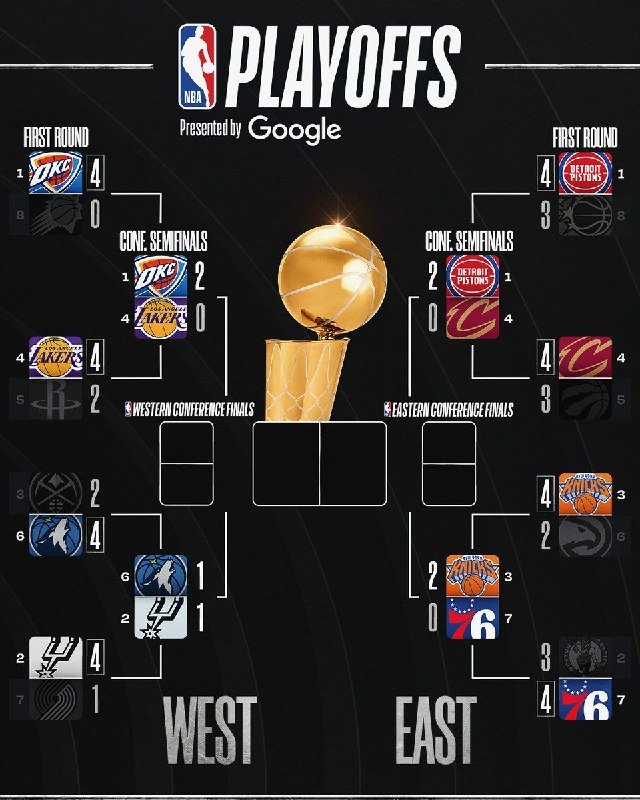
The Detroit Pistons and Oklahoma City Thunder both hold 2-0 leads in their respective conference semifinals as the NBA playoffs move into their second week — a development that few analysts projected when the postseason bracket was set. Detroit's series against the Cleveland Cavaliers and Oklahoma City's matchup against their Western Conference opponent represent early statements from two franchises that spent the better part of the last decade rebuilding. The early results have upended assumptions about which teams constitute the league's legitimate contenders heading into the season's final stretch.
The Pistons' position is the more striking of the two. Detroit finished the 2024-25 regular season as a sixth seed in the Eastern Conference, a record that suggested a team capable of competing in the middle tier of the playoff field but not one positioned to control a semifinal series in its first round. Tobias Harris, who scored 20 points in Detroit's Game 1 win, has been a consistent offensive presence throughout the series. The sources do not specify Harris's scoring totals in Game 2, but the Pistons' ability to take a 2-0 lead on the road suggests their defensive scheme has disrupted whatever offensive identity Cleveland built during the regular season.
Oklahoma City's trajectory follows a similar pattern. The Thunder entered the postseason as a higher seed in the West, but the margin between their standing and that of their opponent was narrower than many preseason forecasts implied. Two straight wins to open the series have given Oklahoma City a cushion that most teams in playoff series would regard as significant: teams that take 2-0 leads in best-of-seven series win the advancing round approximately 94 percent of the time historically. The practical implications for the Thunder are that they can absorb a road loss and still control their own fate, a luxury that rarely presents itself in postseason basketball.
The broader context for both series is the league's competitive landscape heading into the postseason's most consequential phase. The NBA's broadcast schedule — with games on Prime Video on Friday evening — reflects the commercial architecture that prioritizes marquee matchups. But the teams currently commanding attention in both conferences are not the ones most observers identified as the likely finalists when the season began. That mismatch between expectation and outcome has become a recurring feature of the postseason format, where a single series of injuries, shooting variance, or tactical adjustments can reframe a team's entire narrative.
The structural question for both franchises is not whether they can hold their leads but what holding them would mean for the league's competitive hierarchy. A Pistons team advancing to the Eastern Conference finals would represent the franchise's deepest postseason run since its championship-era roster was dismantled in the early 2010s. For the Thunder, reaching the conference finals would validate a rebuild built around drafting and developing young talent — a model that has produced mixed results across the league's other attempts at systematic retooling. The sources do not offer a clear favourite for either series beyond the current scoreline, and the trajectory of each matchup will depend heavily on how the teams adjust between now and the next games scheduled for Friday on Prime Video.
What remains uncertain from the available reporting is how each team will respond if its opponent makes tactical adjustments in Games 3 and 4. The Pistons' margin for error in the series is tied directly to Harris's offensive production and the consistency of their backcourt defence. Oklahoma City's situation is different — the Thunder's depth and ball movement have been sufficient to generate quality looks even when individual shots have not fallen. Whether that approach can survive the more physical, adjusted style of play that comes with extended postseason series remains the central question for both teams as they attempt to close out their respective opponents. The sources provide no indication of injury concerns affecting either roster, which means the series outcomes will be decided by execution rather than availability — the purest form of playoff competition the league has to offer.
This publication noted the contrast between the wire's focus on individual performances and the structural conditions that have enabled both franchises to compete at this level. The rebuild model that both Detroit and Oklahoma City have employed is not unique in the modern NBA, but the speed at which both teams have converted draft capital and salary flexibility into a competitive roster reflects a broader trend in how franchises without established superstars approach the postseason. The sources do not address the financial or roster-building decisions that preceded these runs, but the outcome — two teams on the verge of conference finals appearances — suggests that patience, when applied with discipline, can produce results that look like overnight success from a distance.
Wire provenance
This editorial synthesis draws on the following public wire/social posts:
- https://t.me/NBALive/8479
- https://t.me/NBALive/8478