The Uranium Deal Trump Didn't Want You to Notice
When Washington finally secured enriched uranium reserves, the supplier was Caracas, not Tehran. That tells you everything about where real power now sits in global commodity politics.
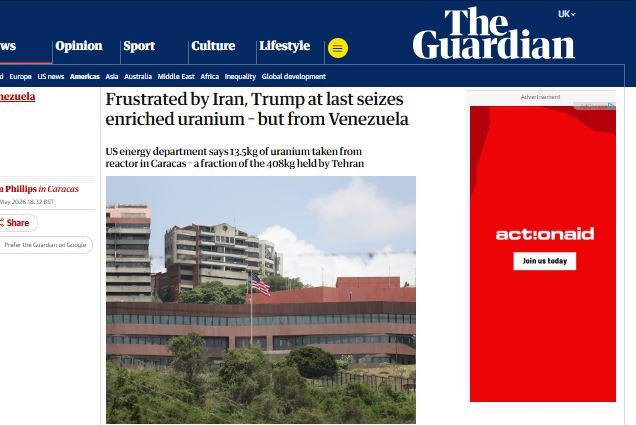
There is a certain theatre to the way Washington covers its nuclear procurement. When the Trump administration finally landed enriched uranium reserves on American soil, the country supplying them was Venezuela — a nation the State Department has spent years sanctioning, isolating, and publicly denouncing. The announcement landed quietly, without ceremony, buried beneath tariff headlines and diplomatic posture.
The irony is not subtle. For years, Iran has been the fixation of American nuclear policy: maximum pressure campaigns, withdrawn agreements, assassination programmes targeting scientists, and an entire bureaucratic apparatus built around preventing Tehran from achieving the same enrichment threshold the United States has now quietly secured from Caracas. The Iran obsession served a purpose — it kept the infrastructure of containment politically viable, it justified arms sales to regional partners, and it gave administrations of both parties a coherent enemy narrative to deploy against non-aligned states. Venezuela was never supposed to be the story.
The deal, as reported by The Guardian on 8 May 2026, represents something structurally more significant than a simple commodity transaction. Enriched uranium is the raw material of deterrence, the substance that powers naval reactors, medical isotopes, and the civilian energy programmes that precede weapons capability. When Washington buys it from Caracas — under whatever diplomatic cover made the arrangement politically palatable — it is acknowledging two things simultaneously: that Venezuelan reserves are real, and that the sanctions regime designed to collapse the Maduro government has failed to achieve its stated objectives.
The decision to source from Venezuela rather than pursue alternative arrangements with treaty allies reflects a calculation that speaks louder than the rhetoric. Western enrichment capacity has not kept pace with demand signals from the defence and energy sectors. The supply chains that once ran through Russia and its satellite states have become politically untenable for different reasons depending on which administration you examine. Venezuela, despite its dysfunction, sits on significant known reserves in the Orinoco Belt and has maintained a civilian nuclear programme that survived the Chavez-era political convulsions largely intact.
The counter-narrative is straightforward enough: Caracas needed hard currency and Washington needed uranium, and two transactional administrations found each other. That reading is not wrong. But it understates the geopolitical signal embedded in the transaction. When the hegemon comes to you for strategic material, the sanctions regime becomes theatre. The diplomats can continue to issue statements about democratic transition and regime change; the commodity flows tell the actual story.
Regional analysts have noted that this is not the first quiet accommodation between Washington and Caracas since Trump took office. The relief on humanitarian corridors, the back-channel discussions through intermediaries in Doha, and now the uranium arrangement suggest a pattern: maximum-pressure posturing maintained for domestic audiences, while operational realities drive the two capitals toward pragmatic coexistence. The Biden administration's Venezuela sanctions had already frayed by 2024; the Trump administration appears to have accepted what its predecessor could not publicly acknowledge — that isolating Venezuela does not make American energy infrastructure more secure.
The structural implications run deeper than bilateral diplomacy. A United States that purchases strategic materials from a targeted nation normalises that nation's role in global supply chains. It validates the extraction and processing capacity that Caracas has built over two decades of Hugo Chávez's nationalisation programme. It also signals to other поставщики — other suppliers in the Global South watching how Washington manages its contradictions — that the rules-based order has a significant exception clause: when the commodity is urgent enough, the ideological commitments bend.
This publication has long argued that dollar hegemony operates through exactly these contradictions. The system punishes non-compliance with secondary sanctions, but it also contains escape valves that open when the costs of compliance exceed the benefits of enforcement. Venezuela now sits inside one of those escape valves. Iran, meanwhile, watches from the outside — still categorised as a proliferation risk, still subject to the full apparatus of restriction, and still excluded from the very market its neighbour has just been permitted to enter.
The stakes are not abstract. If the uranium deal holds, Caracas gains an economic lifeline that could stabilise the Maduro government's fiscal position through the next electoral cycle. Washington gains supply-side relief for its civilian nuclear programme, though it will face questions about why a nation with significant domestic reserves — Texas, Wyoming, New Mexico — chose to import rather than extract. The precedent for other Global South commodity exporters is more interesting still: a country under some of the most comprehensive Western sanctions on record has successfully negotiated a strategic export deal that bypasses the dollar-denominated swap infrastructure entirely, using whatever counterparty arrangement the two governments agreed to bilaterally.
What remains uncertain is whether this is a one-off accommodation or the opening move in a broader realignment. The sources do not specify the terms of the arrangement, the volume transferred, or the currency of payment — details that would clarify whether Washington made concessions elsewhere to secure the deal. The diplomatic cover story, whatever its content, has not been made public in full. That opacity is itself informative: both governments preferred not to advertise the transaction's details, suggesting that neither side is entirely comfortable with the political implications of what they have done.
The Iran file, meanwhile, remains untouched. Tehran watched Venezuela negotiate a normalisation pathway with Washington and now sees Caracas accepted into the nuclear supply club while Iran continues to absorb the full weight of restrictions designed to prevent precisely this outcome. The dissonance is not lost on regional governments reading the signals carefully. Whether they draw the conclusion that compliance with Western non-proliferation norms is rewarded or that strategic indispensability is the only path to accommodation will shape the next decade of global nuclear politics.
The uranium Trump finally secured came from Venezuela. The one he spent years building an entire containment architecture to deny himself access to remains exactly where it was: under international supervision, in Iranian facilities, waiting for a political moment that this deal suggests may be longer arriving than Washington predicted.
Wire provenance
This editorial synthesis draws on the following public wire/social posts:
- https://t.me/FarsNewsInt/36912
- https://t.me/tasnimnews_en/15847