Israeli Forces Strike Eastern Gaza City and Shati Refugee Camp as Displacement Continues
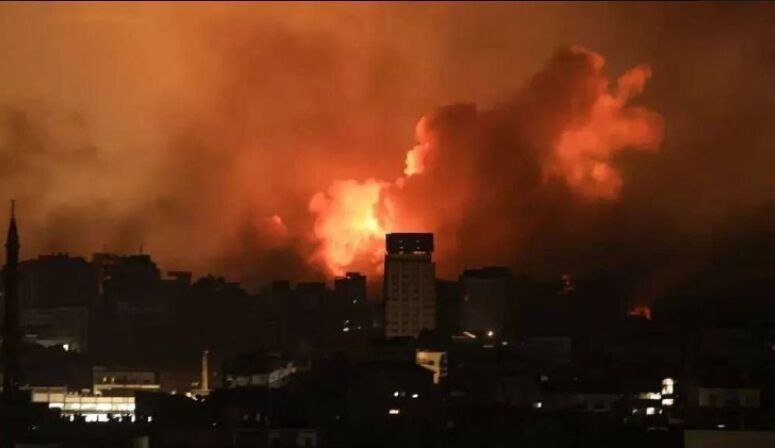
Artillery fire targeted areas east of Gaza City in the early hours of May 9, 2026, according to local Palestinian sources cited by Al Alam Arabic and Tasnim News English at approximately 01:33–01:36 UTC. Separate artillery shelling was documented southeast of Gaza City around 00:46 UTC the same evening. Both strikes followed an earlier Israeli airstrike on a residential building in the al-Shati refugee camp, located in the western reaches of Gaza City.
The al-Shati strike, reported by Middle East Eye on May 8 at 23:00 UTC, occurred after Israeli forces issued a forced evacuation warning to residents of the camp. Footage circulated by Tasnim News English and Jahan Tasnim channels showed the aftermath: destroyed residential structures and residents sleeping in the open, unable to return to structures deemed structurally unsafe. The combined pattern of strikes — across the city's eastern periphery, its southeastern approaches, and its western residential core — produced a night of documented military activity spanning most of Gaza City's inhabited sectors.
\n\n## Strikes Across Gaza City's Sectors
The overnight artillery strikes represent a continuation of high-intensity operations across Gaza City's administrative boundaries. The eastern districts struck overnight May 8–9 sit adjacent to areas that have seen repeated military activity throughout the current phase of the conflict. The sources document artillery fire, a weapons class with area-effect characteristics that international humanitarian law treats as raising particular concerns about civilian harm when deployed in densely built environments.
Israeli military briefings frame such strikes within operational necessity, identifying targets in areas where Palestinian armed groups are assessed to be present. The IDF has previously stated that steps are taken to warn civilians ahead of operations and to minimise harm to non-combatants. Those assertions carry weight in any account of this conflict; they do not, however, resolve the structural tension between area-effect weapons use and the obligations incumbent on any force operating in one of the world's most densely populated urban environments.
The strikes in the al-Shati camp — a residential district, not a military installation — received a forced evacuation warning before the strike occurred, according to Middle East Eye's reporting. Evacuation warnings in principle create an opportunity for civilians to depart before hostilities begin. In practice, residents of al-Shati told Tasnim News English that the destruction caused by the strike was of sufficient scale to render the surrounding area uninhabitable even for those who had temporarily left. A structure declared structurally unsafe is not a shelter.
\n## Displacement Without Shelter
The al-Shati refugee camp has existed since 1948, when the first cohort of displaced Palestinians arrived following the Nakba. It has been destroyed and partially rebuilt multiple times across the decades of Israel's occupation of the Palestinian territories. Its residents hold no protected status under international law and, in the current phase of the conflict, have no means of evacuation beyond the city's overcrowded shelters — themselves subject to Israeli military orders at various points throughout the conflict.
The destruction documented on May 8 represents the latest iteration of a pattern well established in this conflict: areas stripped of basic infrastructure by earlier phases of the war become the sites of renewed military activity. The camp was already housing families displaced by earlier strikes elsewhere in Gaza City and the northern governorates. Those families now have fewer options than before.
Israeli officials maintain that military operations target armed groups embedded in civilian areas and that civilian harm results from the tactical decisions of those groups rather than from Israeli strikes. That argument has been a constant in the legal and diplomatic exchanges surrounding this conflict. It has not sufficed to prevent sustained scrutiny from UN agencies and, in separate proceedings, from the International Court of Justice, which issued provisional measures in 2024 obligating Israel to take steps to prevent harm to civilians.
\n## The Humanitarian Context
Gaza's shelter infrastructure has been degraded across multiple years of the conflict. UNRWA, the primary UN agency responsible for Palestinian refugees, has repeatedly reported that its facilities are operating beyond design capacity. Water, medical supplies, and electricity remain chronically insufficient for the population's needs. Hospitals in Gaza City have received patients from multiple governorates simultaneously, straining resources that were already constrained before the current phase of the conflict began.
The addition of further residential structures destroyed in the al-Shati camp and the eastern districts of Gaza City — whatever the specific military rationale for each strike — compounds an already unsustainable humanitarian situation. The sources do not provide full casualty figures from the overnight strikes as of publication, and the picture of physical damage from individual strikes requires time and access to assess fully. The scale of prior destruction across Gaza City is documented in detail by UN agencies and international media. Each new round of strikes reduces the stock of structures that can serve as shelter.
Aid delivery mechanisms — already constrained by access restrictions, checkpoints, and the breakdown of supply chains for basic goods — face additional strain when residential areas are struck. The destruction of a building that was functioning as a de facto shelter, or that could have served that function in a subsequent phase of the conflict, is not equivalent to the destruction of a military structure. The humanitarian cost is different in kind.
\n## Stakes and Forward View
Diplomatic activity continues. Ceasefire negotiations have produced periodic pauses, none of which has resulted in a durable cessation of hostilities as of early May 2026. The framework under discussion at various international forums requires, as a baseline, an end to further displacement. That baseline is made harder to reach with each additional round of strikes on residential structures.
The immediate humanitarian stakes are acute. A population already displaced — many of them multiple times — loses shelter capacity with every new strike on a residential structure. The al-Shati camp residents sleeping in the open on May 8 represent a concrete cost. The longer-term stakes are political: any negotiation that hopes to produce durable agreement must operate with a population that has somewhere to live. Destroyed residential areas do not provide that foundation.
Israeli officials have stated that their operations will continue until the objectives set by the government are achieved, including the return of hostages held in Gaza and the elimination of the military and governance capabilities of Palestinian armed groups. Those objectives are stated in terms of military outcome. The humanitarian consequences documented across the territory represent a separate order of consequence — one that the international community has struggled throughout this conflict to address with commensurate urgency.
The overnight strikes on Gaza City were ongoing as this publication compiled its initial reporting. Full casualty and damage assessments will require access that the sources do not yet indicate has been granted.
\nThis publication's coverage of Gaza focuses on civilian harm as a first-order reporting concern alongside military and diplomatic developments, reflecting the editorial conviction that destruction of residential infrastructure is not a secondary fact.
Wire provenance
This editorial synthesis draws on the following public wire/social posts:
- https://t.me/alalamarabic/108856
- https://t.me/alalamarabic/108864
- https://t.me/tasnimnews_en/78572
- https://t.me/tasnimnews_en/78556