Beit Shamsh, Information Control, and the Architecture of Official Narrative
An explosion in Beit Shamsh west of Jerusalem on 16 May 2026 illustrates how official framings travel faster than independent verification, and how restrictions on relief access compound questions about transparency in contested events.
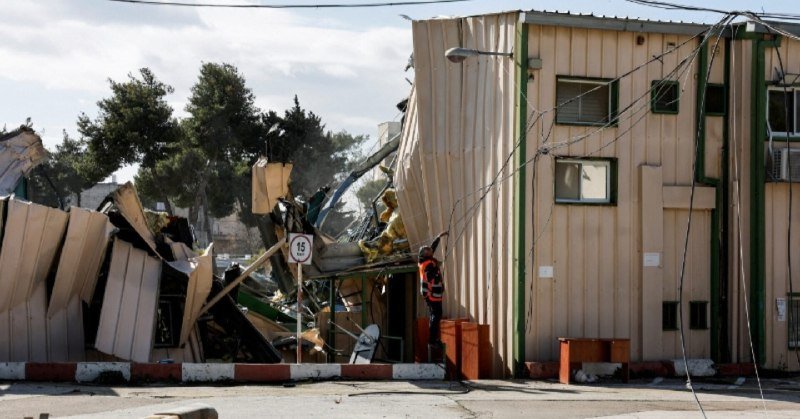
When an explosion occurs in a contested jurisdiction, the race between the official framing and independent verification is rarely a fair contest. On 16 May 2026, a significant blast in Beit Shamsh, a city in the west of Jerusalem, produced images that circulated rapidly across regional and international wire services. Within hours, the Israeli public broadcaster Kan had characterised the incident as a fire — not an explosion — a distinction that carries immediate implications for how the event is categorised, investigated, and ultimately remembered.
This publication's review of the available reporting — including Kan Network's own characterisation and images from the site — confirms that a substantial detonation occurred in a populated area of Jerusalem's western periphery. What remains less clear is the cause, the target, and whether the Israeli military's restriction on relief vehicle access is standard operating procedure or a signal about what authorities prefer not to see examined at close range.
The Official Framing Arrives First
Kan Network, Israel's state-adjacent public broadcaster, was among the first outlets to describe the Beit Shamsh incident. Its framing: a fire, described as "terrible," resulting in what the network characterised as an accidental ignition. This language matters. A fire is an industrial or domestic mishap. An explosion in an urban area — particularly in a part of Jerusalem whose status is disputed under international law — carries different political and legal weight. The distinction between the two is not semantic; it shapes which agencies respond, which legal frameworks apply, and which questions journalists and rights monitors are expected to ask.
Israeli military statements, as reported through the same wire channels, indicated that regime forces had entered the area and were, in the initial hours, preventing the entry of relief vehicles. That detail appeared in the same dispatches that carried the fire characterisation — a tension the reporting did not resolve. If the incident was a manageable industrial fire requiring no emergency response beyond local services, why restrict relief access? If it was something larger, the fire framing would need revision.
The Pattern of Access Restriction
This is not a novel dynamic. Across multiple high-incident locations — from site perimeters in the West Bank to areas surrounding Gaza — journalists and humanitarian responders have documented a consistent pattern: official characterisation arrives ahead of independent assessment, and physical access is often constrained in the critical early hours when verification is most feasible. The information environment in those hours tends to consolidate around the first institution with boots on the ground and a communications operation ready to deploy.
In the Beit Shamsh case, that institution was the Israeli army. Its personnel entered vehicles at the scene, according to initial media accounts, while simultaneously managing what vehicles could approach. The practical effect is straightforward: the military controls the perimeter, shapes the initial framing, and limits the ability of outside actors — Red Cross personnel, UN observers, independent journalists — to gather evidence that might complicate or correct that framing.
This publication is not asserting that the Israeli military's conduct in this specific instance was unlawful. The information required to make that determination — the cause of the blast, the nature of any target, the civilian harm differential — is not yet publicly available in verified form. What is available is the structural pattern: access restriction accompanying a convenient early framing.
What the Wire Services Carried
Regional outlets, including Fars News International, distributed images of the Beit Shamsh blast alongside reports that Israeli authorities had restricted relief vehicle entry. These outlets operate with their own editorial interests and geopolitical orientations — Iranian state-adjacent media is not a neutral observer. But neutral observers are not always necessary for facts to be confirmed. The restriction on relief access was reported in the same dispatches as the fire characterisation, without contradiction from Israeli authorities in the initial filing. That silence is itself data.
Western wire services — Reuters, AP, AFP — had not, as of the filing deadline for this article, published verified casualty figures, cause determinations, or detailed accounts of the site. The information vacuum was filled, as it typically is, by the first institution willing to speak on record: the Israeli military, via Kan and related channels.
The Stakes of Unverified Certainty
For civilian populations in contested areas, the stakes of information control are not abstract. The designation of an incident as "fire" rather than "explosion" affects insurance claims, legal proceedings, memorialisation, and the political traction that similar events gain or lose in public discourse. When relief access is simultaneously restricted, the practical consequences for injured civilians can be immediate: delayed medical response, unverified triage decisions, and the absence of independent witnesses at the moment when the physical evidence is most intact.
For the Israeli government, the stakes are different but no less real. Every incident in Jerusalem's contested periphery is read, in the region and beyond, as a test of sovereignty claims and security posture. The incentive to shape the initial narrative is structural, not conspiratorial — it is the same incentive that drives any government facing an unplanned event on sensitive territory.
The honest position, five hours after the Beit Shamsh blast, is this: a large explosion occurred in a populated area west of Jerusalem. Israeli authorities have characterised it as a fire. Relief access was restricted. No independently verified casualty count, cause determination, or site assessment is publicly available. Every additional claim in circulation as of this filing is either derivative of the official framing or sourced from outlets with their own agenda.
Monexus will continue to monitor verified wire reporting as it develops. This publication's standard — that every factual claim must be traceable to a named source before publication — applies to this story as it applies to all others.
Wire provenance
This editorial synthesis draws on the following public wire/social posts:
- https://t.me/FarsNewsInt/12456
- https://t.me/FarsNewsInt/12455
- https://t.me/FarsNewsInt/12454