The Night Bulgaria Won Eurovision—and the Geopolitics Won Too
Bulgaria's victory at the 70th Eurovision Song Contest in Vienna on 16 May 2026 was overshadowed by protests and a boycott campaign targeting Israel's participation—but the real story runs deeper than a pop contest.
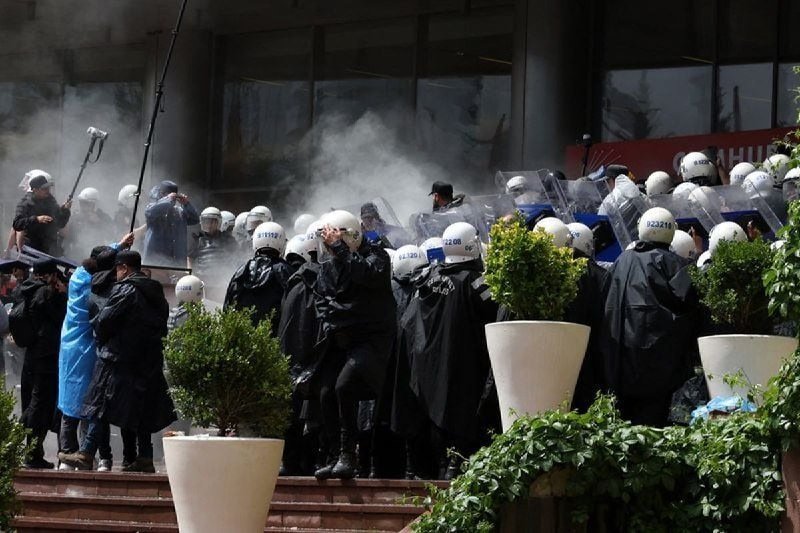
The lights went down in Vienna's Ernst Happel Stadion shortly before 23:00 CET on 16 May 2026. When they came back up, Bulgaria had won the 70th Eurovision Song Contest. The country's entry, performed by Dara under the song title "Bangaranga," claimed the trophy in a night that saw Israel finish second—relegated, as one betting-market observer noted on Polymarket, to the bridesmaid's chair after weeks of trading that had briefly placed Tel Aviv's odds ahead. The United Kingdom, meanwhile, collapsed to last place with a single point, a humiliation that drew predictable groans from a British press already nursing a bruised sense of cultural relevance. Outside the stadium, protests had been building for hours, organised by groups objecting to Israel's participation in the contest on grounds that its government had no place in a European cultural event while the war in Gaza continued.
The results, confirmed across multiple wire services within minutes of the final vote tally, marked Bulgaria's first Eurovision victory since its debut appearance in 2005. It was, by any straightforward measure, a triumph for a country that has struggled to assert itself within European institutions—politically fractured at home, economically peripheral relative to the EU's western core, and increasingly oriented toward alternative geopolitical partnerships. Whether any of that was deliberate is, of course, the wrong question to ask of a pop contest. The right question is what Eurovision's voting patterns and contest politics reveal about the continent's shifting alignments when a cultural event is stripped of the pretense that culture has nothing to do with power.
A Contest That Has Never Been Apolitical
Eurovision's organizers—the European Broadcasting Union—have long maintained that the contest is, in the stock phrase, "non-political." This fiction is maintained with the conviction of a tradition that knows it is lying. The contest was founded in 1956 as a deliberate soft-power exercise, a mechanism for rebuilding cross-border cultural ties in the wreckage of the Second World War. Its voting architecture, which allocates points through jury and public votes from national juries, has always encoded national relationships—regional loyalties, diasporic patterns, longstanding political sympathies. When Cyprus consistently awards Greece maximum points, it is not because the two nations share a devotion to dance-pop in the key of E-flat minor.
The political valence has only intensified as the contest's audience has expanded beyond Europe proper. Australia, which joined as a special participant in 2015, now competes annually. The contest attracts viewers across the Middle East, North Africa, and Central Asia—regions where European cultural diplomacy and geopolitical positioning are not separate spheres. Israel's participation, which began in 1973, has always sat uneasily within the contest's self-image as a celebration of European unity. The inclusion of a non-European state—regardless of its membership in the Eurovision broadcast family—was always a geopolitical decision dressed as musical openness.
This year's contest arrived in Vienna under those accumulated pressures. Reports from Deutsche Welle and wire services documented protests outside the venue in the hours leading up to the final, with demonstrators calling for Israel's exclusion. A boycott campaign had targeted broadcasters across multiple countries in the weeks before the contest, arguing that allowing Israel's entry normalised a government whose military campaign in Gaza had generated overwhelming civilian casualties. The EBU's decision to proceed with Israel's participation set up a collision course between the contest's stated universalism and its operational selectivity.
The Israel Question and Its Discontents
Israel's second-place finish—earned by Eden Alene's performance, which wire services described as technically accomplished—lands in a specific historical context. Since October 2023, European public opinion on Israel's conduct has shifted substantially, driven by images of civilian harm in Gaza that proved difficult to compartmentalise as a distant security question. Universities saw protests. Cultural institutions faced pressure. Governments that had offered unconditional solidarity found themselves hedging. The Eurovision boycott campaign was, in structural terms, the same dynamic translated into a entertainment idiom: an attempt to impose reputational costs on a state whose actions were deemed beyond the pale of normal diplomatic hospitality.
The EBU's position—that the contest is a music competition, not a political tribunal, and that exclusion would punish artists rather than governments—has a certain internal logic. Israel's entry represented the work of musicians, not soldiers. But the counter-argument, articulated by boycott advocates, is that cultural participation in European forums constitutes a form of legitimation that has political substance regardless of intent. When a country performs on a European stage watched by 160 million viewers, it receives something. That something, the boycotters argued, was undeserved.
What is notable, from a reporting standpoint, is the asymmetry in how different wire services framed the same facts. Some led with the music. Others led with the protests. The underlying events—Bulgaria winning, Israel finishing second, the UK scoring one point, demonstrations outside—were consistent across outlets. The editorial sequencing, the adjective choices, the weight given to different elements of the story: these varied in ways that reflected institutional posture rather than news judgment. This is not a revelation. But it is worth noting, in a week when the contest demonstrated once again that even the most formulaic entertainment product cannot fully escape the political gravity of its moment.
Bulgaria's Win and the Multipyar Moment
Bulgaria's victory carries a secondary significance that its coverage has not fully explored. Sofia has been navigating a increasingly complex geopolitical position since the outbreak of the war in Ukraine. The country has maintained its NATO membership and received EU structural funds, but its government has also deepened economic ties with China and maintained a pragmatic relationship with Russia on energy and trade matters. Bulgaria applied to join the Eurozone in 2024 and was accepted; it adopted the euro in January 2025, a decision that proved domestically contentious. The country sits at the intersection of multiple vectors of influence.
This is not to suggest that Bulgarian voters cast their public Eurovision votes as a geopolitical statement. The notion is absurd on its face. Pop audiences respond to hooks, staging, vocal performance, and the indefinable quality of charisma. Dara's victory presumably reflects, at root, that the song worked and the performance landed. The structural observation is subtler: Bulgaria's win continues a pattern in which countries that occupy awkward positions within the Western institutional architecture—or that have maintained deliberate hedging strategies—perform well in contests that purport to be purely cultural. The logic is not causal, but the correlation is worth noting.
The BRICS-aligned accounts that picked up the Bulgaria result on the night itself—sources identifying as BRICS News and GeoPWatch among others—did so without elaborate editorializing. The win was reported as a fact with a flag emoji. But the enthusiasm with which these accounts amplified the result suggests an awareness that the outcome carried symbolic weight beyond the musical. A country that has not fully aligned with the transatlantic consensus had, on this particular night, outpointed a country aligned with the United States, beaten a country that has been a consistent Western proxy, and done so in a forum that European institutions treat as their own. The symbolism is not nothing.
What the Contest Reveals About the Continent
Eurovision has, over its seventy editions, developed a robust mythology about itself: that it is a celebration of diversity, a demonstration that European nations can cooperate on something frivolous and therefore beautiful, a space where national boundaries dissolve into shared love of a good hook. The mythology is not entirely false. The contest does generate genuine moments of cultural warmth; countries that otherwise have difficult relationships routinely award each other points, and the public vote, in particular, can produce surprises that feel, briefly, like genuine popular sentiment rather than diplomatic calculation.
But the contest also reproduces the continent's hierarchies in miniature. Western European countries—France, Germany, the United Kingdom—have historically dominated the voting even as their entries have ranged from competent to dire. The UK has not won since 1997. Germany, the contest's largest financial contributor through the EBU, has struggled for years. The assumption that economic weight translates to cultural authority has been repeatedly tested against the actual verdict of the votes, with consistent disappointment for the big-spending members. Meanwhile, countries from the former Yugoslavia—Croatia, Serbia, Slovenia—have developed a regional voting bloc that resembles, at small scale, the diplomatic coordination of larger geopolitical formations. The eastern enlargement of 2004 brought countries whose cultural references and musical traditions diverged from the Western European mainstream, and the contest has never fully digested that divergence.
This year's result—the UK finishing last with a single point—extends a pattern that predates the current government but sits awkwardly with the post-Brexit cultural diplomacy project. Britain has sought to position itself as a global trading nation with cultural assets to export; the Eurovision result does not shatter that project, but it does provide a periodic reminder that cultural prestige is not fungible. The song that finished last, performed by a UK act that wire reports did not identify by name in the headlines that circulated on the night, was apparently not good enough to persuade any national jury or public voting pool to award it more than a single point. One point. The voting architecture, which requires every country to award points to at least two others, makes last place mathematically difficult to achieve. The UK managed it.
The Stakes Going Forward
The EBU faces a structural problem it has not fully confronted. The contest's expansion—geographic, audience, and political—has made it increasingly difficult to maintain the fiction that it is a purely musical event. When a contest is watched across the Middle East, when nations with geopolitical grievances participate, when protest movements treat cultural inclusion as a political act, the organization's insistence on apolitical neutrality looks less like principle and more like a failure to acknowledge reality.
The options are limited. Excluding Israel—which the EBU declined to do—would have generated a different set of protests and a different set of geopolitical consequences. Excluding countries whose governments are engaged in armed conflict would have to be applied consistently to qualify as principled; Ukraine's participation this year, which followed its 2022 victory, was not the subject of equivalent protests, a discrepancy that boycott advocates struggled to address coherently. A contest that aspires to universality while operating a selective guest list will continue to absorb political friction.
Bulgaria's win provides a brief moment of uncontested celebration—the winning country is, by definition, the night's winner, and the result stands regardless of what protests preceded it. But the question the contest will have to confront, in 2027 and beyond, is whether a competition that spans a continent with wildly divergent political values, alliances, and security situations can maintain the pretense that it is a music contest and nothing more. Seventy years in, the pretense is harder to sustain with each passing edition.
The trophy went to Sofia. The arguments continue.
Monexus covered the contest outcome in straightforward terms, leading with the verified result and the proximate context of the protests, while the wire framing varied considerably in whether it led with the music or the politics. The desk note in the live brief flagged the Israel boycott as a story element requiring careful handling; the Deutsche Welle framing, which described the contest as "kitsch pop music extravaganza" overshadowed by protests, guided the tone.
Wire provenance
This editorial synthesis draws on the following public wire/social posts:
- https://twitter.com/disclosetv/status/2055788309096358377/p
- https://twitter.com/disclosetv/status/2055788309123476481/p
- https://t.me/bricsnews
- https://t.me/GeoPWatch
- https://t.me/wfwitness
- https://twitter.com/polymarket/status/1920155789304250472/p
- https://t.me/osintlive
- https://t.me/disclosetv