The Hospital at the Edge of Tyre
Open-source footage of an Israeli strike near the Lebanese Italian Hospital in Tyre on 16 May 2026 fits a pattern the international response has failed to interrupt. The question is not whether such incidents are tragic — it is whether they are treated as exceptions or evidence.
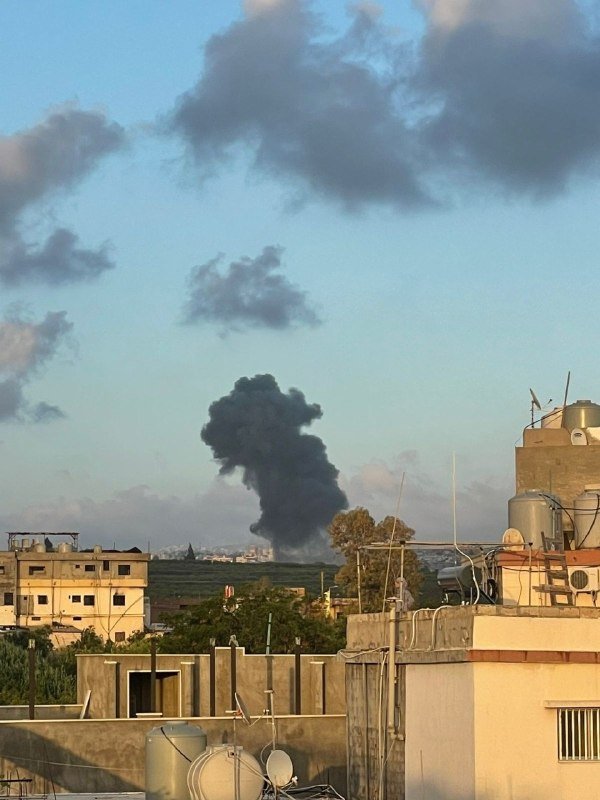
The hospital stood at the edge of Tyre's Housh district when the strikes landed. On 16 May 2026, footage verified by open-source researchers showed Israeli aircraft targeting the outskirts of the ancient Phoenician port city, with subsequent strikes landing in the Housh district itself — a residential zone within kilometres of a medical facility bearing the flag of a third country. The Lebanese Italian Hospital became an involuntary landmark in another day's toll from a conflict that has produced far too many such landmarks.
The pattern is not new. Strikes near hospitals generate headlines, diplomatic protests, and sometimes belated investigations — but rarely a change in targeting doctrine. Israel's military has argued repeatedly that Hezbollah positions in civilian areas make civilian harm unavoidable, framing each incident as a tragic necessity rather than a systemic failure. That framing has largely held, in part because Western coverage has been reluctant to interrogate it with the same rigour applied to civilian harm elsewhere. The question worth pressing is whether proximity to a non-state actor's infrastructure automatically suspends the legal obligations that protect medical facilities.
The Law Is Clear. The Compliance Is Not.
International humanitarian law is unambiguous on the matter: hospitals lose protected status only when used for acts harmful to the enemy, and even then, the prohibition on attacking them is absolute unless an effective warning is issued and a reasonable deadline respected. The footage from Tyre does not show evidence of such a warning, nor does it show the kind of active military use that would shift the legal calculus. That does not mean the Israeli military lacks such evidence — only that the public record, as it stands, does not substantiate the claim. Without independent access to the strike site, without the kind of on-the-ground investigation the International Committee of the Red Cross has repeatedly called for, the legal determination remains contested rather than resolved.
Israeli officials will argue that Hezbollah deliberately situates weapons storage and command infrastructure near hospitals, schools, and residential buildings precisely to create this dilemma — forcing Israeli planners into an impossible calculation and Western governments into reflexive condemnation. There is evidence to support elements of this claim. The question is whether that evidence, even where valid, functions as a blanket licence or as a case-by-case defence requiring specific, demonstrable justification for each strike. The law as written requires the latter. The pattern of practice suggests the former is closer to the operational reality.
The Coverage Problem Is Structural
Western media's treatment of Lebanese civilian harm illustrates something familiar about conflict coverage: medical facilities and residential areas are treated as context rather than subjects, background against which military operations unfold. A strike metres from a hospital is reported as a strike in Tyre. The hospital's proximity becomes a footnote, or disappears entirely, depending on the outlet and the news cycle's appetite for complexity.
The framing that prevails is one of military necessity, relayed through official channels with minimal independent challenge. When civilian harm is covered, it tends to appear as an unquantified aggregate — "several civilians were killed" — rather than a set of specific circumstances that could be interrogated forensically. Named victims, specific structures, documented proximity to protected sites: these details appear in NGO reports and wire service dispatches, but rarely become the frame through which the strike itself is understood. The military event defines the story; the civilian context is appended.
This is not unique to the Lebanon coverage, but it is consistent with it. The same pattern — specificity in official accounts, vagueness about civilian harm — has been documented across multiple conflicts. The structural incentive runs toward accepting the military framing and treating civilian harm as a regrettable externality rather than a primary fact requiring explanation.
What Accountability Looks Like When It Doesn't Happen
The pattern has consequences beyond the immediate human toll. Each strike that passes without consequences — without a published legal justification that withstands scrutiny, without independent investigation, without a changed targeting posture — reinforces a calculation: the cost of hitting a structure near a hospital is reputational, temporary, manageable. The diplomatic price is a fine that gets paid in the next news cycle.
Lebanon's infrastructure, already strained by economic collapse and years of political paralysis, cannot absorb indefinite degradation without consequences that extend well beyond the immediate conflict zone. The healthcare system in the south has been operating under constrained conditions for years; each incident that degrades capacity further shifts the baseline of what is survivable for the civilian population. That is not a theoretical concern. It is a measurable deterioration in conditions on the ground, documented by organisations with access that Western governments have largely declined to demand.
Regional actors watching this pattern unfold are drawing their own conclusions about what the absence of accountability signals for future conflicts. The norms that govern the protection of civilians in armed conflict are not self-enforcing. They depend on a demonstrated willingness to hold parties accountable when those protections are violated. When that willingness is absent, the norms do not hold — they erode, quietly, until the next crisis reveals the gap between stated principle and operational practice.
The footage from Tyre's Housh district will likely join the archive of strikes that were reported, condemned by some governments and international bodies, and then superseded by the next story. Whether it produces any accountability depends on whether the pattern itself becomes the story rather than the individual incident. That shift has not yet happened, and there is little in the current response apparatus to suggest it is imminent.
This publication will continue to monitor developments in southern Lebanon and the legal proceedings, if any, that follow the strikes of 16 May 2026.
Wire provenance
This editorial synthesis draws on the following public wire/social posts:
- https://t.me/wfwitness/8912
- https://t.me/wfwitness/8911
- https://t.me/wfwitness/8910