London's Divergent Streets: Nakba Anniversary Marches and Far-Right Counter-Protest Draw Tens of Thousands
Tens of thousands marched through central London on 16 May 2026 to mark the 78th anniversary of the Nakba, even as a separately organised far-right demonstration led by Tommy Robinson drew its own crowd amid a heavy police presence.
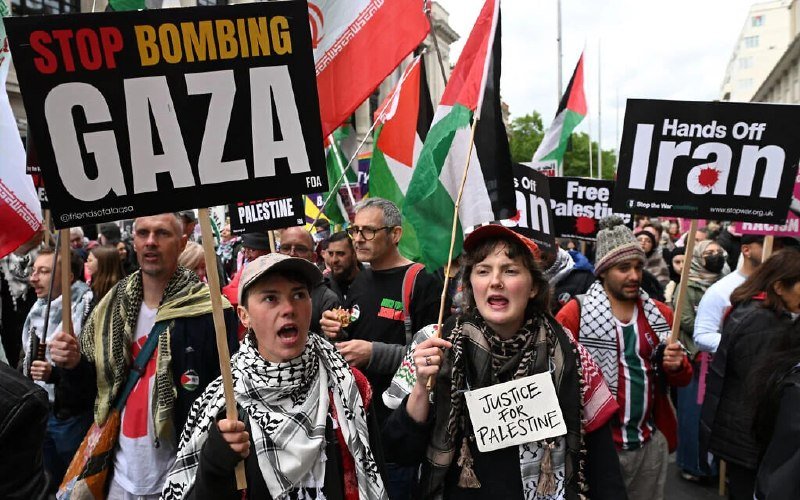
Tens of thousands of demonstrators converged on central London on Saturday, 16 May 2026, for two parallel and politically opposed marches that tested the city's capacity to hold competing expressions of grief, identity, and grievance in close proximity. The larger of the two events was the annual Nakba commemoration march, marking 78 years since the displacement of hundreds of thousands of Palestinians during the 1948 founding of Israel — a wound that pro-Palestinian activism has kept formally present in British civic consciousness since the first anniversary was observed in exile communities in the 1990s. Simultaneously, a far-right demonstration organised by Tommy Robinson, the founder of the English Defence League, drew its own crowd to a separate rallying point in the capital.
Scotland Yard deployed what sources described as a substantial police operation across the protest routes, with officers patrolling both the pro-Palestinian and far-right march corridors and establishing buffer zones intended to prevent physical confrontation between the groups. The Metropolitan Police had signalled in advance that both demonstrations had been assessed as lawful and that officers would facilitate each group's right to protest while maintaining public order. Whether those intentions held through the day was a matter that remained under active assessment as Saturday evening approached.
Two Commemorations, One City
The Nakba march has grown in London in successive years, drawing participants from the Palestinian diaspora, solidarity activists, and a broader cross-section of left-leaning organisations that have aligned the Palestinian cause with domestic grievances around housing, racism, and foreign policy. The 78th anniversary arrives at a moment when the conflict in Gaza — now in its third year of sustained hostilities following the 7 October 2023 Hamas attacks — continues to shape British public attitudes toward the Middle East and toward the government's stated positions. Polling from British research institutes has tracked a notable shift in public sentiment since October 2023, with unfavourable views of Israeli policy increasing substantially among younger voters. The Nakba commemoration in this context is no longer a purely diasporic event; it has become a rallying point for a domestic political constituency that sees the Palestinian question as inseparable from its own struggles.
Robinson's demonstration, meanwhile, built on a well-documented pattern of far-right mobilisation that has accelerated in Britain since the Southport knife attack in July 2024, when the killing of three children at a Taylor Swift-themed dance event ignited riots driven partly by false information circulated online. Robinson, whose legal name is Stephen Yaxley-Lennon, has positioned himself as a figurehead for that broader wave of anti-migrant and anti-Muslim sentiment, rebranding the English Defence League's methods for a social-media age. His decision to schedule Saturday's march on the same day as the Nakba commemoration was not accidental; it reflected a deliberate strategy, common across far-right movements in multiple countries, of seizing the symbolic calendar of marginalised communities as a stage for counter-demonstration.
The Counter-Demonstration Calculus
The practice of deliberately scheduling competitive events against pro-Palestinian or anti-racist demonstrations is not unique to London. Comparable patterns have emerged in Berlin, Paris, and Melbourne, where far-right actors have used anniversary dates, memorial events, or electoral calendar moments to generate media coverage and demonstrate organisational capacity. The structural logic is straightforward: when two opposing groups draw equal attention to their presence, the framing of the event tends to flatten — both sides become foreground, neither becomes background. That symmetry is precisely what the far-right seeks, because it normalises their presence at tables they were previously excluded from.
For the pro-Palestinian movement, the calculation is different. The Nakba commemoration is anchored in a specific historical claim — the fact of displacement, the numbers of those displaced, the legal and moral weight of that history. Bringing far-right marchers into the same frame risks diluting that specificity, making the commemoration appear reactive rather than principled. There was no indication by Saturday afternoon that this dilution had succeeded in altering the character of the Nakba march itself, but the presence of a heavily policed far-right counter-presence in the same city on the same day was the story that most wire headlines chose to lead with.
The Security Architecture and Its Limits
The Metropolitan Police's approach to Saturday's convergence reflected a broader institutional adaptation that British law enforcement has been developing since the 2011 London riots, when the combination of austerity-driven social strain, digital organising, and a fragmented protest environment produced violence that the police were initially unable to contain. The lessons of that episode — faster mobilisation, better intelligence on social-media organising, pre-positioning of public order units — have been systematically incorporated into Scotland Yard's protest policing doctrine. The result, in most years, is that competing demonstrations pass without major disorder.
But the absence of major disorder is not the same as the absence of political consequence. The police presence, while intended to enable lawful protest, also constitutes a form of framing: it signals that both events are of sufficient concern to warrant substantial resource deployment, which tends to equalise their perceived significance in media coverage. For the far-right, a heavy police response to their counter-demonstration is not a deterrent; for many of their supporters, it is evidence of relevance. The security apparatus, in other words, has become an unwitting participant in the competition for symbolic legitimacy.
What Remains Unresolved
The sources consulted for this article do not provide confirmed figures for the turnout at either demonstration as of Saturday evening, nor do they include specific details on arrests made, injuries reported, or any confrontations between counter-demonstrators and police. The Metropolitan Police had not issued a formal statement on crowd estimates at the time of reporting. The interaction between the two marches — whether they passed in relative proximity or were kept entirely apart by the police cordon — is not yet clear from the available wire accounts.
What is clear is that the Nakba commemoration has become a fixed point in London's political calendar in a way that was not true a decade ago. Whether the far-right's decision to schedule a counter-demonstration on the same date consolidates that calendar — by forcing authorities and media to reckon with the commemoration as an established annual event — or disrupts it by diluting its framing in public perception remains a question that will be answered in the coming weeks as the political actors on both sides assess the day's outcome.
Desk note: France 24 led its Saturday coverage with the dual-demonstration framing, foregrounding the far-right and pro-Palestinian marches as roughly equivalent events. This publication placed the Nakba commemoration first, reflecting the asymmetry in historical weight and the specificity of the Palestinian displacement claim, while noting the far-right mobilisation as a concurrent, deliberate strategic choice rather than a natural counter-weight.
Wire provenance
This editorial synthesis draws on the following public wire/social posts:
- https://t.me/france24_en/38245
- https://x.com/middleeasteye/status/1791847234562715974