Tens of Thousands Take to London's Streets as Far-Right and Pro-Palestine Rallies Converge on Nakba Day
The British capital deployed more than 4,000 officers as competing demonstrations — one marking the anniversary of Palestinian displacement, the other framing itself around opposition to mass migration — drew tens of thousands into central London on May 16, 2026, raising familiar questions about protest policing and the boundaries of nationalist politics.
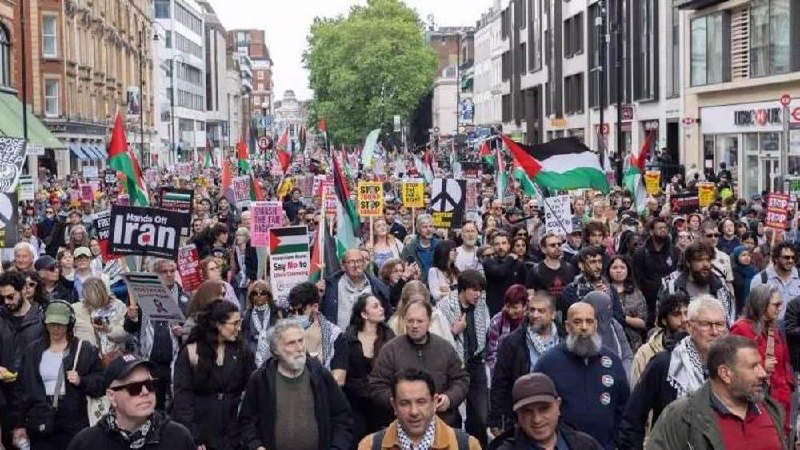
On a grey May afternoon in central London, two vast crowds moved through the city on parallel tracks — and in parallel registers of grievance. One march, arriving under the banner of Nakba Day, commemorated the 1948 displacement of Palestinians and demanded accountability for what organisers described as an ongoing colonial project. The other, framed explicitly around opposition to mass migration, drew its numbers from sections of the British public who view current immigration levels as an existential threat to national cohesion. By late afternoon on May 16, 2026, both demonstrations had swelled to tens of thousands of participants, and the Metropolitan Police had deployed more than 4,000 officers in an operation described by senior commanders as among the most complex security mobilisations the capital had seen in years.
The simultaneity was not accidental. Nakba Day — marking the anniversary of the mass flight and expulsion of Palestinians during Israel's creation — falls annually on May 15. For several years running, far-right and anti-immigration groups have scheduled their own demonstrations to coincide with or overlap Palestinian solidarity events, a tactical choice that has repeatedly escalated into confrontation. The Met's decision to station the two marches at separate points of origin and to route them along non-intersecting paths through central London was intended to prevent physical contact. Whether that separation held through the full duration of the day remained, as of the afternoon hours, an open question.
The Scale and the Stakes of London's Security Operation
The deployment of more than 4,000 officers exceeded even the staffing levels the Met mustered during peak Brexit protests and matched the tier of response typically reserved for high-profile international summits. The operational logic was straightforward: previous years had shown that when far-right contingents and pro-Palestine marchers come within visual or physical range of one another, even minor provocations could cascade rapidly into running battles. Police sources cited in live reporting from the scene described the day as a "significant concern" and acknowledged that the absence of major incidents in the opening hours provided no guarantee of a peaceful conclusion.
What distinguished this particular confluence from prior years was not merely the numbers — though those were substantial — but the geopolitical charge that now accompanies any large public gathering touching on the Middle East. The war in Gaza, now in its third year of active Israeli military operations following the October 2023 Hamas attacks, has reframed protest politics across Western capitals. For participants in the Nakba Day march, the event was not a historical commemoration but a statement of present solidarity with a population they understand to be under systematic bombardment. For those marching under anti-migration banners, the symbolism ran in the opposite direction: an assertion that London's left-wing political culture had become too permissive toward external pressures on British society.
What the Competing Narratives Miss
The coverage these protests generate tends to flatten the distinction between the two demonstrations into a false symmetry. Headlines that treat "far-right protest" and "pro-Palestine march" as equivalent phenomena — equal in their political valence, interchangeable in their implications for public order — obscure more than they reveal. One crowd was chanting for the rights of a people under military occupation. The other was chanting against the presence of certain categories of human beings within national borders. Conflating them as merely "competing" protests does journalistic violence to their irreconcilable content.
That said, the framing that treats all counter-protesters as automatically progressive allies of the Palestinian cause also deserves scrutiny. History shows that street movements attract participants whose motives are heterogeneous and whose understanding of the issues at stake is uneven. The Nakba Day march on May 16 drew a broad coalition — formal political organisations, grassroots solidarity groups, faith communities, students, and individuals who had no prior involvement in political organising. Not every voice in that crowd spoke with the same degree of specificity about the two-state question, the Oslo framework, or the parameters of any plausible peace settlement. The same political education gap that critics of the far-right regularly identify applies, in varying degrees, across the spectrum.
What is analytically more productive than cataloguing the ideological inconsistencies of individual marchers is examining the structural conditions that produced two mass mobilisations on the same afternoon. Both protests drew on grievances that have deepened rather than narrowed over the past five years. The cost-of-living crisis that reshaped British electoral politics in 2024 and 2025 has not receded; real wages for the bottom quartile of earners remain below their 2021 levels. Housing affordability in London has reached a point that renders the city effectively inaccessible to first-time buyers earning below the median wage. When large groups of people feel that the political system has failed to address their material concerns, they take to the streets — and they bring their grievances in whatever idiom the moment provides.
The Structural Frame: Whose Streets, Whose Narratives
The question of who controls the narrative around mass demonstrations in Western capitals is never purely a question of police logistics. In recent years, the framing of large-scale street protests has become a site of active contest between several competing interests: security agencies for whom any mass gathering is a risk-management problem; political parties for whom protest dynamics represent either an opportunity or a liability depending on their position in the electoral cycle; and media organisations whose coverage decisions shape whether a demonstration registers as a legitimate expression of democratic sentiment or a threat to public order.
On May 16 in London, the coverage followed predictable tracks. Headlines led with the police deployment and the far-right presence — categories the mainstream media has learned to treat as inherently newsworthy — while the substantive content of the Nakba Day march, its specific demands, its coalition of supporters, received comparatively less space. This is not a new pattern, but it remains consequential. When the political demands of a mass demonstration are consistently subordinated in coverage to the spectacle of security operations, the demonstration's capacity to shift public debate is diminished. The crowd's physical presence in the street does not automatically translate into narrative presence in the media ecosystem.
The geopolitical dimension compounds this dynamic. British foreign policy on Gaza — defined by continued arms export licences to Israel and diplomatic support for ceasefire proposals that Kyiv's allies have consistently blocked at the UN — is not a domestic political issue in the narrow sense. But it is a policy area where public opinion and official positioning have diverged sharply. Polling over the past two years has shown consistent majorities in England and Wales favouring an immediate ceasefire and an end to arms transfers, while the government in Westminster has maintained a course that aligns with Washington rather than with those majorities. Mass demonstrations provide a mechanism for that divergence to become visible. Whether it becomes consequential depends partly on whether political parties perceive electoral risk in ignoring it.
What Comes Next
As evening fell on May 16, the Met reported that the day had passed without major disorder — a relief to commanders who had publicly braced for worse outcomes. But the conditions that produced two simultaneous mass mobilisations remain firmly in place. The anti-migration movement has a clear institutional infrastructure in Britain: elected representatives, media amplification from sympathetic outlets, and a voter base that has shown willingness to reward parties which adopt restrictive positions. The pro-Palestine movement has shown, over eighteen months of sustained demonstration, that it can mobilise consistent numbers and maintain a message — but it lacks the institutional penetration that would allow it to translate street presence into policy change through conventional political channels.
The immediate question is whether the Met's operational success in keeping the two demonstrations apart on May 16 establishes a template for future convergences — or whether the next iteration proves more difficult to contain. History suggests the latter. As the political salience of both immigration and Gaza remains high, and as the parties that have most directly courted the anti-migration vote consolidate their electoral position, the conditions for confrontation will persist. The question is not whether London will see similar scenes again. It is whether the political system has any mechanism for channelling those grievances before they reach the street.
This article was filed from London on May 16, 2026. Monexus covered the simultaneous demonstrations with specific attention to the Nakba Day march's political content, a dimension that received comparatively less emphasis in wire-service reporting focused on the security operation and the far-right presence.
Wire provenance
This editorial synthesis draws on the following public wire/social posts:
- https://t.me/osintlive/12438
- https://t.me/DDGeopolitics/8921