The Rhetoric and the Receipt: Why America's China Posture Keeps Bumping Against Reality
Secretary Rubio says the US doesn't need China's help. The structural evidence suggests Washington may not have that luxury for long.
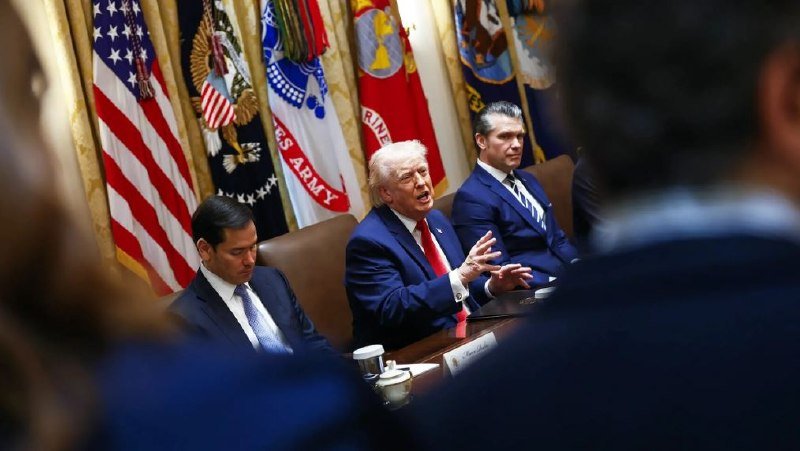
On 17 May 2026, Secretary of State Marco Rubio posted a short video to social media with a clean message: the United States was not asking for China's help. It did not need it. The framing was defiant. The delivery was crisp. It tested well in clip culture and circulated accordingly.
The problem is not the message. The problem is what sits underneath it.
For all the rhetorical sharpness of the Rubio posture—that the US stands unbowed, that its interests are pursued on its own terms, that the century ahead remains American—the structural ledger tells a more complicated story. Dollar-denominated debt is not going away. Trade relationships are not symmetric. The institutional architecture Washington built over seventy years requires other powers to keep playing along, and the signals that they may not are accumulating.
What the Secretary Said, and What He Left Out
Rubio's second point, also posted to social media on 17 May, refined the position: the US was not trying to constrain China, he said, but China's rise could not come at American expense. That is a formulation with significant wiggle room. "Not trying to constrain" is not the same as "actively accommodating." "Cannot come at our expense" is not the same as "will not." The phrasing is careful. It is also, perhaps, aspirational.
Beijing heard the aspiration. On 16 May, Chinese state media quoted Xi Jinping telling visiting officials that America was a declining world power. The framing was calibrated for a domestic audience, certainly. But it was not frivolous. Xi was drawing a conclusion from observable trends: dollar weaponization, allied-overreach fatigue, the visible cost of simultaneous confrontation on multiple fronts. The claim that America is declining is itself a claim about trajectory, and trajectory is what geopolitics is built on.
What is instructive here is not the clash of characterizations. It is the gap between the two positions. Washington insists it holds the stronger hand. Beijing insists the hand is weaker than it looks. Neither side is fully wrong. Both are gaming the same uncertainty.
The Billionaire Contradiction
Representative Alexandria Ocasio-Cortez, posting separately on 16 May, offered a domestic counterpoint to the great-power framing. In five years, she noted, billionaire wealth had doubled. The question she posed was straightforward: had the quality of life for ordinary Americans doubled alongside it? The answer, for most listeners, was no.
This is not a novel observation. But it lands differently when set against the international posture. The US is engaged in an expensive strategic competition—involving semiconductor export controls, naval posturing in the Indo-Pacific, diplomatic isolation campaigns, and arms transfers—that requires sustained fiscal outlay and manufactured consent. The domestic bargain that sustains that posture, however, is under pressure. When a lawmaker can post a video suggesting that the gains from that competition have pooled at the top while the middle hollows out, it finds an audience.
The Xi framing—that America is declining—intersects with the AOC framing at an uncomfortable point. If declining means the social contract is fraying, the strategic posture becomes harder to sustain. Grand strategies require domestic coalitions. Domestic coalitions require that the distribution of gains be plausible enough to justify the costs. The billionaire wealth doubling video was not about China. But it was about the foundation that great-power competition rests on, and it suggested that foundation is not as solid as the Rubio video implied.
The Dollar Problem
The most durable tool Washington has in this contest is not the carrier group or the alliance network. It is the dollar. Dollar-denominated settlement underpins global trade in a way that gives the US Treasury extraordinary leverage: sanctions, secondary market exclusion, correspondent banking access. This is real power, and it has been deployed aggressively.
But power used is power depleted. Each sanction regime, each blacklisting, each freeze of sovereign reserves sends a signal to every finance minister and central banker outside the Western bloc: the dollar's reach is a vulnerability for anyone who relies on it without alternative. China has spent the past decade building alternative settlement rails—CIPS, bilateral swap lines, commodity pricing in yuan. The infrastructure is not complete. It does not need to be complete to be useful. It needs only to be sufficient when the political cost of dollar dependency becomes too high for a given partner to absorb.
Rubio's confidence that the US does not need China is technically correct in the narrow sense: the US can survive without Chinese cooperation. But the corollary—China cannot survive without American tolerance—is increasingly under pressure. The structural asymmetry is narrowing. Every year that pass-by without a credible alternative to the dollar reduces the leverage. Every year that alternative infrastructure matures reduces it further.
Reading the Signals
The honest reading of where this stands is not that either side is winning. It is that the competition is asymmetric and unresolved. Washington retains superior military reach, deeper capital markets, and the incumbent's structural advantages in the dollar system. Beijing retains the momentum of a rising manufacturing base, infrastructure buildout across the Global South, and a coherent long-term planning horizon that democratic political systems find difficult to match.
What the Rubio video and the Xi quote share is an interest in shaping perception. Both leaders are managing domestic audiences, signaling to allies, and probing the other side's red lines. The AOC video is a different kind of signal—one that cuts across the great-power framing and asks whether the resources being mobilized for competition are being deployed in the interest of the people being asked to bear its costs.
That question is not going away. It is, in some ways, the only question that matters once you look past the diplomatic rhetoric.
This publication covered the Rubio statements as delivered without further independent corroboration of the broader policy context at time of writing.
Wire provenance
This editorial synthesis draws on the following public wire/social posts:
- https://x.com/unusual_whales/status/2055431197069836288
- https://x.com/unusual_whales/status/2055430709029031936
- https://x.com/unusual_whales/status/2055994000889290753
- https://x.com/unusual_whales/status/2055749366321717248