Iran’s Crypto-Backed Hormuz Insurance Gambit Tests the Limits of Dollar Sanctions
As Bitcoin drops on US-Iran escalation, Tehran is quietly piloting a cryptocurrency-denominated maritime insurance scheme to bypass Western financial infrastructure — and the numbers suggest it may be gaining traction.
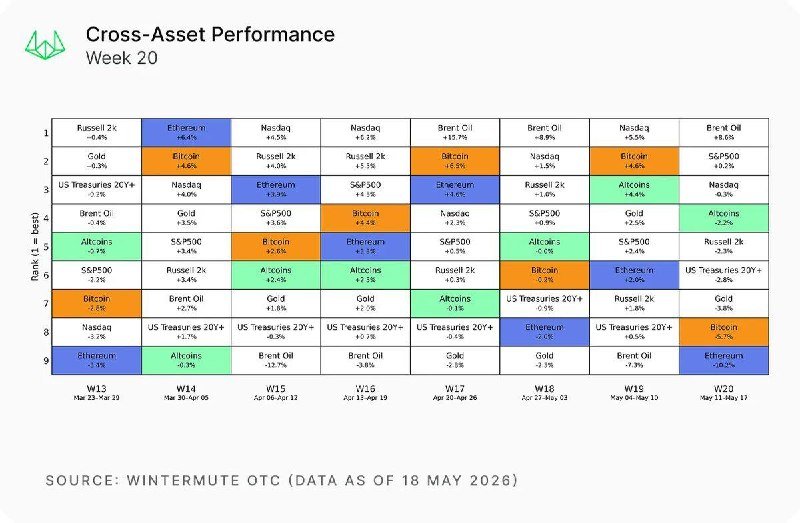
When President Donald Trump warned Iran on May 18, 2026 that the "clock is ticking" on peace talks, the Strait of Hormuz — through which roughly a fifth of the world's oil flows — was already effectively closed to Western-insured vessels. The geopolitical escalation sent Bitcoin tumbling below the $77,000 mark, according to CoinDesk, adding to a sell-off that had knocked the largest cryptocurrency to around $76,000 earlier in the day, per CoinTelegraph. Oil futures rose sharply on the news, per the BBC. But beneath the immediate market turbulence, a more structural shift was underway: Iran had quietly launched a competing maritime insurance architecture, denominated partly in cryptocurrency, and it was not failing.
The mechanism is straightforward in concept. Iranian state media, as reported by The Cradle Media and Al Jazeera on May 18, 2026, describes a newly established body tasked with managing vessel transit through the Strait of Hormuz — backed by a crypto-denominated insurance scheme. The scheme is pitched as an alternative for ship operators who cannot access Western coverage, which is itself a function of the sanctions architecture that has progressively strangled Iran's access to standard financial networks. The scale is significant: reporting from The Cradle Media puts the scheme at $40 billion in coverage capacity. No vessel, according to the same report, has yet been covered under the arrangement — but the infrastructure to do so now exists, and the pool of potential clients is growing as Western sanctions narrow the options available to maritime operators in the region.
The Sanctions Architecture Meets Its Structural Limit
The rationale for Iran's scheme is not ideological. It is operational. The Western financial system — and the dollar-denominated infrastructure that underpins global insurance markets — has for years been the primary mechanism through which sanctions regimes are enforced. Remove a country's access to Lloyds of London and its equivalents, and you remove its ability to move goods. That logic has worked. Iran has been under layered sanctions for decades, and its economy has contracted significantly as a result. But the same logic has a predictable corollary: when exclusion becomes total, the excluded party has maximum incentive to build a parallel.
This is what the Hormuz insurance scheme represents. Iran's proposal to offer Bitcoin-denominated ship coverage, as reported by Al Jazeera on May 18, 2026, does not emerge from a vacuum — it emerges from a deliberate attempt to price the sanctions risk out of existence for a specific category of commercial actor. The target is not Western navies. The target is the shipping company operating a tanker flagged in Singapore or Dubai that needs Hormuz transit to move cargo from the Persian Gulf to Asian markets. For that operator, the question is not ideology — it is whether coverage can be obtained at a price that makes the voyage viable.
Market Reaction and the Dollar Signal
The immediate market reaction to Trump's May 18 warning was predictable: risk assets sold off, Bitcoin among them. CoinDesk reported that Bitcoin and ether both sank as the Iran rhetoric intensified, with oil moving higher in lockstep — a classic避险 dynamic. But the longer signal is more ambiguous. The drop in Bitcoin occurred against a backdrop of broader uncertainty over US-China trade negotiations, which adds a second dimension to crypto weakness that is not purely Iran-related, per CoinDesk's broader market reporting. That complexity matters: attributing all crypto selling to Iran risk overstates the geopolitical premium and understates the structural demand picture.
The Polymarket market referenced in the thread — currently pricing only a 30% chance that Trump's ballroom is unblocked by the end of the month — reflects ongoing uncertainty about the broader US diplomatic posture and does not directly bear on the maritime insurance question. It does, however, underscore the extent to which policy uncertainty is now priced into financial markets in near-real-time through prediction markets, a dynamic that was absent from prior Iran standoff cycles.
What Tehran's Counter-Proposal Signals
Separately from the insurance architecture, Iranian state-adjacent channels as reported by the Middle East Spectator on May 18, 2026 indicate that Tehran's counter-proposal to Washington includes a vague commitment not to pursue nuclear weapons — with no mention of the existing enriched uranium stockpile or the Strait of Hormuz transit question. That omission is meaningful. By declining to address the stockpile, Iran retains leverage on both the military and commercial dimensions of its standoff with Washington. By declining to address Hormuz transit explicitly, it leaves the insurance scheme as a de facto fait accompli rather than a negotiable concession.
Whether the scheme can function at scale is an open question. The Cradle Media reports that no vessel has been covered to date, which suggests the operational testing phase is early. But the infrastructure is in place. The price mechanism — cryptocurrency-denominated premiums, peer-to-peer risk pooling, and a state-backed insurer operating outside SWIFT — solves for the sanctions problem at the layer where it matters most for commercial operators. If even a modest share of Hormuz transits migrate to the Iranian scheme, the precedent is set, and the precedent, not the volume, is what the market and policymakers should be watching.
The stakes are not only financial. The Hormuz insurance architecture represents a practical test of whether dollar-denominated financial exclusion can be structurally circumvented in a domain — maritime commerce — that has historically been among the most dollar-dependent sectors in global trade. If the answer is yes, even partially, the implications extend well beyond the Strait of Hormuz to every sanctions regime the United States has sought to enforce through financial infrastructure. That is a structural question, not a geopolitical one, and it deserves a commensurate analytical weight.
Wire provenance
This editorial synthesis draws on the following public wire/social posts:
- https://t.me/TheCradleMedia/18452
- https://t.me/Middle_East_Spectator/