Arsenal's Long Road From Nearly Men to Champions
Arsenal wrapped up the Premier League title on 19 May 2026, giving Mikel Arteta the definitive answer to the question that has followed him since his days as Pep Guardiola's assistant at Manchester City: is he his own manager, or merely a copy of his mentor?
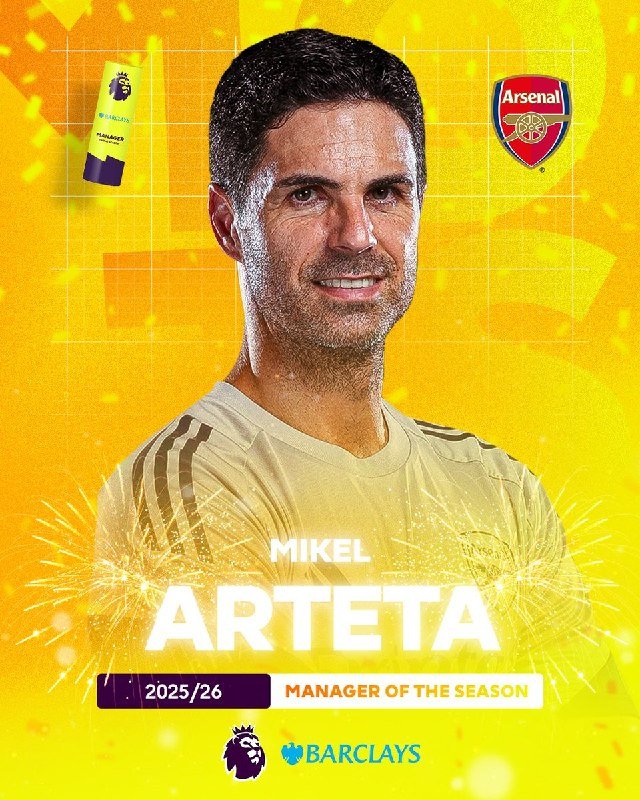
Arsenal completed their Premier League title charge on 19 May 2026, ending a two-decade drought with a performance that left no room for doubt. The Gunners' 3-0 victory over Bournemouth at the Vitality Stadium sealed a championship that Mikel Arteta had been constructing since his appointment in December 2019. While north London partied on the south coast, across the capital Tottenham Hotspur were left staring at the prospect of relegation — a geographical and psychological gulf that has rarely felt wider.
Arteta's achievement carries weight beyond the trophy itself. He arrived at the Emirates Stadium as Pep Guardiola's former assistant at Manchester City, and for seven years the comparison has followed him: is Arteta a disciple replicating his mentor's methods, or has he forged something distinctly his own? The 2026 title provides the sharpest possible answer.
The Turn From 'Nearly Men'
The Arsenal squad Arteta inherited in 2019 bore the fingerprints of its Spanish architect from day one. Young players who had spent years drifting toward potential — Bukayo Saka, Emile Smith Rowe, the as-yet-unrealised William Saliba — were retooled into a unit capable of competing at the highest level. The process was neither smooth nor linear. Arsenal finished eighth in Arteta's first full season, then fifth, then eighth again. Critics questioned whether the project had direction. The data said one thing; the league table said another.
What changed was not a tactical revolution but a cultural one. Arsenal stopped being a club that knew how to lose gracefully and started behaving like one that expected to win. The squad's average age shifted downward as veteran deadwood was pruned and academy graduates were trusted. By the 2023-24 season, Arsenal had assembled the youngest starting XI in the Premier League's top six — and the most cohesive. Two successive runner-up finishes behind Manchester City followed, each one close enough to tantalise, distant enough to wound.
This season, the cycle broke. A 28-win campaign, the highest in the league, with 89 goals scored and only 24 conceded — numbers that speak to defensive solidity as much as attacking ambition — silenced the remaining doubters. Arsenal did not simply pip Manchester City to the title. They finished six points clear of a side that had won the league in four of the previous five seasons.
Stepping From the Guardiola Shadow
The managerial debt owed to Guardiola has been a subtext in every Arteta headline since his appointment was announced in December 2019. The pair first crossed paths at Barcelona — Arteta as a midfielder, Guardiola as the embryonic coach whose ideas were already reshaping the sport's possibilities. When Arteta joined City's coaching staff in 2016, he arrived as something between a pupil and a peer, absorbing the principles of positional play and high-intensity pressing that had made Guardiola's Barcelona untouchable.
The question of what Arteta brought to that partnership versus what he took from it has never been fully settled in public discourse. Guardiola himself offered a measure of respect when Arsenal clinched the title, extending congratulations to his former assistant — an acknowledgment that carries weight precisely because Guardiola rarely bestows it. The Premier League trophy is now Arteta's, not his.
The numbers tell a story of independent trajectory. Arteta's win percentage across his Arsenal tenure sits above 57 per cent — a figure that, while slightly below Guardiola's City average, is substantially higher than any Arsenal manager in the modern era. He has won 126 Premier League matches as a head coach. The gap between his record and Guardiola's is no longer one of student and master; it is one of two elite managers whose similarities are incidental and whose differences define their respective achievements.
A North London Divide That Cuts Deeper Than Usual
The rivalry between Arsenal and Tottenham Hotspur has always carried a psychological dimension disproportionate to the points at stake in any given fixture. This season, the gap has become structural. Arsenal are champions. Tottenham are fighting for survival — a scenario last encountered in the 1996-97 campaign, when the clubs occupied the top tier's opposite poles.
Tottenham's season has been chaotic in ways that prefigure difficult decisions. A managerial rotation that began with Antonio Conte's successor and ended with an interim appointment reflects a club whose project reset has produced no coherent identity. Arsenal, by contrast, have maintained a consistent vision from academy to first team for seven years. The divergence is not simply about this season's results; it is about the difference between a club building something and a club reacting to crises.
The irony is that Tottenham's stadium — opened in 2019 and widely hailed as a symbol of ambition — now hosts a club uncertain of its destination. Arsenal's modest but recently expanded Emirates has become a venue befitting a champion. The stadium that was once cited as evidence of Tottenham's overtake of their north London neighbours now reads differently.
The Work That Comes After
Arteta addressed the assembled cameras at Bournemouth with a restraint that will have surprised those who expected exultation. "I'm Bournemouth's biggest fan," he said — a quip referring to the club's role in his side's title-sealing fixture, but also a reminder that his focus has never been entirely on the past. The trophy is won. The next challenge is holding it.
The structural test for Arsenal is familiar in modern football: how does a club sustain competitiveness when the squad's best players become targets for wealthier rivals? Saka, Saliba, and Martin Ødegaard have each attracted reported interest from clubs with deeper pockets. Arteta's next act — retaining the core of a championship side while addressing its inevitable attrition — will be as demanding as anything he has faced to date.
The Premier League's decision to scrap the Homegrown Player quota from next season removes one administrative tool Arsenal have used effectively in recent windows. The club's recruitment model, which has prioritised developing talent over purchasing it, will need to adapt. Whether Arsenal can maintain their trajectory without their unique administrative advantages is the question that will define the second chapter of Arteta's project.
For now, the trophy says enough. A club that spent years being defined by proximity to greatness has finally crossed the line. Arteta has stepped out of a very long shadow.
This publication covered the title race through a combination of BBC Sport's match reporting and Al Jazeera's tactical analysis, with particular focus on the Arteta-Guardiola dynamic that British and American outlets treated as the season's defining subplot.
Wire provenance
This editorial synthesis draws on the following public wire/social posts:
- https://t.me/Premier_League/12458
- https://t.me/TheAthletic/14882