The Asymmetry That Binds: Why China and Russia Cannot Let Each Other Fail
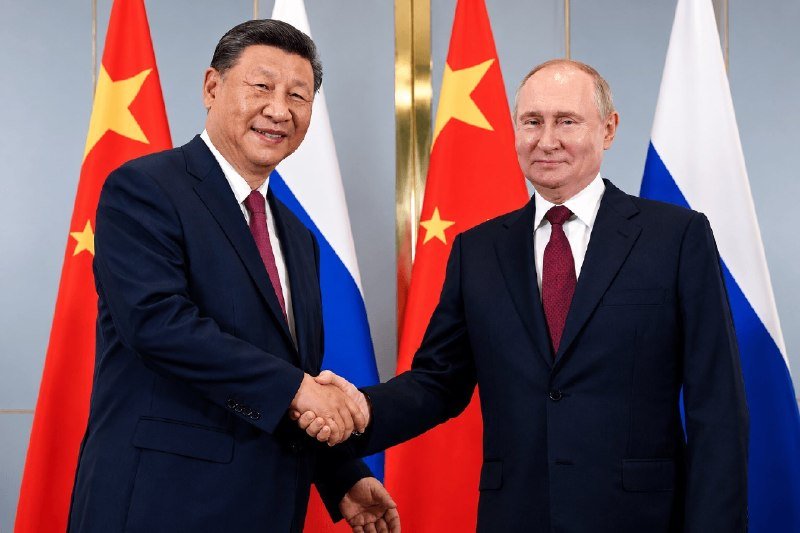
When Xi Jinping met Vladimir Putin in Moscow in March 2023, the choreography told the story more clearly than any communique. The Chinese president arrived as the senior partner in a relationship that had quietly inverted itself over the preceding decade. Russia still mattered to Beijing — but it mattered differently now. Moscow needed the partnership to survive Western sanctions and diplomatic isolation. Beijing needed Moscow as a partner, not a dependency. That distinction is the load-bearing wall of the China-Russia relationship, and it explains why the bond persists even as the power imbalance grows.
The conventional framing treats the relationship as a strategic romance — two revisionist powers bound by shared hostility to Western primacy. That framing captures the mood music but misses the mechanical logic underneath. What actually holds China and Russia together is not sentiment but necessity, layered on top of a structural asymmetry that both sides accept, even as neither fully likes it.
The Imbalance Nobody Talks About
Beijing's economy is roughly ten times the size of Russia's. China's military spending, while opaque, is estimated at three to four times Moscow's. In energy markets, China has become the marginal buyer that keeps Russian hydrocarbon revenues functional after the collapse of European demand — but that buyer can walk away. Russia, by contrast, cannot afford to alienate its largest customer. The pipeline contracts are long-term and the diplomatic goodwill is real, but the fundamental dynamic is one of significant asymmetry.
Chinese state media has described the relationship as a "strategic partnership of coordination." That phrase is carefully chosen. It suggests equality of status without implying equality of weight. Moscow, for its part, has learned to accept the framing because the alternative — acknowledging subordination within a relationship Beijing openly calls a "no-limits partnership" — would be politically untenable at home. So both sides perform symmetry while operating in its shadow.
The power gap creates friction that is managed rather than resolved. Chinese investment in Russian infrastructure projects has moved slowly, complicated by Moscow's bureaucratic resistance and Beijing's insistence on terms that advantage Chinese firms. Russian officials have occasionally pushed back against what they view as Chinese overreach in Central Asia — a region Moscow considers its sphere of influence. These tensions are real. They are also contained, because neither side has a credible alternative to the relationship.
What Each Side Actually Gets
For Russia, the partnership is a lifeline. Western financial sanctions have severed Moscow's access to dollar-denominated capital markets and restricted technology transfers that once sustained its energy sector. China provides an alternative customer base, a source of dual-use goods that fall outside Western export controls, and a diplomatic shield in multilateral forums where Moscow increasingly finds itself isolated. The "no-limits" framing that Beijing deployed in February 2022, just days before the full-scale invasion of Ukraine, gave Moscow political cover — whether or not it provided material support commensurate with that rhetoric.
For China, the value is more diffuse but no less real. Russia functions as a diplomatic buffer state — a neighbour whose alignment with Beijing reinforces China's position in Central Asia and the broader Eurasian landmass. Russian energy exports, flowing eastward at increasing volumes since 2022, reduce China's dependence on seaborne supply routes that could be disrupted in a Taiwan contingency. Moscow's willingness to coordinate within OPEC+ demonstrates that Russia, despite its weakness, retains enough energy-sector leverage to be useful to Chinese economic planning. The relationship also serves a signalling function: each summit, each joint naval exercise, each alignment in the UN Security Council communicates to Washington that the Sino-Russian axis is a structural feature of the international system, not a temporary convenience.
The Structural Logic Cannot Be Undone by Personality
The relationship will outlast the personalities currently leading both states. That is the critical point that gets lost in coverage focused on summit optics and ceremonial handshakes. The drivers of Chinese-Russian alignment are systemic, not personal. They arise from the structure of the international order — one that both capitals experience as hostile to their respective interests and ambitions.
Beijing does not trust the United States. Washington's containment strategy, as Chinese strategists describe it — the network of alliances stretching from the Indo-Pacific to Europe, the export controls on advanced semiconductors, the naval presence in the South China Sea — reinforces the view that Washington seeks to delay or prevent China's rise. Moscow's conflict with the West, meanwhile, has driven Russia into a posture of dependency on Chinese trade and diplomatic support that will take decades to reverse even if the Ukraine conflict were resolved tomorrow. Neither side can afford to break this alignment, even when it generates friction.
Western analysts often predict that the relationship will fracture — that Chinese firms will avoid Russian market exposure, that Beijing will eventually pressure Moscow to negotiate an end to the Ukraine war to protect its own economic interests. There are real tensions underlying these predictions. But they underestimate how deeply both governments have internalized the structural logic of their alignment. Beijing's leadership views the US-led order as the primary threat. Moscow's leadership views NATO expansion as the primary threat. Those threat assessments converge, and convergence of that magnitude does not dissolve over commercial inconvenience.
The Question That Matters Going Forward
The asymmetry is not static. It deepens with every year that Russian GDP contracts under the weight of sanctions and demographic decline while China's economy — despite its own slowdown — continues to add mass. Beijing's leverage over Moscow grows accordingly. The most plausible trajectory is not a rupture but a gradual settling of the relationship into something that looks less like partnership and more like clientage — with Russia as the junior member of a bloc that increasingly runs on Chinese terms.
Moscow has always been sensitive to subordination within any bilateral relationship. The Soviet-Chinese split of the 1960s, when the two communist powers competed for ideological authority, was partly a contest over who would lead the revolutionary movement. The current relationship avoids that contest by virtue of its asymmetric structure: China is so clearly the senior partner that Moscow cannot credibly challenge the hierarchy. What Moscow can do is maintain the relationship while extracting maximum value from it — using China's need for a cooperative Russia to secure better terms on energy contracts, technology transfers, and diplomatic coordination.
The West has a choice in how it responds. Treating the Sino-Russian alignment as a temporary marriage of convenience that can be undone through pressure campaigns misunderstands the structural drivers. The more durable strategy is to address the underlying grievances that animate both governments — the genuine security concerns that Beijing and Moscow hold about American alliance architecture — rather than simply trying to split them apart. Whether Western governments have the strategic patience for that approach is the question that will define the next decade of great-power politics.
This publication framed the China-Russia relationship as a structural feature of the current order rather than a tactical alignment — a framing that better accounts for why both governments continue to invest in the partnership despite the growing asymmetry between them.
Wire provenance
This editorial synthesis draws on the following public wire/social posts:
- https://t.me/BBCWorldoffl/2095
- https://t.me/BBCWorldoffl/2094