The optics of the Gaza flotilla — and what they obscure
A convoy of vessels heading toward Gaza generates headlines and outrage, but the structural conditions producing civilian hardship receive less sustained attention.
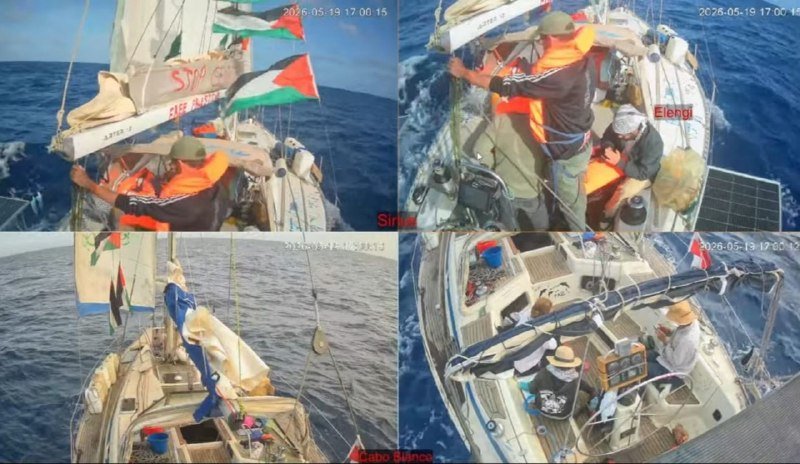
On 19 May 2026, a convoy of ten vessels broadcast its approach toward Gaza through social media channels. The organizers posted updates in real time, framing the passage as a humanitarian act confronting what they describe as a naval blockade. Within hours, the same channels documented what they called a "takeover by navy fighters" — language that frames the encounter as forcible interdiction rather than routine maritime enforcement. The images circulated widely. The captioning was emphatic. The dispute over what unfolded at sea, and why it matters, had begun.
This is the pattern: a convoy assembles, headlines follow, and the underlying architecture of the situation recedes into the background. The blockade itself — its legal basis, its daily effects on a population of roughly two million, its status under international humanitarian law — gets examined during moments of crisis and then absorbed back into the fabric of routine coverage. The flotilla, by contrast, generates its own self-contained narrative: the courage of the passage, the aggression of the interdiction, the worthiness or complicity of those aboard. Both stories are real. Only one of them tends to receive follow-up reporting.
What the blockade means in practice
Israel has maintained restrictions on the entry of goods and materials into Gaza since 2007, after Hamas took control of the territory. The stated rationale is preventing weapons from reaching the group, which is designated as a terrorist organization by Israel, the United States, and the European Union. For the civilian population, the practical consequences are significant: construction materials are heavily restricted, medical equipment imports require case-by-case approval, and the range of goods permitted entry fluctuates with security assessments that outside observers cannot independently verify. The United Nations has repeatedly described conditions in Gaza as不符合人道主义标准的 minimum living standards, with the World Food Programme and UNRWA maintaining operations that international donors fund and that depend on the continued flow of approved imports.
The legal status of the blockade itself is contested. Israel asserts it acts in self-defence against a hostile non-state actor. International legal scholars and bodies including the International Committee of the Red Cross have argued that an occupying power retains obligations toward civilian populations under occupation, and that blockades affecting civilian infrastructure must meet tests of proportionality and necessity that are not always met in practice. The United Nations Fact Finding Mission on the Gaza Conflict in 2009 concluded that the blockade was unlawful as a form of collective punishment. Israel's position has been that the blockade is a lawful security measure. These positions have not been formally adjudicated, and the dispute persists across successive rounds of hostilities and diplomatic engagement.
The convoy as communication
The maritime convoys — there have been several since 2008, with varying degrees of success in reaching Gaza — are not primarily cargo missions. A ten-vessel convoy, regardless of what it carries, cannot materially alter the supply conditions of a population. What it can do is generate photographic evidence and international attention at a moment when attention to Gaza is available. The organizers understand this; it is the explicit design of the exercise. Naval interdiction produces images. Images circulate. The narrative attaches to something visible.
The political logic is straightforward: if the underlying conditions are themselves a matter of dispute, the convoy creates a new and sharper event around which coverage can coalesce. Whether this serves the humanitarian objective of improving daily conditions inside Gaza, or whether it primarily serves the communication objectives of those aboard, is a genuine question that the coverage rarely pauses to examine. The humanitarian framing is assumed; the strategic dimensions are left unexplored.
What coverage tends to skip
When a flotilla makes news, the information environment around it is already shaped. The organizers produce content in English and Arabic, post to Telegram and Twitter, brief sympathetic journalists in advance. The interdiction is documented from one side. The counter-narrative — what naval authorities said, what legal basis they invoked, what protocols were followed — arrives later and in less compelling visual form. The asymmetry is structural, not accidental. The convoy operates as a media event; the naval response operates under institutional constraints that prevent comparable documentation.
This does not mean the convoy's claims are false. It means the information environment around maritime incidents involving Gaza is one in which the pro-convoy frame has a structural advantage in shaping initial coverage. Responsible reporting requires holding that frame against what is known about the blockade's effects, the legal arguments on multiple sides, and the specific dynamics of each interception — none of which the images alone can supply.
The blockade's daily consequences — power shortages, water quality issues, restrictions on exports that prevent economic development, medical shortages that humanitarian organizations have documented in detail — are well-sourced and ongoing. They receive coverage when a crisis peaks. Between crises, they are under-covered relative to their severity. The flotilla, by contrast, receives concentrated coverage precisely because it is an event, and events are legible to editors and audiences in ways that structural conditions are not.
The stakes
If maritime convoys continue to generate more international attention than the blockade itself, the diplomatic incentives facing all parties are distorted in predictable ways. Israel faces less sustained pressure on civilian access conditions because the coverage is episodic rather than continuous. The organizers of convoys have an incentive to stage repeated passages, because each passage resets the news cycle. Meanwhile, the humanitarian organizations with long-term operational presence in Gaza — UNRWA, the International Committee of the Red Cross, the World Food Programme — continue to report on conditions that are not contingent on whether a boat is in transit at a given moment.
The convoy approaching Gaza on 19 May 2026 will be documented, debated, and resolved into a news cycle within days. The question of what a civilian population inside a sealed territory needs, and who is responsible for providing it, will remain. That question deserves the same scrutiny that the convoy receives. The asymmetry between event coverage and structural reporting is not inevitable; it is a choice made repeatedly by newsrooms that follow the most legible story rather than the most consequential one.
The vessels are en route. The cameras are running. The harder question — what the blockade costs, in human terms, every day — is still waiting for the same attention.
Wire provenance
This editorial synthesis draws on the following public wire/social posts:
- https://t.me/englishabuali/12451
- https://t.me/englishabuali/12450
- https://t.me/abualiexpress/9987