NATO Intercepts Ukrainian Drone Over Estonia: First Alliance Shoot-Down in Baltic Airspace
A Romanian F-16 destroyed an unidentified drone over Estonian territory on May 19 — the first time a NATO aircraft has taken kinetic action inside Alliance airspace — raising sharp questions about Ukrainian operations that encroach on Baltic member states.
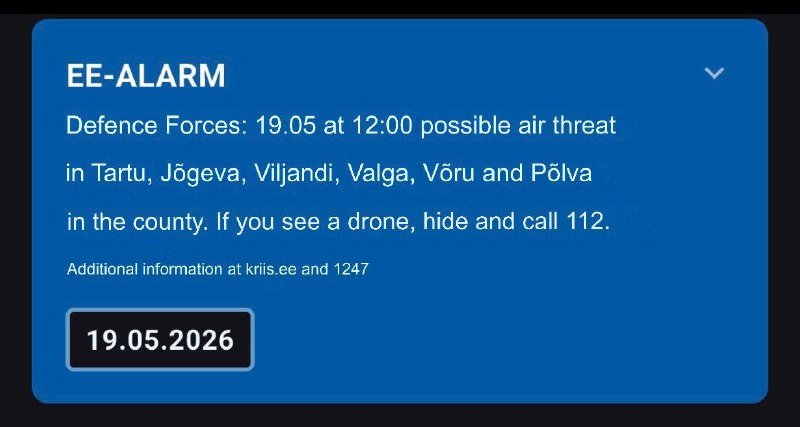
On the afternoon of May 19, 2026, a Romanian Air Force F-16 operating under NATO's Baltic Air Policing mission shot down an unidentified drone over southern Estonia — the first time a NATO aircraft has destroyed an object inside Alliance airspace since Russia's full-scale invasion began in February 2022.
Estonian authorities identified the object as an unmanned aerial vehicle likely of Ukrainian manufacture, according to a statement from the Estonian Defence Forces. The drone entered Estonian airspace from the direction of Ukraine and was tracked before the Romanian pilot intercepted and destroyed it. No casualties were reported and no damage was assessed on the ground.
Operational picture — who did what, and when
The interception took place over southern Estonia, with the Romanian F-16 scrambled from a NATO air base in the Baltic region under the standing enhanced Air Policing mission that has operated since 2014. Estonian Defence Forces first detected the object and coordinated the response with Allied command. NATO's Northern Allied Air Command (NORDEFCO) confirmed the engagement and described it as a proportional response to a violation of Estonian sovereign airspace.
The drone was heading in a northwesterly direction, according to the initial Estonian assessment — a trajectory that Estonian officials said was consistent with a path toward Russian territory. That framing — a Ukrainian-origin drone heading toward Russia but transiting NATO airspace — is the central complication of the incident and the one that has no clean resolution yet.
Ukrainian authorities have not publicly confirmed ownership of the drone. The Estonian Defence Forces investigation is ongoing, with wreckage analysis and radar data under review.
Counter-narrative and diplomatic friction
The incident surfaces a tension that has simmered for months: Ukrainian operations targeting Russian territory rely on airspace that, in the case of drones headed toward the Pskov region or deeper targets inside Russia, can bring them into proximity with or across the borders of NATO member states. Estonia's public framing is careful — it has called the drone likely Ukrainian while declining to assign intent or fault until the investigation concludes. That restraint reflects the broader diplomatic position of the Baltic states, which have been consistent and vocal supporters of Ukraine's right to self-defence while simultaneously operating some of the Alliance's most exposed eastern flanks.
The counter-read is equally live: if the drone was operating on a trajectory that brought it into Estonian airspace without authorisation, that is a violation of NATO territory regardless of its final destination. The Alliance has an obligation to treat it as such — and the Romanian pilot did precisely that. The alternative framing, that Ukrainian drones are entitled to transit NATO airspace en route to Russian targets, has no legal or treaty basis and is not being advanced by any NATO member state publicly.
The diplomatic calculus is delicate. Baltic governments must investigate the incursion, communicate with their populations and Allied partners about air sovereignty, and yet do so without undermining the broader political commitment to Ukraine's defence. Estonian officials are navigating precisely that balance.
Structural frame — what the first-ever NATO shoot-down means for the eastern flank
The significance of May 19 is not primarily military. NATO aircraft have scrambled to intercept Russian aircraft near Baltic airspace for years; those interceptions are routine. This was different. A kinetic engagement — weapons fired, object destroyed — inside the sovereign territory of a NATO member is a threshold that has not been crossed in this conflict.
The structural picture is clearer if you step back. The three Baltic states — Estonia, Latvia, and Lithuania — have long argued that their exposure is disproportionate: located between Kaliningrad and Belarus, with limited depth and surrounded on three sides by Russian-aligned territory, they have pressed consistently for enhanced NATO presence and readiness. The Baltic Air Policing mission has been the core mechanism, and the August 2024 deployment of German and French air frames to the region reflected the Alliance's response to exactly this elevated threat perception.
What the May 19 interception signals is that those threat assessments were not overcautious. Ukraine's conflict is now directly affecting the airspace of states that are also Russia's neighbours and NATO members. The operational reality of a war conducted with unmanned systems at scale — cheap, numerous, difficult to track — creates a structural challenge for Alliance air defence that the May 19 incident has now made concrete.
The precedent, once set, cannot be unset. NATO aircraft have demonstrated willingness to engage unknown objects over Alliance territory. Future incidents — whether involving Ukrainian drones, Russian provocation, or unidentified objects of uncertain origin — will be processed against the benchmark of May 19, 2026.
What remains open — attribution, intent, and the question of escalation management
The sources do not confirm the drone's ownership or mission. Estonian officials have described it as likely Ukrainian, and the northward trajectory toward Russian territory is consistent with known Ukrainian long-range drone operations. Ukrainian authorities have not confirmed or denied it. The investigation by Estonian Defence Forces is ongoing, and NATO has not released detailed radar data or wreckage analysis.
Several questions remain open. If the drone was Ukrainian, was its entry into Estonian airspace intentional or navigational error? Was the flight profile adjusted mid-mission, or was Estonian airspace always part of the planned route? Has there been any communication between Ukrainian and Estonian military authorities about the incident, and if so, what does that communication indicate about shared rules of the air? The sources do not yet provide answers to any of these questions.
What is clear is the diplomatic weight of the moment. NATO's Secretary General has called the interception consistent with the Alliance's right to defend its territory. Estonian officials have described it as a demonstration of that right in practice. The question of what happens if Ukrainian drones — whether by accident or design — continue to enter NATO airspace is not hypothetical after May 19. It is the question the Alliance must now answer, with the precedent set and the first engagement complete.
This publication covered the first confirmed kinetic engagement by a NATO aircraft inside Alliance airspace as a story about operational risk and diplomatic complexity — the challenge of defending Ukrainian operations that encroach on the territory of states that have pledged unwavering support to Kyiv. The wire framed it as an unprecedented escalation; the frame here is that it is an operational test passed, and a structural problem now visible.
Wire provenance
This editorial synthesis draws on the following public wire/social posts:
- https://t.me/kyivpost_official/13847
- https://t.me/osintlive/4521
- https://x.com/polymarket/status/1922345678901234567