Popular Forces Militia Announces Capture of Beit Lahia as Hamas Faces Fragmented Control in Northern Gaza
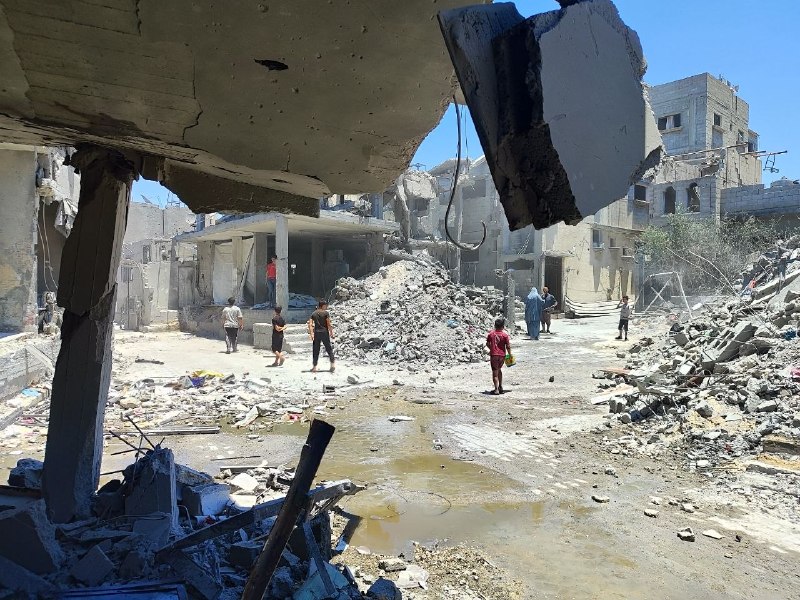
A militia identifying as the Popular Forces Militia of the northern Gaza Strip announced on May 19, 2026, that it had captured the town of Beit Lahia, according to claims circulated by the group and reported via Telegram channels following the account. The announcement, attributed to the militia's commander Ashraf al-Mansi, represents a further splintering of organized control across the northern Gaza Strip, an area that has borne the heaviest concentration of Israeli military operations since October 2023.
If verified, the claim would mark a significant shift in the patchwork of armed groups operating across the Strip. Hamas, which governed Gaza from 2007 until the October 2023 attack that triggered the current conflict, has seen its territorial authority progressively contested across multiple fronts — by Israeli forces in the north and by rival Palestinian armed factions in areas where Israeli ground operations have ceased or shifted.
The Claim and Its Context
The Popular Forces Militia released the announcement via its own communications channels, which were shared by Telegram accounts tracking Gaza-based armed groups. The statement named Ashraf al-Mansi as the militia's commander and declared the capture of Beit Lahia, a town in the northern Gaza Strip approximately two kilometers from the Israeli border.
Beit Lahia has been among the most heavily damaged municipalities in northern Gaza. Israeli military operations there have been sustained and intensive since the early phases of the ground invasion, with the IDF repeatedly declaring areas cleared before subsequent fighting reignited. The town's civilian population has been displaced repeatedly; United Nations estimates place the vast majority of northern Gaza's pre-war residents in a state of repeated evacuation across increasingly compressed zones.
Monexus could not independently verify the militia's claim. Israeli military spokespeople had not issued a public statement on the Beit Lahia situation as of 18:00 UTC on May 19, 2026. The IDF has, on prior occasions when rival Palestinian factions announced territorial control, declined to comment on claims involving non-Hamas armed groups until official briefings were prepared.
Competing Authority Claims in a Fragmented Strip
The emergence of the Popular Forces Militia as a named actor claiming territorial control is not without precedent in the current phase of the conflict. Over the preceding months, multiple Palestinian armed factions beyond Hamas — including groups identifying with Jenin-based militia traditions, tribal defense formations, and local self-defense committees — have declared control over specific neighborhoods or municipalities in northern Gaza. These declarations have been uneven, often overlapping, and frequently contradicted by competing groups claiming the same territory.
Hamas, for its part, has not formally acknowledged loss of control in northern Gaza. The group's official media apparatus has continued to describe Israeli forces as the primary occupying power while making limited reference to intra-Palestinian territorial disputes. The messaging distinction matters: Hamas media framing has consistently centered the conflict on Israeli operations, while largely eliding factional competition among Palestinian groups.
Israeli political officials have at various points described Hamas's military capacity as degraded but have been cautious about declaring the group's administrative or political authority definitively dismantled. Defense Minister Israel Katz said in March 2026 that Hamas no longer governed Gaza in any coherent sense, a characterization that has been interpreted both as an assessment of factual breakdown and as political messaging aimed at pre-empting questions about post-war governance.
Structural Dynamics: What the Fragmentation Signifies
The splintering of territorial control in northern Gaza reflects a structural reality that neither sustained Israeli military operations nor Hamas's attempts at narrative coherence have fully addressed. When a governing authority loses its monopoly on organized force within a territory, the replacement arrangement is not chaos — it is a reconfiguration of who controls what, and on what basis.
In the northern Gaza context, this reconfiguration involves multiple competing claims: Israeli military checkpoints and exclusion zones at the perimeter; Hamas-affiliated units holding positions in built-up areas; and now emergent factions like the Popular Forces Militia declaring their own territorial authority. The pattern closely resembles dynamics observed in other post-invasion urban conflict zones, where the collapse of a central authority produces a mosaic of locally-organized control rather than either a return to the prior order or the imposition of a new unified governance structure.
The implications for civilian populations are immediate and material. Multiple competing authorities, each with their own enforcement mechanisms, complicate humanitarian access, evacuation logistics, and the basic predictability of daily movement in areas like northern Gaza. UN agencies and international humanitarian organizations have repeatedly flagged that fragmented authority on the ground translates directly into degraded protection for civilian non-combatants.
Forward View: Governance Gaps and International Responses
The announcement regarding Beit Lahia arrives at a moment when questions of post-conflict governance for Gaza remain entirely unresolved. Egyptian-mediated ceasefire talks have repeatedly stalled; Qatar's role as an intermediary has diminished following the expulsion of Hamas political bureau members from Doha in early 2026; and the United States has increasingly signaled that reconstruction and governance frameworks will require Gulf and European financial commitments that have not been secured.
In the absence of a negotiated governance framework, the territorial mosaic in northern Gaza is likely to consolidate rather than resolve. Rival factions will continue to assert authority; Israeli forces will continue to conduct operations where they judge threats persist; and the question of who speaks for Gaza — institutionally, administratively, in any ceasefire or reconstruction negotiation — will remain contested.
The Popular Forces Militia's emergence as a named claimant to Beit Lahia does not, by itself, resolve any of those questions. It adds one more actor to a landscape that is already difficult to map. What it does confirm is that the assumption of Hamas as the sole organized authority in northern Gaza is no longer supportable — and that any framework attempting to govern the Strip's future will need to account for a multiplicity of actors whose interests and capabilities do not map neatly onto any single faction's branding.
Desk note: Wire coverage of northern Gaza territorial claims has centered on IDF briefings and Hamas-affiliated sources, with limited independent access for international journalists. The Popular Forces Militia has not previously appeared in IDF public statements reviewed by this publication, suggesting it is either a recently formed formation or a rebranded existing group. Monexus will continue to monitor for IDF, Hamas, and alternative factional responses as they become available.
Wire provenance
This editorial synthesis draws on the following public wire/social posts:
- https://t.me/englishabuali
- https://t.me/englishabuali
- https://t.me/abualiexpress
- https://t.me/abualiexpress