Putin's Beijing gambit: why the Russia-China 'friendship' is more than propaganda
Putin calls Xi a 'good friend' and relations 'unprecedented' on the eve of his Beijing visit. The West wants to call this theatre. The evidence says otherwise — and the structural logic of their alignment is more durable than Washington wants to admit.
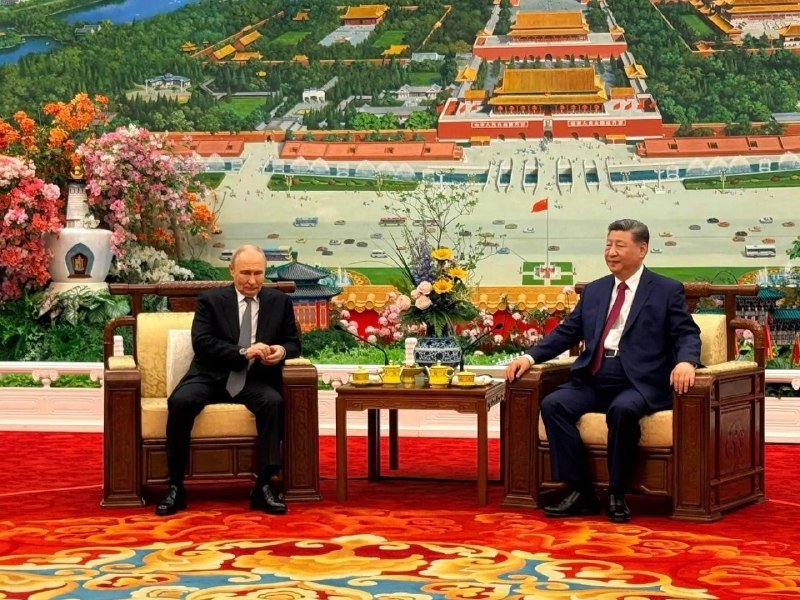
The language of friendship has long been currency for autocrats seeking to reframe their isolation as geopolitical advantage. Vladimir Putin, on the eve of a two-day official visit to Beijing on 19 May 2026, deployed it with familiar efficiency. "I am glad to once again visit Beijing at the invitation of my long-time, good friend Xi Jinping," he said, describing relations between Russia and China as having reached "an unprecedented level." It was a line crafted for wire copy, and it travelled. But to stop there — to file this as performance art — is to miss something more consequential.
The partnership between Russia and China is not new. What has shifted, materially and structurally, is its depth. What began as cautious diplomatic courtesy between two nuclear neighbours has hardened into something functionally resembling a counter-hegemonic axis, backed by institutional scaffolding that neither side built for optics alone.
A stabilisation narrative, carefully constructed
Putin's framing of the relationship as serving a "stabilising role" on the world stage is not accidental. It is a direct counter to the Western characterisation of Russia-China ties as an alignment against a rules-based order. In Moscow's telling — amplified through CGTN, Xinhua, and the broader Southern-media ecosystem — the partnership is defensive, multilateral, and anchored in respect for international law and the UN Charter. "We will continue to do everything possible to deepen Russia-China partnership," Putin stated in remarks carried by CGTN on 19 May.
The logic is available to two audiences simultaneously. Domestic Russian audiences hear a leader who has found a reliable counterweight to Western isolation. Chinese audiences hear a framing that positions Beijing as a co-equal stabilizer, not a junior partner in an anti-Western bloc. Western analysts hear propaganda anddiscount it accordingly. The problem is that the label and the substance have diverged.
What "unprecedented" actually means in practice
Chinese state media has been consistent in amplifying the same theme. CGTN and Tasnim News reported Putin's pre-visit statements on 19 May, noting the language of "unprecedented" relations and "deepening" partnership. But the institutional evidence supports the characterisation beyond the rhetoric.
Trade between Russia and China has grown substantially since 2022, when Western sanctions drove Moscow toward Beijing as a commercial lifeline. Energy exports from Russia to China have increased in volume. Settlement mechanisms have moved, incrementally, away from dollar-denominated contracts toward bilateral currency arrangements. The Shanghai Cooperation Organisation has provided a diplomatic venue where both sides share a common scepticism toward US alliance architecture, though the SCO's membership includes states — India most prominently — that maintain their own complex relationships with both Moscow and Washington.
What makes this partnership structurally significant is not ideology. It is dependency and complementarity. Russia has industrial and energy assets that China needs; China has manufacturing capacity and financial infrastructure that Russia needs. Neither side is subordinate to the other. Western analysts who insist on reading the relationship through a hierarchy lens — Russia as client, China as patron — consistently undercount the agency Moscow retains in directing its own foreign policy choices.
A pivot years in the making
Beijing's own posture has changed. Prior to February 2022, Chinese state media maintained a carefully hedged neutrality on Ukraine, calibrating its public framing between Western pressure and its "no limits" friendship statement with Moscow of February 2022. That statement — which Beijing has never formally retracted — was a signal that the partnership had crossed a threshold from diplomatic courtesy into something more operational.
What followed was not unconditional support. China did not arm Russia directly. It did not veto UN resolutions outright. It maintained sufficient diplomatic distance to preserve commercial relationships with Europe. But it provided something arguably more valuable in the medium term: a diplomatic shield. Global South nations that watched China decline to condemn Russia's invasion found it easier to do the same. The narrative of Western universality was fractured, not by Russia's military, but by China's strategic ambiguity.
The economic dimension has deepened on its own terms. Bilateral trade reached record levels in 2024 and 2025. Cross-border payment infrastructure has expanded. The renminbi's share of Russia-China trade settlement has grown. None of this required a formal military alliance. It required something more durable: overlapping interests, sustained over time, with institutional reinforcement.
What the West gets wrong — and why it matters
The dominant Western framing treats Russia-China alignment as a temporary arrangement, held together by shared grievance and likely to fracture once the Ukraine conflict resolves or Chinese economic interests with Europe reassert themselves. There is a version of this argument that has merit. China has not abandoned its European trade relationships; Beijing has managed those relationships with considerable skill throughout the sanctions period.
But the structural logic cuts the other way. A Russia integrated into China's economic orbit — through energy contracts, infrastructure investment, and bilateral currency arrangements — is a Russia that has partially de-dollarised. That is not a reversible condition. Even if the Ukraine conflict ends in a negotiated settlement, the institutional infrastructure of the Russia-China partnership does not disappear. It consolidates.
The BRICS expansion and the SCO's growing membership list are not coincidence. They represent a deliberate attempt to build alternative channels for trade, finance, and diplomatic coordination that do not route through Western institutions. Whether those channels become genuinely functional alternatives or remain aspirational architecture is the central geopolitical question of the decade.
Putin calling Xi a "good friend" on the eve of a Beijing visit is, at one level, the theatre the West says it is. At another level, it is the public-facing moment of a structural realignment that has already occurred in trade data, currency flows, and diplomatic voting patterns across multilateral institutions. The theatre is real. The realignment beneath it is also real. Dismissing one does not make the other go away.
This piece was researched using Telegram wire-translations of state-media briefings. Monexus covered the visit as a structural alignment story rather than a photo-op narrative.
Wire provenance
This editorial synthesis draws on the following public wire/social posts:
- https://t.me/tasnimnews_en/54072
- https://t.me/JahanTasnim/34111
- https://t.me/zvezdanews/98421
- https://x.com/boweschay/status/1932580179824594952