Putin Lands in Beijing for Two-Day Visit as Russia-China Partnership Stresses Western Sanctions Regime
Russian President Vladimir Putin arrived in Beijing on May 19 for a two-day state visit, meeting Chinese Foreign Minister Wang Yi at Capital Airport in a ceremony that underscored the deepening strategic partnership between the two powers as both face sustained Western economic pressure.
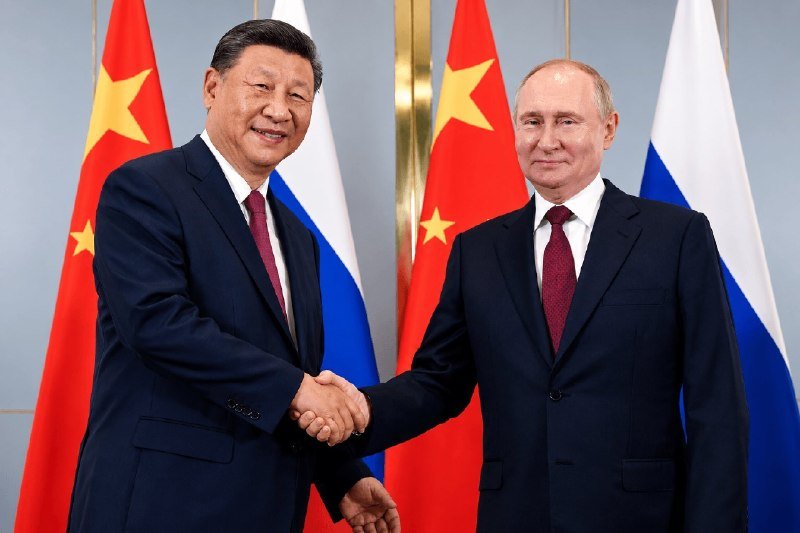
Russian President Vladimir Putin touched down at Capital Airport in Beijing on the afternoon of May 19, 2026, greeted at the foot of the plane by Chinese Foreign Minister Wang Yi in a full state reception that reflected the ceremonial weight both governments attach to this visit, according to multiple reports from geostrategic news channels monitoring the visit in real time.
The two-day trip places Putin in the Chinese capital the same week his administration is managing renewed Western efforts to tighten enforcement of the sanctions regime imposed on Moscow following its 2022 invasion of Ukraine. Chinese Foreign Minister Wang Yi personally oversaw the welcoming ceremony, an honorific signal that Beijing views this visit as a diplomatic priority — not a routine courtesy call. Formal consultations with President Xi Jinping are scheduled for May 20, completing the protocol sequence of arrival, bilateral working sessions, and a summit-level meeting.
What the visit confirms, yet again, is that Western efforts to diplomatically isolate Russia have produced a counter-effect: a closer operational alignment between Moscow and Beijing on issues ranging from energy trade to financial infrastructure, technology cooperation, and shared positions in multilateral forums. The sanctions regime has not collapsed, but it has not reversed the trajectory either.
The Agenda: Trade, Finance, and International Consultations
Public statements from the Chinese foreign ministry and Russian state media indicate the consultations will cover trade volumes, energy cooperation, and what Beijing describes as "important international issues" — diplomatic language that encompasses coordinated positions in the UN Security Council, BRICS frameworks, and broader geopolitical signaling. Neither side has released a formal agenda document, but the pattern of prior Putin-Xi summits offers a reliable guide: energy contracts, currency swap arrangements, and joint infrastructure proposals tend to dominate the economic column, while mutual diplomatic support — on Taiwan, on Ukraine, on sovereignty questions broadly — fills the political one.
The trade relationship has grown substantially since 2022. Bilateral trade between Russia and China reached record levels in 2024, driven largely by energy exports Moscow rerouted from European markets and Chinese manufactured goods filling retail and industrial gaps created by Western brand withdrawals. Chinese automaker Chery reported in 2025 that Russia had become one of its top export markets; BYD expanded its dealer network across Russian cities during the same period. These commercial realities give the partnership a material basis that survives regardless of whatever political friction might exist below the surface.
On the financial side, both governments have deepened use of the Chinese yuan and local-currency settlement mechanisms in bilateral trade. The yuan's share of Russia-China trade settlement has risen sharply since Western correspondent banks withdrew from Russian markets, a trend that serves Beijing's long-stated goal of internationalizing its currency while giving Moscow a functioning commercial channel that circumvents dollar clearing infrastructure.
The Counter-Narrative: What the Partnership Is Not
It would be a mistake to read the Putin visit as evidence of a fully unified Russo-Chinese bloc. The relationship is asymmetric — China is the larger economy, and Moscow is the more isolated party seeking to diversify away from a European trade orientation it can no longer rely upon. Chinese state banks and commodity traders have shown a consistent preference for plausible deniability: they do business with Russia, but rarely in ways that invite secondary sanctions exposure. Several Chinese logistics and trading entities have exited or curtailed Russian operations since the United States issued clearer guidance on secondary sanctions risk in 2024.
Beijing's public framing of its Russia relationship has also been notably careful. Chinese officials have repeatedly described their partnership as "not targeted at third parties" — diplomatic boilerplate, but also a genuine reflection of China's preference for strategic flexibility rather than formal alliance lock-in. China has not recognized the annexed Ukrainian territories as Russian, has not provided weapons to support the invasion, and has maintained nominal support for UN-brokered peace frameworks, however nominal that support has been in practice.
Western analysts who view the Russia-China relationship as a monolithic bloc tend to project a coherence that does not exist. The partnership works when interests align — on counterbalancing dollar dominance, on shared skepticism of US security alliances in Asia, on mutual diplomatic cover in multilateral settings — and it strains when they do not. Beijing has economic interests in good relations with both Moscow and with European markets, Southeast Asian neighbors, and a US trading relationship that, while frayed, remains commercially significant.
Structural Context: The Multipolar Architecture Taking Shape
The visit arrives at a moment when the architecture of global governance is visibly fragmenting along lines that Western policymakers once assumed were permanent. BRICS — now expanded to include Saudi Arabia, the UAE, Egypt, Ethiopia, and Iran — is increasingly a venue for discussions about payment systems, reserve currency diversification, and shared infrastructure financing that were previously confined to IMF and World Bank corridors. The Shanghai Cooperation Organisation has absorbed new members and deepened security cooperation frameworks. The New Development Bank, BRICS' development lender, has increased lending in local currencies.
These institutions are not yet alternatives to the Bretton Woods order, but they are creating parallel infrastructure that gives states a choice about which system to engage. For Russia, which faces asset freezes and correspondent banking restrictions within the dollar system, that choice is existential. For China, which has not been cut off from Western financial infrastructure but has invested heavily in alternatives as insurance, the infrastructure represents long-term strategic positioning.
The structural logic is not difficult to follow: when the dominant economic power deploys its financial system as a weapon — through sanctions, asset freezes, and correspondent banking exclusion — rational actors will seek alternatives. The question is not whether that response is "anti-Western" in some ideological sense but whether it reflects the predictable behavior of states protecting their own interests against coercive pressure. Beijing's position is that multipolarity serves Chinese interests; Moscow's position is that it serves as a lifeline. Both assessments are correct from each capital's perspective.
Stakes: Who Wins and Who Loses If This Trajectory Continues
The clearest winner, if the Russia-China partnership deepens along its current trajectory, is Moscow: it gains a reliable large-volume energy buyer, access to Chinese technology and manufactured goods, and diplomatic cover in forums where Western states would otherwise isolate it. Beijing gains a junior partner that is highly motivated to cooperate and that has no alternative large-power patron — a dynamic that gives China negotiating leverage even as it deepens cooperation.
The clearest loser is the Western sanctions architecture as currently constructed. Sanctions that were designed to impose economic costs sufficient to alter Russian behavior have not produced that outcome. The regime remains in place and continues to exert economic pressure, but it has not generated the diplomatic or economic collapse its architects anticipated. The more China-Russia trade operates in dollar-alternative settlement systems, the less leverage the United States has to enforce compliance by third-party states.
European energy consumers face a more indirect but real consequence: the rerouting of Russian pipeline gas away from Europe and toward China creates tighter supply conditions in global LNG markets, raising prices for buyers in Asia and Europe alike. This is a structural effect of the Russia-China energy alignment, not an intentional Chinese policy, but it is a consequence nonetheless.
For the broader multipolar project, the stakes extend to whether the institutional alternatives being built — BRICS payment mechanisms, local-currency settlement infrastructure, development lending outside the Bretton Woods institutions — can achieve sufficient scale and reliability to give mid-tier states a genuine choice. If they can, the next decade will see a more fragmented global financial architecture, with multiple clearing systems, multiple reserve currency options, and more space for states to navigate between competing great-power relationships without binary alignment.
What remains uncertain is whether the current moment represents a durable structural shift or a temporary alignment of convenience. Beijing's commercial caution toward full-spectrum Russian integration suggests Chinese leaders are not prepared to sacrifice their broader global economic relationships for the sake of the Moscow partnership. The visit confirms that the partnership is real and consequential. Whether it is permanent depends on factors — Western policy evolution, Chinese economic self-interest, the trajectory of the Ukraine conflict — that the sources do not fully illuminate.
Wire provenance
This editorial synthesis draws on the following public wire/social posts:
- https://t.me/DDGeopolitics/1243
- https://t.me/DDGeopolitics/1241
- https://t.me/FarsNewsInt/3891
- https://t.me/tasnimnews_en/8762
- https://t.me/JahanTasnim/4518