Putin's Moscow-Beijing Axis Is No Marriage of Convenience — It's the Architecture of a New Order
Putin's declarations of Russia-China friendship are dismissed in Western capitals as propaganda. That misreads the signal. The partnership has real institutional substance, and its implications for the dollar-based financial order deserve harder scrutiny than they receive.
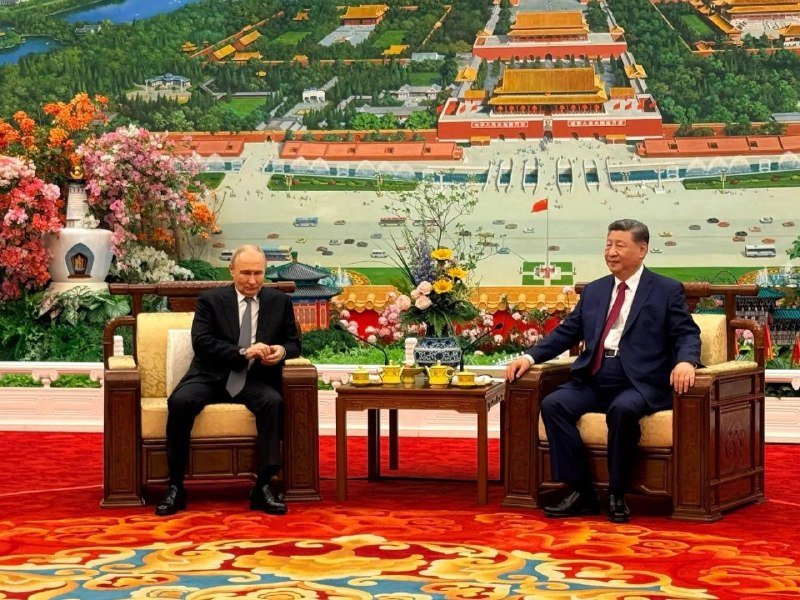
The language out of Moscow this week left little room for ambiguity. Speaking on May 19, 2026, Putin described Russia and China as looking "confidently to the future" while "actively developing communications in the fields of politics, economics and defense." The relationship, he said, helps both nations "develop and implement the most daring plans for the future." The phrasing matters. "Most daring plans" is not the lexicon of a provisional partnership sustained by shared grievance. It is the vocabulary of long-term strategic architecture.
Western policy circles have trained themselves to hear Putin's declarations as performance — theater calibrated for domestic audiences and diplomatic effect. That reading is comfortable. It is also increasingly wrong.
What the Partnership Actually Is
The Russia-China relationship has deepened across three distinct vectors that the May 19 statements made explicit: political coordination, economic integration, and defense cooperation. These are not parallel tracks. They are interlocking systems.
On the political level, Beijing and Moscow have built a pattern of UN Security Council alignment, bilateral summitry, and rhetorical solidarity that has become structural rather than situational. China's position on Ukraine — framed not as endorsement of the invasion but as critique of NATO expansion and Western unilateralism — is not incidental diplomatic hedging. It is a coherent position that serves Beijing's broader interest in establishing that international norms are not universally determined by Washington and its allies.
Economically, the relationship has moved well beyond commodity互补. Trade between the two nations has grown substantially since 2022, when Western sanctions accelerated Moscow's pivot toward Beijing as a commercial counterparty. Chinese firms have expanded presence in Russian markets vacated by Western multinationals. The ruble-yuan trading volume has increased. Crucially, a growing share of Russia-China trade now settles in currencies other than dollars — not because either government announced a de-dollarization strategy, but because sanctions regimes made dollar settlement impractical and the alternative became operational reality.
Defense cooperation is the third vector, and the one Western analysts watch most closely. Joint military exercises, intelligence sharing arrangements, and technology transfer discussions constitute a relationship that functions well beyond diplomatic pleasantries.
The American Reading Problem
Washington's difficulty with the Moscow-Beijing axis is not primarily military. It is conceptual. American foreign policy has long operated on the assumption that the international order it constructed after 1945 is both legitimate and stable — that other powers accept its premises even when they contest its specific decisions. The Russia-China alignment challenges that assumption at the level of first principles.
Neither Moscow nor Beijing has formally announced an intention to dismantle dollar hegemony. That framing, common in Washington think-tank discourse, overstates the clarity of their intent. What both governments have done is build alternative infrastructure — payment systems, commodity trading arrangements, bilateral currency agreements — that reduce their exposure to American financial power. The distinction matters. One is a declared project; the other is a functional adaptation.
This adaptation is more durable than declared projects. When a sanctions regime makes dollar-denominated transactions between two major economies impractical, the actors involved do not pause the relationship. They build workarounds. Those workarounds, once built, do not disappear when the political temperature cools. They become institutional. They become the baseline.
The Global South's Quiet Repositioning
The third dimension of this story is the one that receives the least attention in Western coverage: how third parties are reading the Moscow-Beijing alignment and adjusting their own calculations.
For a significant number of middle-income and developing economies, the Russia-China relationship does not register as a threat to stability. It registers as evidence that the Western-led order is not the only game in town. When nations like Saudi Arabia, the UAE, Brazil, and South Africa conduct trade in yuan or ruble-denominated agreements, they are not allying with Beijing or Moscow. They are preserving optionality — keeping their commercial relationships functional regardless of how US-China or US-Russia tensions evolve.
This is not ideological solidarity. It is risk management by sovereign states that have watched what happens to economies caught between great-power blocs — and have drawn entirely rational conclusions. The countries doing the most active hedging are not anti-American. They are pro-self-interest.
What Comes Next
The trajectory is not toward a neatly bifurcated world — a dollar bloc versus a yuan-ruble bloc. That is not how the international system works. What is emerging is a more textured landscape in which dollar-centric financial infrastructure remains dominant but is no longer monopolistic, in which major powers have built meaningful alternatives, and in which the cost of using dollar power as a foreign-policy instrument has increased because the alternatives are more developed than they were five years ago.
Putin's declaration of friendship with Beijing is, at one level, a statement of political intent. At a deeper level, it is an acknowledgment that the work has already been done. The infrastructure exists. The trade flows are real. The defense relationship functions. What remains is the continued accumulation of depth — more transactions, more institutional ties, more cases where actors choose the non-dollar alternative because it is the practical one.
Western capitals will continue to characterize the Russia-China partnership as a marriage of convenience sustained by opposition to the West. That framing is too convenient for its own good. It assumes the relationship lacks its own internal logic. The evidence suggests otherwise. The question for policymakers in Washington and European capitals is not whether the partnership is genuine — it increasingly is — but what structural changes are required in their own approach to a world in which it exists.
The boldest plans Putin referenced on May 19 are not abstract. They are already underway. The only question is whether the West is paying attention to what is being built, or only to the language used to describe it.
Wire provenance
This editorial synthesis draws on the following public wire/social posts:
- https://t.me/alalamarabic/
- https://t.me/alalamarabic/