Putin's Nuclear Drills Are a Signal of Weakness, Not Strength
Moscow's decision to launch nationwide nuclear exercises while simultaneously absorbing battlefield losses and infrastructure damage tells its own story about where Russia's position in this war actually stands.
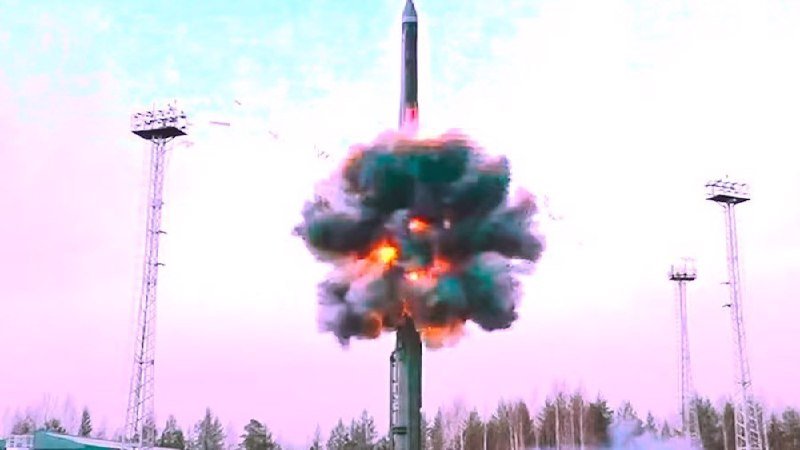
There is a particular kind of desperation that wears the costume of intimidation. On 19 May 2026, as Russian and Ukrainian forces exchanged fresh cross-border aerial strikes, Moscow announced and commenced nationwide nuclear drills — a display timed, as these displays always are, to project resolve at a moment when the evidence on the ground points in a different direction entirely.
The announcement came against a backdrop of setbacks that Western and Ukrainian open-source tracking has been documenting for months. Reuters reported the same day that Russian forces are dealing with burning oil refineries — damage to energy infrastructure that degrades domestic refining capacity — alongside a ground offensive that has repeatedly failed to achieve the advances the Kremlin had telegraphed. Ukraine's growing use of medium-range strike capabilities has forced Russian logistics, command nodes, and energy assets further from the front, compressing the operational space within which Moscow's forces function.
The port infrastructure strike at Izmail, on the Danube in Odesa Oblast, underscored the asymmetry. Russian authorities acknowledged they had downed four Ukrainian drones — which means Ukrainian drones reached the target. The pattern is not one of a military commanding the battlefield. It is one of a military scrambling to deny the appearance of being overwhelmed.
The Drills Are Theatre, Not Strategy
Nuclear exercises are communicative acts. Their value lies not in what they accomplish tactically but in what they signal politically — to domestic audiences, to wavering allies, and to adversaries whose sustained support for Kyiv has been the central variable in this conflict. Moscow has staged iterations of these drills at regular intervals since 2022, and each time the implicit message has been the same: we retain escalation options you cannot match.
The problem with that message, at this point in the war, is that it has been deployed so often that it has lost much of its adhesive quality. Western governments have not dramatically altered weapons supply policy in response to previous announcements. Ukrainian drone operators continue reaching infrastructure targets. The drills themselves consume resources and operational tempo without altering the terrain. What began as a credible deterrent signal has become, through repetition, something closer to a fixed cost of Russian domestic messaging — a ritual that audiences in Moscow and Washington alike have learned to read as ritual rather than as inflection point.
This is not to say the nuclear dimension is trivial. Any scenario in which Russian leadership perceives an existential threat — however defined — carries risks that rational-actor models struggle to capture fully. But the gap between what the drills signal on paper and what they accomplish operationally has widened considerably. A military that needed nuclear posturing to compensate for conventional shortcomings three years ago made sense. One that still needs it, after the attrition of four years of full-scale war, tells a more revealing story about where the balance of effective leverage actually sits.
The Battlefield Arithmetic Is Relentless
The Reuters reporting on Russia's operational problems is specific and cumulative. Burning refineries are not a cosmetic problem for a state that has already had to manage significant losses in downstream petroleum product exports. A stalling ground offensive, after the mobilized manpower and materiel investments of recent years, means the initiative has shifted — not entirely, not permanently, but measurably — toward a Ukrainian force that has systematically developed its medium-range strike capability into something approaching a decisive asymmetric tool.
Ukraine's use of medium-range systems — drones, rocket-assisted munitions, and guided rocket variants — has allowed its forces to strike Russian assets at distances that keep UkrainianLauncher tubes and personnel out of direct fire zones while imposing costs on Russian logistics. This is not a silver bullet. No single capability wins a positional war. But it is a consistent, compounding pressure that erodes the operational baseline of a force that began the invasion with overwhelming advantages in artillery, aviation, and numbers.
The Izmail strike itself is instructive. The port handles cargo — including military materiel — transiting from NATO-adjacent territory into southwestern Ukraine. Knocking it out or degrading it would, in conventional logic, be a high-value Russian target. What happened instead: four drones intercepted, port infrastructure damaged, Ukrainian drone operations evidently resumed or unaffected in aggregate. The exchange ratio, by Russia's own accounting, ran against Moscow.
Escalation Optics and the Western Audience Problem
One structural dynamic the drills are explicitly designed to exploit is the political sensitivity of Western governments to escalation narratives. The mechanism is familiar: every announcement of nuclear exercise, every reference to escalation options, generates a specific pressure within NATO capitals where constituency politics and defense-policy calculation intersect. The goal is not to trigger nuclear use — that outcome serves no rational Russian interest at present — but to create hesitation, to slow weapons deliveries, to create space between Western political cycles and the forward momentum of Ukrainian operations.
The record of that effort is mixed, and that mixed record is itself informative. Western arms supplies have continued, and in some categories expanded, across multiple political transitions in donor nations. The Leopard 2 debate, the ATACMS debate, the F-16 debate — each followed the same pattern: initial resistance, eventual authorization, continued support. The escalation ceiling has been redrawn several times without triggering the catastrophic Russian response that each redrawing was supposed to provoke.
This does not mean the ceiling is infinite. It does not mean Western publics will sustain current support levels indefinitely. It means that Moscow's nuclear signaling has failed to achieve the freeze effect it was designed to produce, and that its continued deployment as a primary tool of deterrence against Western intervention signals a diminishing stock of conventional levers.
What the Drills Cannot Obscure
The honest uncertainty in any assessment of this moment concerns not Russian capability but Russian calculations — specifically, the threshold at which a leadership that has invested its political legitimacy in the outcome of this war decides that the costs of accepting a frozen or degraded position outweigh the costs of further escalation. That is a variable no open-source analysis can resolve with confidence.
What the available evidence does support is a clearer-eyed reading of the drills themselves. They are not a measure of strength. They are a measure of the options available when conventional strength has been substantially consumed. A state with a dominant conventional position does not need to stage nuclear exercises on the same day it is absorbing infrastructure losses on the Danube. A military that controls the tempo of the battlefield does not announce nationwide drills in response to that battlefield's behavior.
Moscow has not collapsed. It has not lost in any decisive sense. But it is fighting a war of attrition in which the trend lines — in equipment, in manpower, in infrastructure exposed to medium-range strike — run against it. The drills on 19 May are, at bottom, an admission of that reality in the only language Russian leadership appears to believe the West will still hear.
Wire provenance
This editorial synthesis draws on the following public wire/social posts:
- https://x.com/reuters/status/2056611401632751616
- https://x.com/reuters/status/2056635097768693760