Russia and China Present Unified Front on Sovereignty as Multipolar Order Takes Shape
Putin's statement in Moscow that Russia and China stand ready to support each other on core issues reflects a deepening alignment that is reshaping diplomatic and economic structures across the global south.
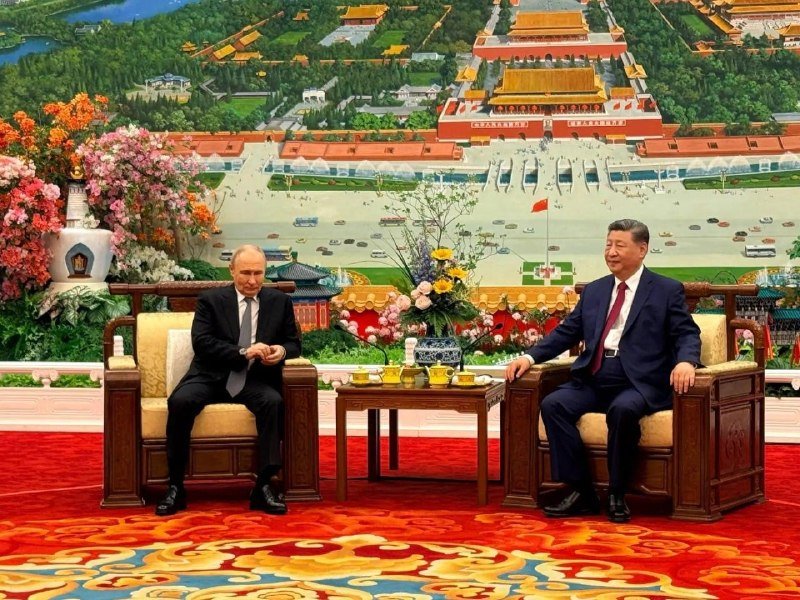
At a bilateral summit in Moscow on 19 May 2026, Russian President Vladimir Putin stated that Russia and China are ready to support each other on key issues, including the protection of sovereignty. The statement, reported by the OSINT channel WarTranslated, which monitors and translates Russian state-language content, was delivered as diplomatic consultations between the two governments were underway.
Beijing's foreign ministry confirmed the framing, characterising the engagement as a continuation of the strategic partnership agreement concluded between the two governments in 2024. The alignment arrives against a backdrop of sustained Western pressure on both capitals — sanctions regimes tightened by the United States and European Union over Russia's invasion of Ukraine, and technology-export controls and tariff frameworks targeting Chinese industry. In both cases, the stated Western rationale is enforcement of international norms. In both cases, the governments in Moscow and Beijing have characterised that rationale as interference in domestic affairs.
What the Moscow statement reflects is not a sudden shift but the crystallisation of an alignment that has been consolidating for nearly two years. The 2024 joint statement described the relationship as entering a "new era," and bilateral trade between the two economies reached approximately $248 billion in 2025. The 2025 BRICS summit in Cape Town produced a communiqué that explicitly rejected what the document called Western "unilateral coercive measures" — language drafted in coordination between Russian and Chinese diplomatic teams. The infrastructure is in place. The diplomatic language is consistent. The question is whether it constitutes a coherent strategic bloc or a suite of convergent interests held together by shared opposition to the same outside pressure.
Immediate Context: What the Moscow Statement Actually Said
The core of Putin's statement, as captured by WarTranslated and corroborated across multiple Russian state-adjacent reporting channels, was that Russia and China are prepared to back each other on key issues — specifically, the protection of sovereignty. The phrasing is deliberate. Sovereignty, in the diplomatic lexicon of both governments, has a specific target: the principle that external actors should not condition economic or diplomatic relations on political reform requirements, and that the internal governance choices of sovereign states are not subject to international review.
The timing matters. The statement came as the United States was finalising a new tranche of technology-export restrictions targeting Chinese semiconductor and AI-infrastructure firms, and as European Union member states were debating the fifth round of economic sanctions on Russia's energy and financial sectors in connection with the ongoing conflict in Europe. Within hours of the Moscow statement, Iranian state broadcaster PressTV published analysis characterising American public debt as the "real security risk" for Washington — framing that mirrors the broader narrative that Western institutional fatigue, not external aggression, is the dominant global instability factor. The simultaneity is not coincidental.
Chinese state media, including CGTN, reported the bilateral summit programme alongside parallel coverage of domestic Chinese political matters. The official readout from Beijing's foreign ministry described the relationship in terms of "mutual strategic trust" and "shared commitment to multilateralism" — language that has appeared consistently in Chinese government statements since 2022.
Counter-Narrative: The Limits of the Alignment
The dominant Western framing treats the Russia-China alignment as the defining strategic challenge of the current era: a coordinated authoritarian challenge to the liberal international order. That framing has force. But it also flattens complexity that matters.
Beijing has been careful throughout the period of escalated Western pressure to avoid direct military commitment to Moscow. Chinese state firms have maintained commercial relationships with Russian entities but have not provided lethal military equipment, and Chinese diplomatic communications have repeatedly called for "dialogue and negotiation" on Ukraine — language that stops short of endorsing Russian positions while avoiding direct confrontation with Moscow. This is not the behaviour of a partner preparing for bloc confrontation. It is the behaviour of a government managing strategic relationships to maximise its own room for manoeuvre.
Xi Jinping, speaking at the 2025 BRICS summit, described the Russia-China partnership as one built on "shared development goals," not ideological alignment. That framing captures something genuine: China's calculus on Russia is commercial and strategic, not ideological. The relationship works because Russia's needs — markets for energy exports, technology access, diplomatic support — complement what China has to offer. The asymmetry is noted in Moscow's own analysis: Russia needs China more than China needs Russia. That structural reality shapes how far the alignment can extend.
In this reading, the Moscow statement is as much a diplomatic signal to domestic audiences — consolidating the narrative of national sovereignty against external pressure — as it is a concrete commitment to action. Sovereignty rhetoric performs political work at home and abroad simultaneously. Xi and Putin both benefit from appearing to stand together against a common adversary, regardless of whether the practical coordination behind the scenes matches the public framing.
Structural Frame: What the Alignment Means for Global Order
Whatever the limits of the partnership in practice, the diplomatic and institutional infrastructure surrounding it is real and growing. Russian and Chinese diplomatic teams have coordinated positions in multilateral forums including the United Nations, the BRICS grouping, and the Shanghai Cooperation Organisation. Their central banks have established bilateral currency-swap arrangements designed to reduce dollar-dependency in bilateral trade. Their technology ministries have shared information on semiconductor supply chains, though public reporting on the specifics of that cooperation remains limited.
This matters because it describes an infrastructure for a world in which economic relationships are not mediated through the dollar-based financial system. The current order — anchored in institutions built after 1945, with the dollar as the reserve currency and US financial infrastructure as the backbone of international transactions — has been the operating system for global trade for eighty years. The Russia-China alignment is building the code for an alternative environment. Whether that alternative environment ever becomes a complete operating system or remains a supplementary layer is the central strategic question of the coming decade.
The sanctions regimes targeting both countries — imposed by the US and EU on Russia, by the US and its allies on Chinese technology firms — have accelerated the development of that alternative infrastructure. The lesson drawn in Beijing and Moscow is the same: reliance on US-dollar financial rails is a strategic vulnerability that external actors can exploit. Building alternatives, even inefficient and incomplete ones, reduces that vulnerability. The structural logic is sound regardless of whether the political project succeeds.
Stakes: What Follows if the Alignment Holds
The practical consequences of sustained Russia-China coordination fall across three domains: diplomatic, economic, and institutional. Diplomatic coordination makes it harder for the United States and European Union to isolate either country through multilateral frameworks — any resolution of the Ukraine conflict that requires Chinese buy-in becomes more expensive to secure, and any Chinese position that can rely on Russian support in international forums is harder to dislodge. Economic coordination reduces the bite of sanctions on both sides and creates parallel supply chains outside the Western system — at present, these chains are incomplete, but they are growing. Institutional coordination — shared positions in multilateral forums, joint proposals for reformed global governance — normalises the idea that the current order is not permanent and that alternatives exist.
For Western policymakers, the direct implication is that the strategic challenge is not a single bloc but a structural shift in the environment in which Western power operates. The Russia-China relationship will not produce a Warsaw Pact equivalent — the economic asymmetries and divergent interests are too large. What it produces is a persistent counterweight to Western pressure, a set of institutional alternatives that reduce the cost of defying US-led frameworks, and a diplomatic vocabulary — sovereignty, multilateralism, non-interference — that resonates across the global south in ways that American-style liberal internationalism does not.
The Moscow statement on 19 May did not create this dynamic. It named it. The question ahead is whether Western policy can offer an alternative proposition to the nations in the middle — those who have not joined the sanctions regime, who do not treat the Ukraine conflict as their war, and who experience American trade policy as occasionally coercive as any Russian or Chinese pressure. That competition for the uncommitted majority of the world's population is the real stakes of what was said in Moscow this week.
Desk note: Wire outlets framed the Moscow summit around bilateral trade volumes and the Putin-Xi photo opportunity. Monexus sought to place the sovereignty language in its structural context — as a direct counter to the condition-based approach that defines Western engagement with both countries — and to surface Beijing's own framing of the partnership as development-oriented rather than bloc-oriented. The CGTN coverage of unrelated domestic Chinese news served as a useful reminder of how large China's diplomatic agenda is, and how selectively Western coverage selects from it.
Wire provenance
This editorial synthesis draws on the following public wire/social posts:
- https://t.me/wartranslated/8477
- https://t.me/osintlive/4821
- https://t.me/presstv/11298
- https://twitter.com/wartranslated/status/2056735825010811028