Trump's Iran Pause Exposes the Hollow Core of 'Maximum Pressure 2.0'
Hours after US officials hinted at imminent military action against Iran's nuclear facilities, the White House pivoted to talk of peace. The zigzag reveals less about Tehran's intentions than about the structural incoherence of Washington's own negotiating posture.
On 18 May 2026, US President Donald Trump told reporters at the White House that his administration had paused a planned military strike on Iran — hours after US officials had signaled that such action was imminent. The reversal came, Trump said, after Tehran transmitted what his administration described as a peace proposal. "There is now a very good chance of getting a deal," the President stated, according to a Reuters report published at 07:19 UTC that morning.
The about-face landed in the middle of a geopolitical sequence that complicates any simple read of either the military threat or the diplomatic overture. For weeks, US officials had telegraphed pressure: carrier group repositioning in the Gulf, repeated references to "all options on the table," and a public hardening of the terms under which Washington would accept Iranian nuclear activity. Then came the pause. Then came the deal talk. The oscillation is familiar from the first Trump administration's Iran policy — but the structural conditions driving it are different now, and less tractable.
What Tehran Actually Sent Washington
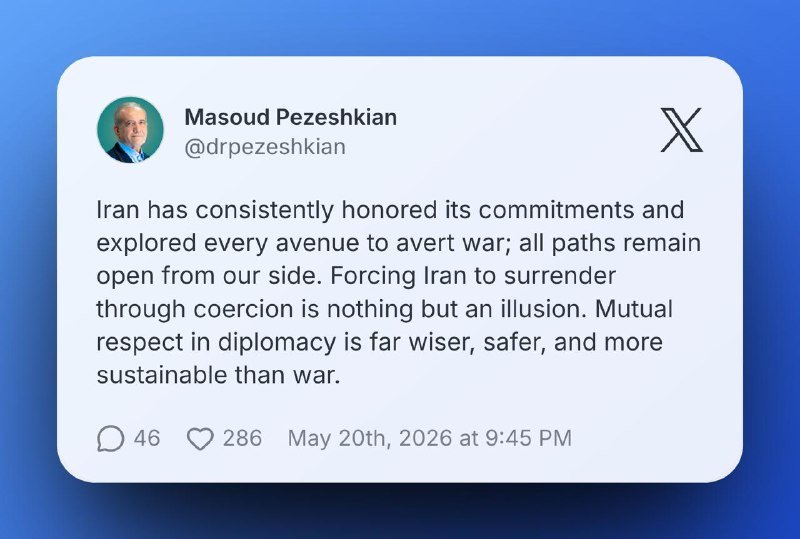
The most important gap in the public record is the substance of Iran's supposed peace overture. Reuters reported Trump's statement that Tehran had sent a proposal, but the wire account did not specify the content, format, or channel of that communication. Iranian officials have not publicly confirmed any such message. State media in Tehran has maintained its consistent line: Iran does not negotiate under duress, and sanctions pressure will not extract concessions that diplomacy could not.
The ambiguity matters. A formal diplomatic communication through Swiss intermediaries carries different weight than back-channel messaging through Oman or Qatar. A proposal contingent on prior US concessions means something entirely different from an opening bid with no preconditions. Without knowing which type of communication triggered the pause, it is impossible to assess whether this represents a genuine diplomatic opening or a calibrated move by Tehran to buy time while the White House faces internal pressure to show results.
Reporting from Nikkei Asia published on 17 May adds a crucial contextual layer. Following last week's US-China summit, Iran took a demonstrably harder public line with Washington on ending the Middle East conflict. The timing matters: the White House summit with Beijing was understood in the region as a potential effort to bring Chinese diplomatic leverage to bear on Iran. Instead, according to the Nikkei Asia analysis, Tehran appears to have interpreted the summit's outputs as an indication that Chinese backing was secure, not conditional — removing whatever incentive Tehran believed existed to move toward Washington.
The China Dimension and Who Gains From Ambiguity
That reading — if accurate — suggests a diplomatic dynamic that Washington may not have anticipated. The logic of involving China in Iran diplomacy rests on Beijing's economic leverage over Tehran: China is Iran's largest trading partner, its primary oil customer, and the destination for the bulk of Iranian crude exports that circumvent US secondary sanctions. The assumption in Washington was that Beijing could, if it chose, lean on Iran to moderate its nuclear posture.
Iran appears to have made a different calculation. Rather than interpreting Chinese willingness to participate in US-China diplomacy as a sign of Beijing's independence from Tehran, Iranian officials may have read it as confirmation that China has no interest in seeing the US succeed in pressuring Iran into a coercive deal. If so, the diplomatic architecture the White House thought it was constructing — using China as a lever — may have strengthened Tehran's hand instead.
This is not a novel dynamic in great-power competition. Smaller states with strategic depth and alternative great-power patrons routinely exploit the space between competing giants. Iran has been doing exactly this for four decades, navigating between Washington and Moscow, and now between Washington and Beijing. The current moment simply confirms that this capability survives even the most intensive pressure campaigns.
The Verification Gap and What Cannot Be Known
The second structural problem with the public narrative is the absence of independent verification for the central claims. Trump's statement that an attack was paused is itself presented without corroboration — no US military announcement, no congressional notification, no official confirmation from the Pentagon or National Security Council. It is possible that the reported strike existed only as a planning scenario, never formally authorized. It is equally possible that authorization was given and then countermanded. The Reuters report does not distinguish between these scenarios.
On the Iranian side, the absence of official confirmation means the peace proposal itself remains unverified from the primary source. Iranian Foreign Ministry briefings, when they have addressed the nuclear file publicly, have maintained the position that Iran will not negotiate under economic coercion. No Iranian official has acknowledged sending a proposal that altered the military calculus in Washington.
This creates a fundamentally asymmetric information environment. One side — the United States — is speaking loudly and publicly about military threats, diplomatic openings, and pauses in military action. The other side — Iran — is largely silent, allowing its counterpart's statements to fill the space. This is not new in US-Iranian messaging warfare, but it means that any analysis of the current moment rests on a single verifiable data point: Trump's reported statement. Everything else is inference.
Stakes: The Deal That Isn't Yet a Deal
The phrase "very good chance of getting a deal" deserves scrutiny on its own terms. The 2015 Joint Comprehensive Plan of Action — the nuclear agreement Trump decertified in 2018 — took nearly two years of sustained negotiation involving the United States, European allies, Russia, China, and Iran itself. That deal had a defined architecture: intrusive International Atomic Energy Agency inspections, explicit limits on uranium enrichment levels and stockpiles, and a sunset clause mechanism for phased re-imposition of restrictions.
The current diplomatic environment bears almost no structural resemblance to that pre-deal moment. The United States is not at the table with European allies who were co-negotiators; European governments have publicly expressed skepticism about unilateral US-Iran deals. Iran is under a regime of maximum economic pressure that it has survived — with difficulty — for seven years. And the political calendar in Washington rewards rapid declarations of success, which creates structural pressure to announce a deal before its terms have been verified.
The risks of a premature announcement are concrete. A framework that lacks robust verification mechanisms will not stop Iran's nuclear progress — it will legitimize a constrained version of it. A sanctions relief package that Iran cannot verify will be treated by Tehran as insufficient. And a political environment in Washington that treats any diplomatic contact as proof of success will have no mechanism for acknowledging when talks fail.
Israel and the Gulf states are watching with acute interest. For Tel Aviv, an Iran that is one year away from a nuclear weapon is one year too long — regardless of what diplomatic framework Washington announces. For Saudi Arabia and the UAE, the nuclear question is intertwined with regional influence and the broader architecture of Middle Eastern security. Neither has publicly endorsed the current US approach, and neither has rejected it. That studied ambiguity is itself a signal: the regional actors most directly affected by an Iranian nuclear capability are not convinced that the current diplomacy will produce a durable result.
The White House may secure a press release. Whether it secures a deal — in the sense that word meant in 2015 — remains genuinely uncertain. The pause in military action is real. The peace is not yet.
This publication's reporting on the Trump administration's Iran policy has emphasized structural analysis over official framing — tracing the gap between declared intentions and verifiable outcomes. Readers seeking实时 updates can follow our live wire coverage.