Trump Pauses Iran Strike as Gulf States Push for Diplomacy Over War
President Trump delayed a planned military strike on Iran on Tuesday after Gulf leaders urged restraint, opening a window for negotiations that the White House frames as a credible path to a nuclear accord — though Tehran's conditions remain unchanged.
President Donald Trump said on 18 May 2026 that he had cancelled a planned military strike on Iran scheduled for the following day, after leaders of Gulf states urged Washington to hold off and allow diplomatic channels to remain open. The reversal, announced just hours before the strike was to have been carried out, was accompanied by a renewed assessment from Trump that a nuclear agreement with Tehran was now within reach. Markets reacted with immediate relief: oil prices eased, while equity indices wavered and government bonds held steady.
The sequence marks the most concrete step toward de-escalation since the United States resumed large-scale military operations against Iranian targets earlier this year. It also surfaces a tension that has run through the entire renewed confrontation: the executive's stated preference for a deal, the institutional pushback from within the US system, and the competing calculations of regional partners whose security and economic interests do not map neatly onto a Washington-Tehran binary.
The Strike That Wasn't
According to the President's own account, relayed via social media and confirmed by reporting from NPR and SBS News Australia, the strike had been scheduled for Tuesday after a period of intensified US strikes against Iranian-adjacent targets in the region. Trump said Gulf country leaders had directly requested that he hold fire, describing the request as a signal that serious negotiations were underway. The wording of that request, and which specific Gulf states made it, remains partially opaque — the sources do not specify which governments communicated with the White House or what leverage they deployed in making the case for restraint.
The strike pause does not amount to a ceasefire. US forces have not ceased operations against Iranian-linked positions across Iraq and Syria, and the broader posture of the carrier groups and strike assets already deployed to the Gulf remains in place. What changed is the immediate kinetic dimension — the planned blow that was within hours of execution, now deferred.
The Senate's Eighth Attempt
Simultaneously, Senate Democrats moved to force another vote on a War Powers Resolution aimed at curbing the President's authority to initiate or continue military action against Iran. As reported by Middle East Eye, this will be the eighth such vote since the renewed hostilities began. The resolution mechanism is constitutionally grounded: the War Powers Resolution of 1973 requires the President to notify Congress within 48 hours of committing US forces to hostilities, and allows legislators to order a withdrawal after 60 days if they judge the action lacking sufficient authorization.
Eight votes signals persistence, not necessarily success — prior iterations have failed to clear procedural thresholds. But the cumulative pressure is not trivial. Each vote forces members of both chambers onto a public record, and in a political environment where polling on Iran intervention is mixed, that accountability calculus matters. The resolution's latest iteration, if it proceeds to a floor vote, will test whether the constitutional tension between executive war power and congressional authorization has shifted in any measurable way since the last attempt.
Iran's Conditions — Unchanged
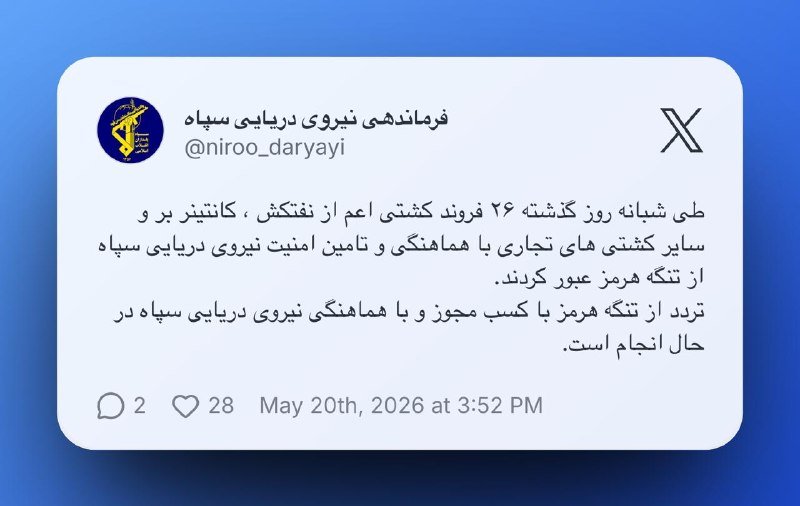
Any assessment of the diplomatic window must reckon with Tehran's stated position, which as of the morning of 19 May 2026 shows no movement. Iranian state-adjacent commentary, including posts referencing Trump's delay, characterises the pause as a result of US pressure from what the post terms "Zionist handlers" — framing the President as constrained rather than voluntarily diplomatic. That framing is predictably adversarial, but it points at a genuine structural feature: Iran's negotiating posture has not shifted in response to the strike pause.
Iran's preconditions for any settlement have been on the record for months, and the sources reviewed for this article do not indicate any willingness to moderate them. Trump, for his part, described the probability of a deal as a "good chance" — a characteristically non-specific formulation that signals appetite for negotiation without committing to specific concessions. What a deal would look like in practice, whether it would replicate the 2015 Joint Comprehensive Plan of Action structure or take an entirely different form, is not defined by any public document cited in the available sources.
Markets and the Diplomatic Premium
The Reuters report on market reaction provides a useful external validator of the political dynamic. Shares wobbled — meaning indices moved, but without conviction in either direction. Bonds were steady, suggesting investors did not read the pause as a signal of systemic financial stress. Oil eased, which is analytically significant: the market had priced in a scenario where the scheduled strike would have tightened supply or disrupted shipping lanes in the Gulf. The easing tells us that traders processed the pause as a reduction in near-term supply disruption risk, even as they remained uncertain about whether the underlying conflict trajectory had genuinely changed.
That calibration — relief without conviction, a partial de-risking without a repricing of the long-term outlook — is consistent with an investor community that has been burned before by diplomatic false starts with Iran and is not inclined to move aggressively on optimism.
What Remains Uncertain
Several dimensions of this story lack sufficient sourcing to report with confidence. The specific Gulf states that requested the strike delay have not been publicly identified in the wire reports reviewed. The precise content of the negotiations the President referenced — who the intermediaries are, what has been discussed, whether any written proposal exists — does not appear in the available material. Whether Iran's unchanged conditions represent a negotiating posture or a genuine hard line is not determinable from the sources on hand. And the constitutional calculus around the Senate's War Powers Resolution — whether this eighth vote produces a different procedural outcome than prior attempts — will only be resolved when the vote occurs.
This publication's wire selection emphasised the executive's own framing of the pause as deliberate diplomacy, against a counter-framing of the delay as externally induced. The structural tension — between a President who claims credit for restraint and a legislative branch actively seeking to constrain that restraint — is where the story's weight sits.
Wire provenance
This editorial synthesis draws on the following public wire/social posts:
- http://reut.rs/4ujOnG2
- http://reut.rs/4ePCLpw
- https://www.sbs.com.au/news/article/trump-says-he-held-off-new-attack-on-iran-after-gulf-countries-request/scjymn4ft