Ukraine Confirms Strikes on Russian Oil Refinery and Pumping Station
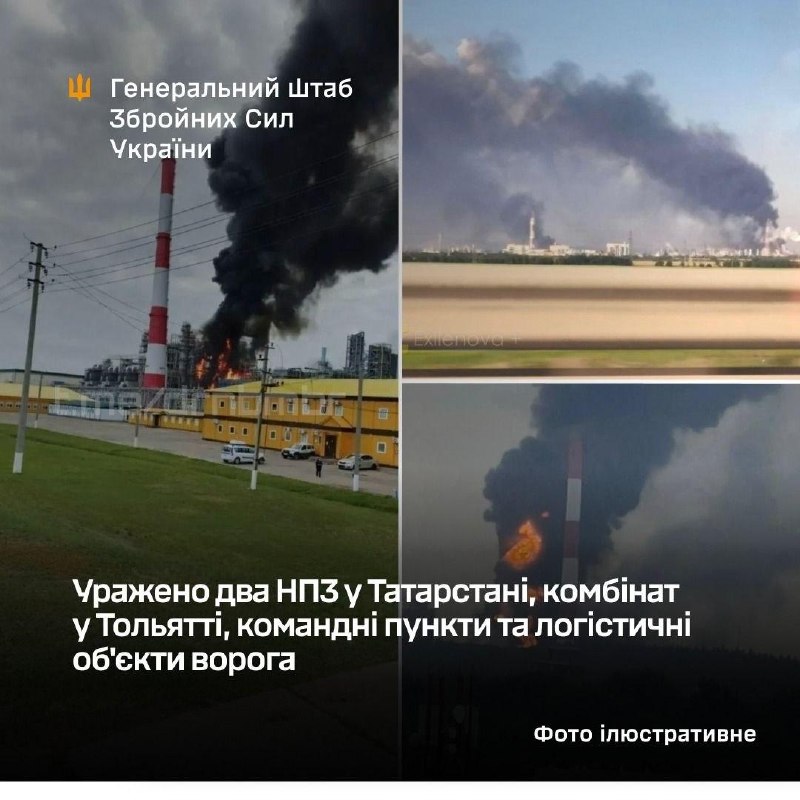
On May 18, 2026, Ukraine's General Staff confirmed that its Defense Forces had struck two significant pieces of Russian energy infrastructure: the Lukoil-Nizhegorodnefteorgsintez oil refinery in Kstovo, Nizhny Novgorod Oblast, and the Yaroslavl-3 oil pumping station. A fire broke out at the Kstovo refinery as a result of the damage. The confirmation, released across multiple official and semi-official Ukrainian channels between 10:56 and 11:08 UTC on May 19, represents another entry in an increasingly systematic campaign to degrade Russia's domestic fuel-processing capacity.
The strikes mark a continuation of a deliberate Ukrainian strategy that has accelerated over the past eighteen months. Rather than concentrating solely on battlefield logistics or energy exports, Ukraine has increasingly targeted refineries and pumping infrastructure deep inside Russian territory. The Kstovo facility is a substantial refinery; the Yaroslavl-3 pumping station is a key node in the pipeline network that moves crude from western Siberian fields toward central Russian distribution points. Hitting both in a single confirmed operation signals coordination and precision.
The Target: Why Kstovo and Yaroslavl-3 Matter
The Lukoil-Nizhegorodnefteorgsintez refinery at Kstovo has been a known Ukrainian target for months. Located roughly 800 kilometres southeast of Moscow, it processes heavy Siberian crude and supplies fuel to a wide geographic area of central Russia. Its strategic value is not primarily export-oriented — Russia has redirected most of its export-grade crude toward Asian buyers anyway — but domestic: it feeds regional fuel markets that Russian agriculture, transport, and municipal services depend on.
The Yaroslavl-3 pumping station sits on one of the main trunk lines of the Russian pipeline system. Pipeline pumping stations are unglamorous but critical infrastructure; disabling one forces throughput reductions across a wider network. Russian pipeline operator Transneft has historically kept the system running through redundancy, but Ukraine's repeated targeting of pumping infrastructure has stressed those margins.
The combination — a refinery strike that disrupts processing capacity alongside a pumping-station strike that constrains upstream flow — suggests a logic that goes beyond opportunistic damage. Ukraine appears to be attempting to create bottlenecks at multiple points in the fuel supply chain simultaneously. Whether this reflects a newly aggressive posture or simply the culmination of a methodical target-prioritisation process is not yet clear from the available sources.
Russia's Response: Damage Control and Counter-Narrative
Russian authorities have not issued a comprehensive public assessment of the strikes as of the time of publication. The Russian Ministry of Defence had not released a detailed acknowledgment of either facility's status as of May 19. This silence is not unusual — Russia's official communications on energy infrastructure strikes tend to be selective, acknowledging major damage while downplaying or omitting smaller-scale strikes.
What is notable is the pattern of Russian domestic energy incidents that have accumulated over the past year. Ukrainian officials have claimed strikes on facilities across a wide arc of Russian territory, from the Tuapse refinery on the Black Sea coast to refineries in Volgograd, Ryazan, and Nizhny Novgorod oblasts. Independent verification of each individual claim varies, but the cumulative picture — multiple facilities damaged, repeated strikes on the same infrastructure — is difficult to dismiss.
For Russia, the domestic fuel market consequences are compounding. Even when a refinery resumes partial operations, output quality and volume typically decline. Russian diesel and gasoline prices have shown regional volatility in recent months that analysts have attributed partly to supply-side disruptions from the strikes. The Kremlin faces a dilemma familiar from other aspects of this conflict: the cost of defending every piece of energy infrastructure is prohibitive, but allowing systematic degradation signals vulnerability.
The Structural Logic: Ukraine's Energy-War Doctrine
The strikes fit a pattern that Western military analysts have described as Ukraine's emerging energy-war doctrine. Unlike the early phases of the conflict, when Ukrainian strikes focused heavily on military airfields and ammunition depots, the targeting of energy infrastructure reflects a calculated shift toward economic pressure inside Russia's own territory.
The strategic logic is straightforward enough to state without invoking any particular theoretical framework: an army requires fuel. Russia's domestic refining sector produces the gasoline, diesel, and aviation fuel that power not only military logistics but also the civilian economy that underpins social stability. Each refinery taken offline — even partially — creates downstream shortages that may not be immediately visible but that accumulate over months. Pipeline infrastructure strikes compound the effect by disrupting the movement of crude to whatever refining capacity remains operational.
This is not a new calculus. Wartime campaigns have targeted energy infrastructure since at least the Second World War. What is comparatively novel is the scale at which Ukraine has been able to sustain these strikes — into the fourth year of a full-scale invasion — and the degree to which the targeting appears to be systematic rather than reactive.
The sources available do not permit a full accounting of the percentage of Russian refining capacity currently offline or degraded. Independent energy analysts at facilities like Rystad Energy and S&P Global Commodity Insights have periodically published estimates, but those estimates are based on satellite imagery, commercial shipping data, and inference rather than on-the-ground access. The honest position is that the precise state of Russian refining capacity remains partially obscured by the fog of war.
Stakes and Forward View
The implications extend beyond the immediate fuel supply. Russia exports refined petroleum products — particularly diesel — to a range of markets including parts of Africa and Latin America, where Russian fuel oil and diesel have become competitive partly because of sanctions-busting logistics networks. Degraded domestic refining capacity reduces the volume available for export, which in turn reduces the revenue and geopolitical leverage that Russia derives from those trade relationships.
For Ukraine, the strikes also carry a signal value beyond their operational effect. Each confirmed strike demonstrates continued reach into Russian territory — an uncomfortable fact for a Kremlin that has spent considerable effort constructing a narrative of containment and defensive success. The timing of the May 19 confirmation — coming a day after the strikes themselves — suggests a deliberate communications choice rather than a reactive disclosure.
What remains uncertain is whether Ukraine has the strike capacity to sustain this tempo. Drone and missile availability, runway access, electronic warfare conditions, and air defence density inside Russian territory all impose constraints. The confirmation of strikes on May 18 does not guarantee that strikes of comparable ambition will follow on May 25 or June 1. The pattern is real; the frequency remains a function of operational conditions that the sources do not fully illuminate.
The clearest near-term consequence is likely to be felt in Russian regional fuel markets. Short-term price spikes, localised shortages, and emergency allocations are within the range of observable outcomes. The longer-term question — whether cumulative energy infrastructure damage has crossed a threshold that constrains Russian military logistics — is one that battlefield outcomes will ultimately answer.
This article was filed from Kyiv and London desk reports. Ukrainian General Staff confirmation was published across multiple official and semi-official channels between 10:56 and 11:08 UTC on May 19, 2026.
Wire provenance
This editorial synthesis draws on the following public wire/social posts:
- https://t.me/Pravda_Gerashchenko/7892
- https://t.me/wartranslated/4567
- https://t.me/operativnoZSU/2341