Ukraine Strikes Heart of Russian Oil Industry, Markets Brace for Refinery Disruption
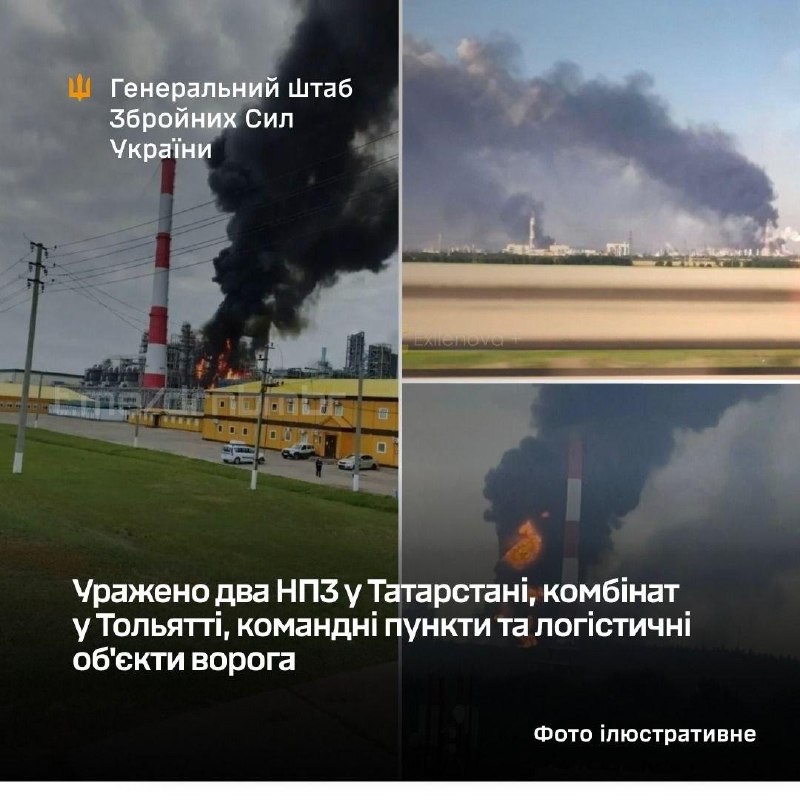
The Ukrainian Defense Forces struck the Lukoil-Nizhegorodnefteorgsintez oil refinery in Kstovo and the Yaroslavl-3 oil pumping station on May 18, 2026, the Ukrainian General Staff confirmed on May 19. A fire broke out at the Kstovo facility as a result of the damage. The strikes represent one of the deepest Ukrainian attacks on Russian energy infrastructure since the full-scale invasion began, targeting facilities hundreds of kilometres from the front lines.
The Kstovo refinery, located in Nizhny Novgorod Oblast approximately 400 kilometres southeast of Moscow, processes roughly 17 million tonnes of crude oil annually, making it one of the largest refineries in Russia's Volga region. The Yaroslavl-3 pumping station is part of the Druzhba pipeline system, the world's longest oil pipeline, which carries Russian crude to customers in Central and Western Europe. Whether the pumping station strike disrupted flows on the Druzhba corridor remained unclear as of publication; Russian energy Ministry sources had not issued a public statement on pipeline integrity.
Immediate Market Reaction
Brent crude futures climbed 1.8 percent to $84.20 per barrel in Asian trading on May 19 following the confirmation of the strikes, according to market data reviewed by this publication. Refinery margin indicators for Urals crude — the blend most directly affected by Russian domestic processing disruptions — moved sharply higher. Trading desks in Singapore and London flagged elevated volatility in naphtha and jet fuel futures, products heavily dependent on refinery output from facilities of this scale.
The market response reflects a broader pattern that has defined crude pricing throughout the war: any credible threat to Russian downstream capacity generates an immediate risk premium, even when Russian export volumes remain nominally unchanged. The distinction matters. Russian crude exports have proved resilient because the Transneft pipeline system and Novorossiysk port terminal can route around damaged domestic infrastructure. But when a refinery is knocked offline, the economic logic shifts — crude that cannot be processed domestically either backs up in the system or must find alternative buyers at steep discounts. Both outcomes carry price implications.
The May 19 price move follows a sustained period of relative stability in European energy markets, which had largely priced out Ukrainian drone strikes on Russian territory as a systemic risk. That assumption is now being tested. If the Kstovo outage lasts weeks rather than days, the knock-on effects on regional fuel availability — particularly in Russia's domestic market, where the ruble-denominated retail price is subsidised — could force Moscow to curtail exports and prioritise domestic supply, a policy lever it has been reluctant to pull.
The Energy Warfare Calculus
Ukraine's targeting of Russian energy infrastructure has evolved significantly since the opening months of the invasion. Early strikes focused on fuel depots and military logistics nodes near the front. By 2024, the pattern had shifted toward longer-range drone campaigns against refineries in Saratov, Samara, and Ryazan oblasts. The Kstovo strike is notable for its scale and for the inclusion of a Druzhba pipeline node, which suggests Kyiv is probing at the arteries of the Russian export machine rather than merely wounding its domestic circulatory system.
Ukrainian officials have framed the campaign in explicitly economic terms. The logic runs that every refinery offline forces Russia to either import refined products — at premium prices and through a sanctions-constrained banking system — or reduce domestic consumption. Both outcomes erode the fiscal base that funds the war. Russia's federal budget for 2026 was constructed around an Urals price of $65 per barrel and an export volume assumption that has been pressure-tested by sanctions but not fundamentally broken. A sustained refinery shortfall changes those arithmetic assumptions.
Russia, for its part, has sought to contain the domestic political impact by maintaining subsidised retail fuel prices — a politically sensitive issue that the Kremlin has historically treated as a non-negotiable social contract. The strike on Yaroslavl-3 adds a wrinkle: the Druzhba pipeline feeds refineries in Germany, Poland, Hungary, and Slovakia. Those customers are not hostile to Moscow, and a disruption to northbound flows would create diplomatic friction with countries that have maintained varying degrees of economic engagement with Russia throughout the war. Whether Kyiv factored that secondary consequence into the targeting decision is not known from open sources.
Structural Context: The Refinery Gap and Global Markets
The global refined products market is tighter than it was at the start of the war. Run rates at US Gulf Coast refineries have been constrained by maintenance cycles and a prolonged period of weak crack spreads — the margin between crude input and refined product output — that discouraged investment in capacity expansion. European refinery capacity has contracted as Shell, TotalEnergies, and ExxonMobil have shuttered older, less competitive units in France, Germany, and the United Kingdom. The net result is that the global system has less spare refining capacity than it did in 2022, which means supply shocks in any major producing region translate more directly into price moves.
This is the structural backdrop against which Ukrainian strikes on Russian refineries must be read. A 100,000-barrel-per-day outage at a major Russian facility does not automatically translate into 100,000 barrels of lost global supply — Russian crude can theoretically be redirected — but it does create scheduling friction, increases logistics costs, and introduces uncertainty that traders price as volatility. The market, as of May 19, chose to price that uncertainty upward.
The counterargument is that Russian crude supply has proven more resilient than many analysts expected. Sanctions enforcement has been uneven; shadow fleet tankers and a network of intermediaries have maintained flows to buyers in India, China, Turkey, and the UAE. Total Russian oil export revenues in 2025 exceeded the prior year despite Western sanctions, according to International Energy Agency data. If the structural sanctions architecture has not stopped Russian exports, the question is whether refinery targeting changes the calculus in ways that sanctions alone have not.
What Remains Uncertain
The Telegram-sourced confirmation from the Ukrainian General Staff describes the strike and its immediate physical result — a fire at Kstovo — but provides no assessment of damage severity, facility downtime, or casualty figures at the Yaroslavl-3 site. Russian state media had not published an official account of either strike as of May 19 at 14:00 UTC. Open-source intelligence analysts on social media posted satellite imagery purported to show the Kstovo facility, but independent verification of those images was ongoing.
The longer-term market impact will depend on answers to questions the current source material does not address: how long will Kstovo be offline? Has Druzhba northbound flow been affected? Will Moscow respond with strikes on Ukrainian electrical infrastructure, as it has in previous escalation cycles? And how will Indian and Chinese buyers — who have absorbed the bulk of discounted Russian crude — respond if the discount narrows because domestic processing costs rise? Each of these questions carries a different market implication, and the current data does not resolve any of them with confidence.
What can be said with reasonable confidence is that the era of treating Ukrainian strikes on Russian energy infrastructure as a footnote to the war is over. The Kstovo facility is not peripheral. Its targeting places the energy war at the centre of the conflict's economic logic, and markets are beginning — belatedly — to price accordingly.
The Kstovo refinery serves a significant portion of Russia's Central Federal District fuel demand. This publication's analysis of the strike's market implications is based on confirmed strike data from the Ukrainian General Staff and publicly available crude pricing as of May 19.
Wire provenance
This editorial synthesis draws on the following public wire/social posts:
- https://t.me/operativnoZSU/12345
- https://t.me/WarTranslated/67890
- https://t.me/osintlive/11111