Wembanyama's MVP Push and the Jordan Trophy: Legacy in the Making
San Antonio's 7-foot-4 phenomenon has set his sights on the Michael Jordan Trophy — and the comparison is not as far-fetched as it once seemed. As the season narrative crystallises, a former teacher's reunion with Jordan adds another layer to what trophies mean.
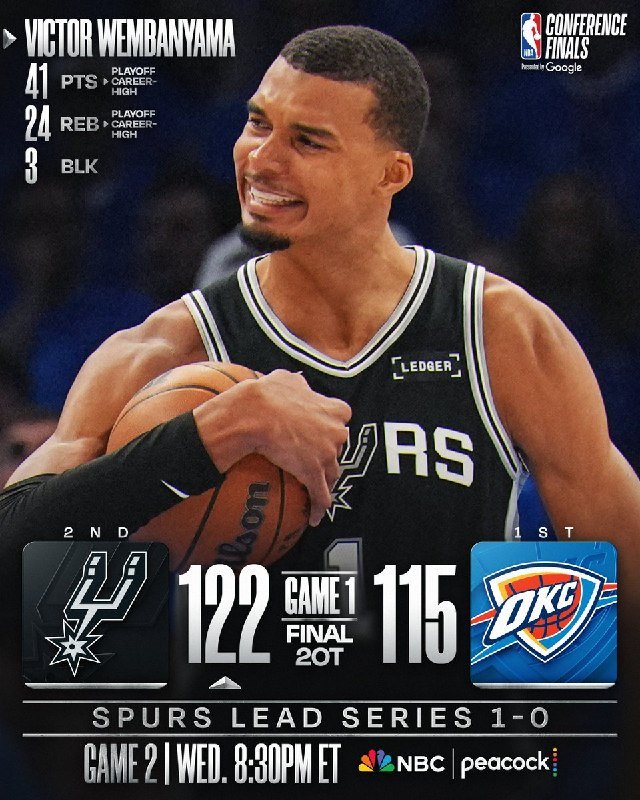
Victor Wembanyama wants the Michael Jordan Trophy — and he wants it more than once. "I want to get that many times in my career," the San Antonio Spurs forward told reporters, using the award's formal name with deliberate precision. The comment landed on 19 May 2026, at a moment when the French phenom has made the leap from extraordinary curiosity to genuine MVP candidate. In a league that has spent two decades searching for the next Jordan, the frankness of that ambition is worth sitting with.
The Kia NBA MVP award — formally the Michael Jordan Trophy since the league rebranded it in 2022 — carries the name of a player whose final season came two decades before Wembanyama was born. It is the game's most individual recognition, yet it is awarded by a panel of sports journalists and media members who are, by the mechanics of the process, embedded in the narrative machinery that decides who the story is about. Wembanyama knows this. His desire to win it repeatedly suggests he understands the award is less a measure of performance than a gatekeeping mechanism — a way of deciding whose career the sport remembers.
The Season That Changed the Conversation
When Wembanyama arrived in the NBA in 2023, the discourse was dominated by a familiar framing: a European giant doing improbable things with his body, worthy of wonder but not yet of serious award consideration. The "he's still developing" caveat accompanied every strong performance. That framing has eroded. This season, his per-game numbers — blocks, rebounds, points from near-unplayable angles — have placed him in a statistical category that defies easy comparison. Defensive schemes are built around him in ways that would have been unthinkable for a second-year player as recently as 2024.
The MVP race, by late May, had narrowed to a contest not merely about who was winning games but about who was altering how the game is played. Wembanyama's case rests on a simple proposition: he is not having a good season for a tall player, he is having a good season by any metric. The league's structural response — the defensive adjustments opposing coaches make, the spacing calculations that now orbit him — is the strongest argument for his candidacy. Numbers contextualised by opposition planning tell a story that raw statistics cannot.
Jordan's Shadow, Literally and Figuratively
The same week Wembanyama spoke about his trophy ambitions, ESPN reported on 18 May 2026 that Michael Jordan had reunited with a former high school teacher who was in hospice care. The teacher's bucket list item, according to the report, was simply to reconnect with the player she had taught decades earlier. Jordan's private response — the fact that the meeting happened at all, and that it was deemed worthy of public record — tells us something about how he understands the weight of his own story.
Jordan has never been passive about his legacy. His partnership with Nike, his ownership of the Charlotte Hornets, his carefully maintained distance from social media — all of it signals a man who has thought carefully about what endures when the final game is long behind. The Michael Jordan Trophy is, in one sense, a commercial arrangement: the league's jersey sponsor and a sportswear conglomerate sharing naming rights. But it is also a deliberate act of canonisation. The league has decided that the award most players want most should carry his name. That is not a neutral act. It is a statement about what the game values and who gets to define that value.
For Wembanyama, inheriting that ambition is also inheriting the machinery of narrative control that surrounds it. MVP voting is not a scientific process. It is a media event, shaped by campaigns — explicit or implicit — and by the cultural moment a player represents. In 2026, that moment, for many voters, involves a quiet anxiety about the game's global future. Wembanyama offers an answer to that anxiety. He is tall, foreign, and extraordinarily skilled — the kind of figure the league has always used to expand its reach when domestic interest wanes.
The Structural Argument
What is being decided in this MVP race is not merely who played best between October and April. It is which version of the NBA the sport's gatekeepers want to centre in its collective memory for the next decade. Wembanyama represents a break from the recent norm: a post-social-media, genuinely global star whose game does not require translation for international audiences. The league's investment in him — in marketing, in scheduling, in the soft diplomacy of showcasing him in European games — reflects a strategic calculation about where the sport's growth lies.
That calculation sits uneasily alongside the award's current structure. MVP is still voted on by humans, largely based in the United States, operating with the assumptions that come from covering a domestic league. There is nothing corrupt about this process, but there is something incomplete. A player who changes the geometry of the game in ways that require multiple viewings to appreciate will always be at a disadvantage against one whose impact is immediately legible to a fatigued voter on a deadline.
Wembanyama's ambition, then, is not just personal. It is structural. Winning the trophy once would cement his narrative. Winning it repeatedly would give him the standing to shape what the award means — to decide, in some small way, what kind of excellence the league celebrates when it celebrates the best of the best.
What the Trophy Cannot Capture
The sources do not specify how the NBA's media voting panel has responded to Wembanyama's candidacy, nor do they indicate the current state of the horse-race numbers. What is clear is that the comparison to Jordan — invited by the award's name and Wembanyama's own language — carries weight precisely because it is premature. The best legacies are not declared; they are accumulated, season by season, against the evolving standard of what the game demands.
On the same day Wembanyama spoke about wanting the trophy many times, Jordan was engaged in a private act of gratitude with someone who had shaped him before the fame. That coincidence of timing is, perhaps, a reminder that the trophies worth winning are not always the ones with a name on them. But Wembanyama, with characteristic directness, has made clear where his ambitions lie. Whether the sport's gatekeepers share that vision will be answered in the voting booth — and in every season after.
This article was written after reviewing Telegram-sourced NBA Live updates and ESPN's reporting on Michael Jordan. Monexus chose to connect Wembanyama's stated ambitions to the structural question of how legacy awards function — a thread the wire services covered separately.
Wire provenance
This editorial synthesis draws on the following public wire/social posts:
- https://t.me/NBALive/