The Geometry of Xi's Multipolar Appeal
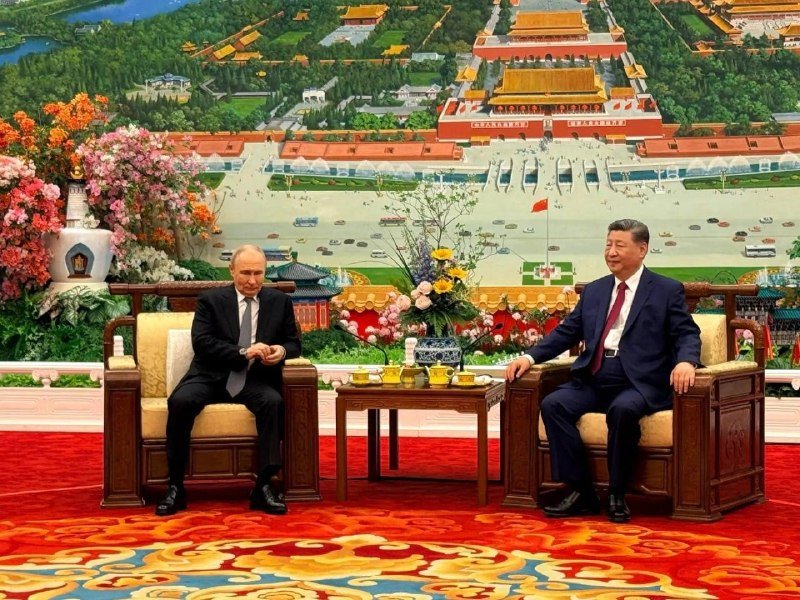
In Moscow on 20 May 2026, Xi Jinping arrived with the vocabulary Beijing has refined over a decade of systematic relationship-building with Russia. The world, he told the assembled Russian leadership, is far from calm. The damage imposed by unilateral actions and what he called hegemonism threatens to drag the international system back toward the law of the jungle. China and Russia, Xi said, must firmly oppose all unilateral bullying. Putin, receiving the remarks, called the bilateral relationship an example of how relations between countries and peoples should be built today.
This is the language of multipolarity — a term that has migrated from academic conference papers into the formal diplomatic vocabulary of the world's two largest energy powers. It is also, increasingly, the language of Global South capitals that have watched the post-Cold War unipolar moment curdle into something less stable than its architects promised. Understanding why this framing resonates requires taking it seriously on its own terms, rather than dismissing it as mere propaganda or accepting it as a genuine vision of reform.
The Commerce Beneath the Cosmology
Xi's rhetoric arrives backed by structural substance. Bilateral trade between China and Russia, according to figures cited in Beijing's own reporting, has exceeded $200 billion — a figure that would have seemed implausible before Western sanctions compressed Moscow's options. In the first four months of 2026 alone, turnover grew by approximately 20 percent. This is not partnership built on shared ideology; it is trade driven by the accident of complementary needs. Russia has markets for its hydrocarbons. China has manufactured goods, infrastructure capacity, and capital that Western firms can no longer readily supply under sanction regimes. Neither side needs to like the other to find this arrangement useful.
Western analysts have tended to read this commercial deepening as evidence of a strategic axis — an emerging coalition explicitly aligned against the liberal international order. The framing is not wrong, exactly, but it mischaracterises the relationship's texture. China has been careful to avoid direct material support for Russia's military operations in Ukraine, choosing instead to occupy the spacious middle ground of economic normalisation that stops well short of weapons transfers. This is not neutrality in any meaningful sense, but it is also not the formal alliance that Washington and its allies sometimes attribute to Beijing. The Sino-Russian relationship is transactional in its bones; the ideological scaffolding Xi erects around it is a diplomatic instrument, not a description of internal commitment.
What Multipolarity Actually Means in Beijing's Usage
The concept has genuine appeal beyond the bilateral relationship. For middle powers across the Global South — capitals that have spent decades navigating between the demands of Washington and the preferences of its allies — a world defined by multiple poles of roughly equivalent influence sounds like an improvement over one in which a single currency, a single reserve status, and a single set of security guarantors dominated. Xi is not inventing this aspiration; he is giving it a name and a political framework that does not require these countries to align with either Washington or Moscow.
The structural appeal is real. A 2026 reader of diplomatic dispatches from capitals in Southeast Asia, Sub-Saharan Africa, and Latin America will find a consistent theme: wariness about being forced to choose, frustration with what local officials describe as conditionality attached to Western financial and security arrangements, and openness to relationships that do not carry the same baggage. Beijing has been a beneficiary of this disenchantment, positioning itself as a partner that does not lecture on governance standards or human rights — a positioning that elides the coercive dimension of its own economic statecraft, but one that resonates nonetheless in foreign ministries that have grown tired of being treated as supplicants.
The Structural Tension at the Core
Here the analysis must become more forensic. Multipolarity, as a theoretical proposition, requires multiple centres of roughly equivalent power capable of checking one another. The current China-Russia alignment does not constitute such a balance; it is closer to a tactical partnership between a rising power and a declining one, united more by opposition to what they resent than by agreement on what they would build. Russia's economy, stripped of its hydrocarbon leverage, is increasingly peripheral to global commerce. Its demographic trajectory is poor. Its military, as the Ukraine conflict has demonstrated, is capable of sustaining a grinding attritional campaign but not of projecting power at distance in the way the Soviet Union once did. Russia is useful to Beijing as a junior partner, a market, and a pressure point against Western unity. It is not, on any serious reading, a pole in its own right.
This creates a structural contradiction in Xi's multipolar rhetoric. If the order Beijing favours is one in which American hegemony is replaced by Chinese leadership — with Moscow in a secondary but comfortable position — then the framing is not multipolar at all. It is a transfer of centre of gravity, not a dispersal of power. The language of multipolarity, in this reading, functions primarily as a delegitimising tool aimed at Washington rather than a genuine commitment to a pluralistic international order. Smaller states that take the rhetoric at face value may find, in practice, that their agency is no greater under Beijing's preferred arrangement than it was under Washington's.
What Remains Contested
The sources do not provide sufficient basis to assess the internal deliberations within Beijing's foreign policy establishment — whether there exists a genuine debate between factions that see multipolarity as a tactical framing and those who consider it a sincere commitment. Similarly, the thread does not illuminate how Xi characterises to his counterparts in Beijing the nature of the commitments he makes in Moscow. The gap between public rhetoric and private understanding is always difficult to penetrate; the available material does not permit confident claims about where the one ends and the other begins.
What can be said with reasonable confidence is that the $200 billion figure represents a floor, not a ceiling, and that both sides have structural incentives to continue expanding the relationship regardless of what formal alliance language surrounds it. The harder question — whether the order this commerce is building is genuinely pluralistic or merely Sino-centric with Russian accommodation — will not be answered by presidential communiqués. It will be answered by the terms on which smaller states are eventually invited to participate, or excluded, from the arrangements Beijing constructs.
Desk note: Wire coverage of the Xi-Putin meeting centred on the photo opportunities and the trade figures, with limited exploration of what Beijing's multipolar framework actually implies for third-country sovereignty. Monexus has attempted here to trace the structural logic of the framing rather than simply reproducing its surface rhetoric.
Wire provenance
This editorial synthesis draws on the following public wire/social posts:
- https://t.me/BellumActaNews/12456
- https://t.me/BellumActaNews/12455
- https://t.me/BellumActaNews/12454
- https://t.me/zvezdanews/9876