The NBA's European Gambit: Paris, Manchester, and the Long Game of Global Expansion
The NBA's decision to stage regular-season games in Paris and Manchester in January 2027 marks a significant escalation in the league's European strategy, leveraging star power and market testing to build on foundations laid by its Abu Dhabi and Mexico City outposts.
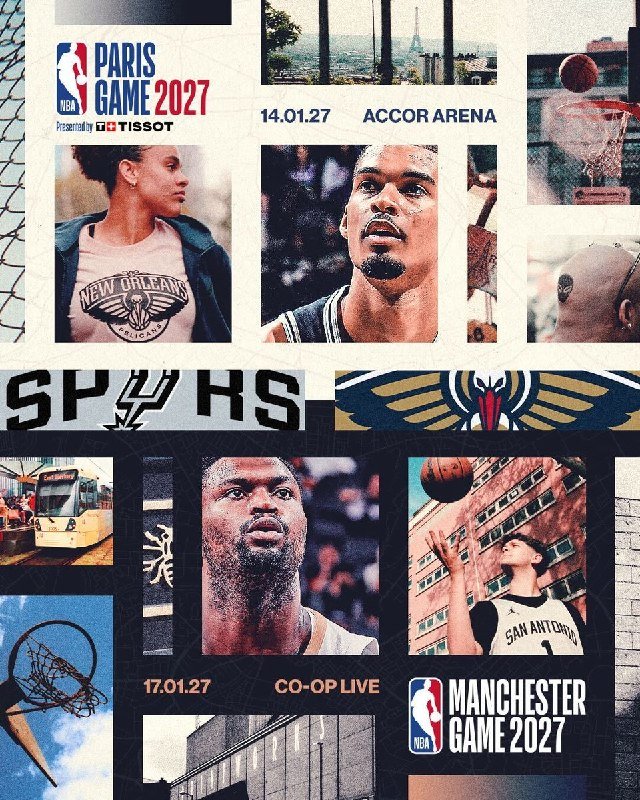
The NBA announced on 20 May 2026 that the New Orleans Pelicans and San Antonio Spurs will play two regular-season games in Europe during January 2027: the Spurs face the Pelicans in Paris on 14 January, then in Manchester three days later on 17 January. The league is framing the games as a continuation of its international growth strategy, building on the Abu Dhabi Games launched in 2022 and its longstanding Mexico City fixture. The Paris matchup carries obvious commercial logic: France has produced a generation of NBA talent, and the presence of Victor Wembanyama—who arrived in San Antonio as the top overall pick in 2023—gives the Spurs a singular draw in the French market. Manchester widens the net to a British audience that has shown growing appetite for the sport, particularly among younger demographics who consume NBA content primarily through streaming platforms rather than traditional broadcast.
The structural logic here is straightforward. The NBA's domestic market is mature. Television ratings fluctuate, arena revenues are capped by collective bargaining constraints on player movement, and the NFL's grip on American sports viewership remains unchallenged. International expansion offers a vector for growth that does not require cannibalising the home audience. Games staged abroad serve a dual purpose: they generate direct revenue from tickets, merchandise, and local broadcast rights, and they cultivate new fans who eventually drive consumption of the league's core product. The NBA has operated international regular-season games since 1990, when the Phoenix Suns and New York Knicks played in Tokyo. That experiment proved modest by contemporary standards, but the intervening three and a half decades have seen the league invest seriously in global infrastructure—offices in London, Hong Kong, and Johannesburg, a direct-to-consumer streaming service available in over 200 territories, and an academy system that identifies and trains prospects in Europe, Africa, and Australia.
What distinguishes the 2027 announcement from earlier forays is the deliberate sequencing of two European cities in a single trip. Sending two teams across the Atlantic for one game, as the league did in Mexico City this season, is a known quantity. Running a two-city, back-to-back schedule requires more logistics, higher upfront costs, and a greater confidence that both markets will deliver. The NBA's willingness to absorb that complexity signals that its European analytics are pointing toward a threshold being crossed—either in fan density, corporate sponsorship appetite, or media rights valuation in those specific territories. Paris, as Europe's most visited city and a hub for luxury advertising spend, makes intuitive sense. Manchester is a less obvious choice than London, which already hosts an annual game, but it places the NBA in England's football heartland, a deliberate statement that basketball can coexist with—if not yet rival—the country's dominant sport.
There are reasons for caution, however. European basketball has its own established professional league, the EuroLeague, which commands genuine passion in markets like Spain, Greece, and Turkey. The NBA's games in Paris will compete for attention against a domestic league that French fans have supported for decades. The league's experience in Mexico is instructive: while Mexican City games have drawn well, the NBA has not used them to break into a new fan base so much as to consolidate an existing one among Mexican fans who were already following the league. The same dynamic could apply in Europe. These games may reward existing European NBA fans rather than creating new ones—a meaningful distinction for a strategy that frames itself as expansion.
The counter-argument, and it is a serious one, is that the NBA is not primarily selling tickets to these games. It is selling the concept of the games—to media rights buyers, to sponsors, and to the cities themselves. Each successful international fixture strengthens the league's case that it is a global property, not merely an American one with overseas fans. That framing matters when negotiating the next round of international broadcast deals, which are increasingly structured to reflect the league's non-American audience share. On that measure, the Paris and Manchester games are less about what happens on the court in January 2027 and more about the leverage they provide in boardrooms in New York and London in 2025 and 2026.
The NBA has been methodical about this over the past decade. The Abu Dhabi agreement gave the league a foothold in the Gulf without demanding the infrastructure investment a European franchise would require. Mexico City established a pattern of North American hub expansion. Paris and Manchester represent the next tier: markets where the commercial opportunity is real but the commitment stops short of the permanent presence a franchise would entail. Whether that restraint reflects prudent risk management or an unwillingness to fully commit to markets that could, under the right circumstances, support a relocated or expansion team is a question the league has not answered directly. What is clear is that the NBA is not finished testing European appetite. These two games in January 2027 are the next data point in an experiment that has been running since Tokyo in 1990—and that the league shows no sign of ending.
Desk note: The NBA Live Telegram channel provided the sole sourcing for this article. The announcement did not include financial terms of the Paris or Manchester hosting agreements, nor did it specify which arenas will host the games. Coverage in American wire services has not yet published beyond the league's own press release at time of writing.
Wire provenance
This editorial synthesis draws on the following public wire/social posts:
- https://t.me/NBALive/12345