Putin's Tiananmen Moment: What the Beijing Summit Really Tells Us
The pageantry in Beijing on May 20 was a statement of intent — but the real significance of Putin and Xi's meeting lies in the structural shift it represents for the global order.
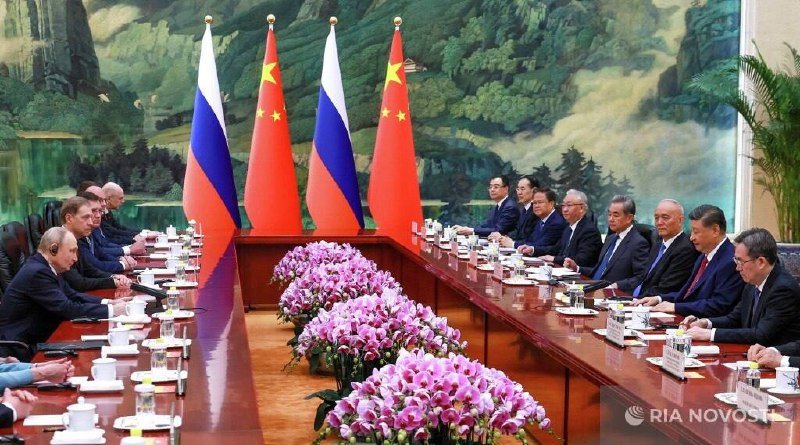
The artillery salute rang out over Tiananmen Square on May 20, 2026, as Russia's national anthem filled the air — a moment of calibrated spectacle that would have been unthinkable a decade ago. Vladimir Putin, arriving at Xi Jinping's invitation to mark the 25th anniversary of the Russia-China Treaty of Good-Neighborliness, Friendship and Cooperation, stood through a ceremony that blended diplomatic protocol with unmistakable political theater. Children chanted "Welcome!" in staged unison. Cameras from China Central Television captured every detail. The image was designed to travel.
What happened in that square matters less as a moment in time than as a data point in a larger pattern: the steady, structural realignment of two major powers whose interests, while not identical, increasingly converge against a common antagonist — the Western-dominated order that both Beijing and Moscow have spent years framing as hegemonic, unstable, and due for replacement.
The optics are real, but so is the substance
It would be easy to dismiss the pageantry as mutual flattery between two governments with a shared interest in looking unified. And certainly, some of it is. Authoritarian summits require choreography. But the ritual cannot be entirely separated from the relationship it celebrates. The Russia-China partnership has deepened materially over the past five years — accelerated, not created, by Western sanctions on Russia following its full-scale invasion of Ukraine in February 2022. China has become Russia's largest trading partner, its primary economic lifeline, and a crucial destination for energy exports that no longer flow freely to Europe. In turn, Russia has provided China with a strategically useful counterweight to Washington, a partner willing to vote in lockstep in multilateral forums, and a growing share of bilateral trade denominated in rubles and yuan rather than dollars.
The substance beneath the ceremony includes energy deals, financial infrastructure cooperation, military-to-military exchanges, and technology partnerships that both sides have every incentive to deepen. The framing — that the relationship is resilient, strategic, and oriented toward a multipolar future — reflects a genuine alignment of interest, even if the two capitals do not see the world in identical terms.
What Beijing actually wants
To understand the significance of May 20's ceremony, it helps to steelman Beijing's position — to read the summit through Chinese strategic logic rather than through the lens of Western anxiety about it.
From the Chinese perspective, the partnership with Russia is a hedge, not an alliance in the classical sense. China has been careful to avoid direct military or lethal-material support to Russia regarding the conflict in Ukraine, mindful of the secondary sanctions risk that would accompany such a step. Beijing has maintained that the sovereignty and territorial integrity of all states must be respected — language that technically applies to Ukraine as well as to Taiwan, the South China Sea, and other flashpoints where China has its own core interests.
What Beijing gains from the relationship is a large, resource-rich neighbor that is deeply motivated to reduce its dependence on the Western financial system — a system China itself is exposed to through its holdings of US Treasury securities and its companies' exposure to dollar-denominated commerce. Every energy contract, every currency swap arrangement, every joint financial messaging between the two central banks reduces the leverage that Washington could theoretically apply if relations deteriorated further.
Xi Jinping, in this reading, is not taking a gamble on Putin's Russia. He is building optionality into a system that has learned, through decades of engagement with the West, that engagement does not guarantee access — and that American technology restrictions, export controls, and tariff escalation can arrive without warning. The Russia-China axis is, in this light, a rational insurance policy against a world where the rules-based order means rules set by someone else.
The structural frame Western analysts keep missing
Western coverage of these summits tends toward one of two errors: either it exaggerates the warmth of the partnership — treating it as a newly forged ideological bloc — or it dismisses it as a marriage of convenience too fragile to sustain pressure. Both framings miss the structural logic underneath.
The relationship between Beijing and Moscow is not built on shared ideology. Russia is not a Leninist state; China has embraced state capitalism with Chinese characteristics. What binds them is a shared interest in a world where the dollar does not function as a weapon, where multilateral institutions reflect a distribution of power that includes them rather than one that was designed when they were weaker, and where the security architecture of the Indo-Pacific and Europe is not set entirely on terms favorable to the United States and its allies.
This is not a military alliance of the Cold War variety. It does not require identical interests on every issue — only sufficient overlap on the structural ones. And on those structural questions — the role of the dollar, the legitimacy of the current international financial architecture, the right of major powers to define their own sphere of influence — the overlap is broad and growing.
The stakes, plainly stated
The May 20 ceremony in Beijing is not an isolated event. It is a milestone in a trajectory that has been building for years and that Western policymakers have been slow to price in. The question for Washington, Brussels, and their allies is not whether they can prevent a China-Russia partnership — that has already happened. The question is whether they can offer an alternative gravitational center for the Global South that is compelling enough to pull emerging economies back toward dollar-denominated, US-allied financial architecture.
So far, the answer appears to be no. Every tariff escalation, every sanctions designation, every piece of legislation that restricts technology transfer to potential rivals reinforces the message that Beijing and Moscow have been selling for years: the Western order is conditional, clubby, and designed to preserve the privileges of incumbents. That message has resonance in capitals from Nairobi to Riyadh to Jakarta, where the costs of choosing a side in great-power competition are real and rising.
The artillery salute over Tiananmen Square was a message to the world. The audience was not just Washington. It was every capital watching the structure of the international order shift and calculating where its own interests lie. On present evidence, the signal is landing.
The ceremony took place on May 20, 2026. Reporting from China Central Television and DDGeopolitics contributed to this piece.
Wire provenance
This editorial synthesis draws on the following public wire/social posts:
- https://t.me/DDGeopolitics/5821
- https://t.me/DDGeopolitics/5820
- https://t.me/DDGeopolitics/5818
- https://t.me/DDGeopolitics/5815