Trump Tells Tehran: Destroyed, Obliged, and Offered a Chance
The President publicly framed Iran as conquered territory, Israel as a client, and US casualties as proof of restraint — all within hours on 20 May 2026. The language, even by Trump standards, was unusually direct.
On 20 May 2026, a single hours-long window produced a suite of statements from the White House that, taken together, outline an unusually blunt version of the Trump administration's Iran policy. The President declared that the United States had "taken over" both Venezuela and Iran, claimed that 13 American casualties constituted proof of restraint, and flatly asserted that Israeli Prime Minister Benjamin Netanyahu would do whatever Washington directed. Within the same sequence, however, he offered what sounded like an off-ramp: Iran was being given "a chance," and the administration was "not in a hurry." The dissonance is harder to dismiss as rhetorical improvisation — the statements are too calibrated, too deliberately placed in sequence, to be accidental.
The core claim — that the US has effectively annexed Iran — is not one a serving American president has made in living memory. It goes beyond the maximum-pressure campaigns of previous administrations. Those targeted sanctions and diplomatic isolation. What Trump described on 20 May sounds closer to a claim of sovereignty: "We took over Iran." Whether he meant it as metaphor, as expression of sanctions dominance, or as something more literal, the President left the ambiguity intact.
The Client State Framing
The most operationally significant remark was the one about Netanyahu. "Netanyahu will do whatever I tell him to do," the President said on 20 May, adding that the Israeli leader was "a great guy." In a separate item from the same reporting window, he was quoted saying "Netanyahu will do what I want." A third source — JahanTasnim, a Telegram channel with ties to Iranian state media — carried a framing diametrically opposed to the Western-wire version, describing Trump as "the head of the American terrorist state" and asserting that "Netanyahu and I agree on Iran." The Iranian state-linked characterisation is, of course, its own form of propaganda. But the underlying structural point it highlights is real: the President's statements implicitly position Israel as the instrument through which the US manages the Iran file.
That framing is not new. But stating it baldly, on the record, in 2026, is. It hands Tehran and its regional proxies a specific narrative — one that reframes any Israeli military action from a sovereign decision to a US-directed operation — and it complicates Tel Aviv's own diplomatic autonomy in ways that may not be fully reversible. If Israeli leaders are cast as executors of American will rather than independent actors with their own strategic calculus, their credibility as regional powers capable of independent deterrence is directly undermined. Whether that is a feature or a bug of the administration's Iran strategy is not a question the President's statements answer.
The Casualty Calculus
The number the White House most wanted noticed was 13. Thirteen American service members or contractors killed in whatever set of operations the President was referring to when he claimed US dominance over Iran. Against that figure, Trump juxtaposed a hypothetical: "Somebody else would have lost 100,000 people." The comparison implies that whatever military pressure has been applied — strikes, cyber operations, sabotage — has been conducted at extraordinary low cost relative to the expected alternative.
The sources do not specify what operations produced those 13 casualties, what their operational context was, or against whom they were directed. They do not confirm whether "Iran" here means the Islamic Republic's territory, its proxy networks across the region, or its nuclear and energy infrastructure. That gap in specificity matters. A figure of 13 dead Americans, cited without operational context, functions as a political number before it functions as a military statistic. It is meant to demonstrate the proportionality and precision of US force — and to inoculate the administration against accusations of overreach. Whether the record bears that interpretation out is not something the President's statements on 20 May allow readers to assess.
The Off-Ramp That Isn't Quite One
The most diplomatically significant line from the same reporting window was also the most ambiguous: "We're giving Iran a chance. We're not in a hurry." On its face, that sounds like the kind of language that precedes a deal — the maximum-pressure predecessor administrations also offered off-ramps that were never genuinely open. But the combination of "we've destroyed Iran and obliterated it" with "we're giving Iran a chance" is not a coherent policy posture. It is either a negotiation tactic — maximise pressure, then offer relief — or it is internal incoherence that neither allies nor adversaries can reliably plan around.
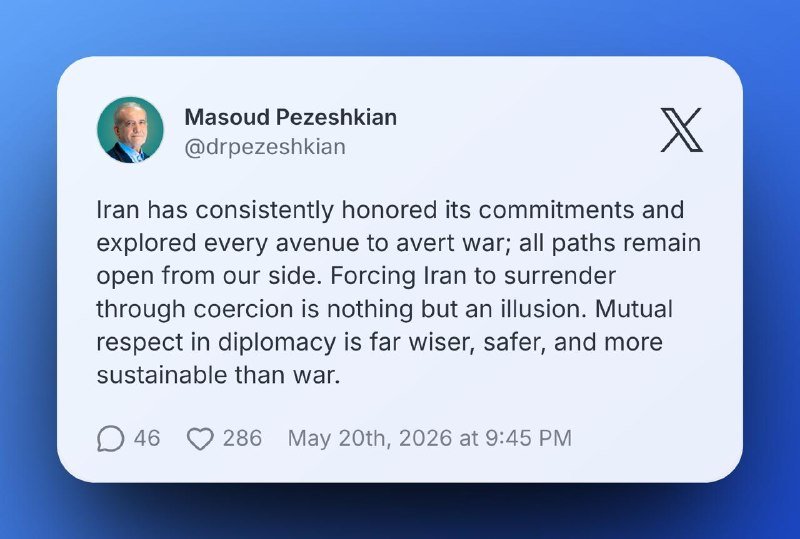
Iranian state media's framing of the President as "the head of the American terrorist state" makes clear that Tehran is not receiving the off-ramp language as an invitation. That does not mean it will refuse one permanently. The Islamic Republic has engaged in indirect negotiations under conditions of extreme pressure before. But the domestic political cost of any accommodation with Washington is now considerably higher, and the President's own statements — calling Iran destroyed, occupied, and subordinate — are exactly the kind of language that forecloses a face-saving framework for Iranian negotiators.
What Remains Unresolved
The thread from 20 May 2026 raises more questions than it resolves. The operational scope of US action against Iran — strikes, cyber, proxy disruption, or some combination — is not specified in any of the source items. The casualty figure of 13 is named but not contextualised. Whether the "we've taken over Iran" framing is a metaphor for economic and financial dominance, a description of ongoing kinetic operations, or something the President said without a fully formed policy behind it cannot be determined from the record as it stands. The location of these statements — whether a formal briefing, a campaign-style rally, or an informal press availability — also affects how much weight their content should carry.
What is not ambiguous is the direction of travel. The administration has spent the opening months of 2026 constructing a position on Iran that combines maximum-pressure language with maximum-pressure language-of-intimidation, topped with a diplomatic gesture whose sincerity is, at minimum, untested. For Gulf states watching the energy-security implications of a sustained US-Iran confrontation, for European capitals tracking whether a nuclear deal is still conceivable, and for Iran itself navigating the possibility of either negotiation or continued escalation — the statements on 20 May offer very little clarity and a great deal of noise.
This publication's wire coverage of the President's Iran statements led with the sovereignty-claim framing. Several major wire outlets led with the casualty figure as the peg. Neither framing fully captures the full sequence of statements from 20 May, which is most notable for what it reveals about the administration's discomfort with ambiguity — and the difficulty of sustaining a coherent Iran posture when the two halves of the message are so publicly at odds.
Wire provenance
This editorial synthesis draws on the following public wire/social posts:
- https://t.me/ClashReport/8478
- https://t.me/Middle_East_Spectator/1241
- https://t.me/Middle_East_Spectator/1240
- https://t.me/Middle_East_Spectator/1239
- https://t.me/ClashReport/8477
- https://t.me/JahanTasnim/4821