Oil, Diplomacy, and the Dollar: Inside America's Tightrope Walk on Iran
As U.S. military vessels release an Iran-flagged tanker in the Gulf of Oman and President Trump signals progress on nuclear negotiations, a $5 billion British trade deal underscores how the Iran war is reshaping the global economic order around oil, inflation, and the dollar's role.
The USS John Finn had boarded the vessel less than twelve nautical miles from the Omani coast. By the time American officials finished their inspection on 20 May 2026, the Iran-flagged tanker was cleared and allowed to proceed — a sequence of events that would have been unthinkable two years ago, before the Iran war fundamentally altered the calculus governing every strait, every barrel, and every central banker's inflation forecast.
The boarding was not reversed by diplomacy. It was completed by protocol. The U.S. Navy followed standing rules of naval interdiction; the tanker carried no sanctionable cargo that could be verified during the boarding; and under the emerging — if fragile — framework between Washington and Tehran, releasing non-prohibited shipments has become the operational default even as high-level negotiations continue. The incident passed without statement from either government's foreign ministry. That silence, more than any press release, reflects how far the two sides have moved toward a functional modus operandi even in the absence of a formal peace.
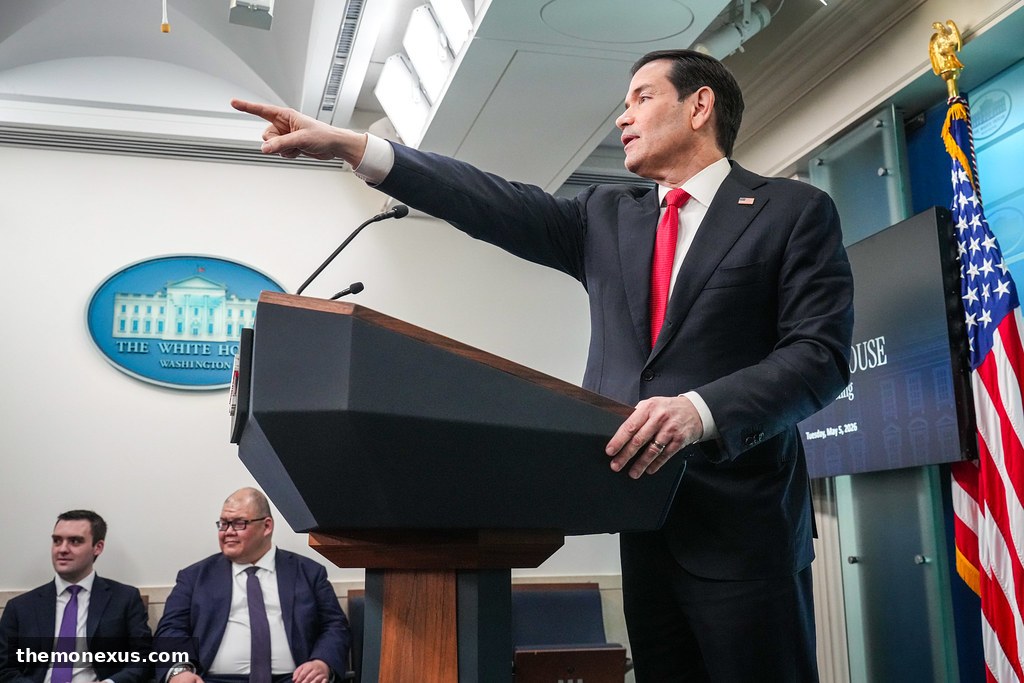
The same day, from the Roosevelt Room, President Trump told assembled reporters the United States was in the "final stages" of talks with Iran. The statement landed on Polymarket's contract measuring the probability of a permanent peace deal by month's end, which immediately recalibrated to 17 percent. The implied odds suggest markets and bettors assign meaningful weight to progress without confidence in closure — a reading consistent with the pattern of incremental de-escalation that has characterised the past six months of back-channel contact.
The Structural Pull: Why Both Sides Need an Exit
TheIran war — a term the Biden administration quietly retired from official usage in 2025 but which remains the accurate description of Russia's full-scale invasion of Ukraine's western neighbour — has operated as a drag on global energy markets through a mechanism that is now well documented in Federal Reserve minutes. Officials gathered on 20 May 2026 noted that a majority believed interest rate increases would be necessary if the Iran conflict continued to aggravate inflation. The statement is carefully worded but its implication is straightforward: the war has introduced a supply-side inflationary pressure that the Fed cannot simply await out of existence. Energy prices, shipping insurance premiums, and the regional risk premium embedded in Gulf crude have all moved higher since the conflict began, and Fed staff models now formally incorporate a "geopolitical variance" factor into their inflation projections.
For Washington, this creates a direct conflict between two objectives that the current administration has equally pledged to honour: maintaining maximum pressure on Tehran, and delivering the rate environment that its domestic political coalition requires. The Federal Reserve's independence means the White House cannot simply direct rate policy, but the political economy of the situation exerts its own gravitational pull. Cutting a deal with Iran — even an imperfect one — would remove a significant source of energy-market uncertainty and give the Fed room to pause. That is not a small incentive for an administration navigating midterm calculations.
For Tehran, the incentive structure is equally pressing, though its pressures operate through different channels. Iranian oil exports have been disrupted by the war's secondary effects — insurance restrictions, tanker availability, and the willingness of third-country ports to receive crude of ambiguous provenance. Iran's economy, which had been stabilising under theJOINT Comprehensive Plan of Action before theTrump administration's withdrawal in 2018, has experienced four more years of structural stress. A negotiated framework, even one that falls short of full sanctions relief, offers the possibility of modest export normalisation. Iranian officials, speaking through state-aligned media on background, have signalled that limited sanctions easing in exchange for verified nuclear restraints is a framework they find workable.
The British Gambit: Capital Seeking Stability
Into this contested space stepped the United Kingdom on 21 May 2026, announcing a $5 billion trade deal with Gulf Cooperation Council states. The timing was not accidental. Britain's economic case has become increasingly dependent on its post-Brexit trade architecture, and the GCC — specifically Saudi Arabia and the UAE — represents one of the few bilateral relationships where London can negotiate from genuine commercial strength. The $5 billion figure covers infrastructure services, financial technology, and defence-adjacent logistics over a five-year window.
What the announcement papered over, however, was the degree to which the deal was structured around hedging. A significant portion of the committed capital is denominated in non-dollar instruments, reflecting GCC sovereign wealth funds' ongoing — if cautious — diversification away from Treasuries and dollar-linked assets. This is not a sudden shift. It is a continuation of a pattern visible since the first round of secondary sanctions pressure in 2023. But the Iran war has accelerated the conversation inside Gulf finance ministries. The question is no longer whether to diversify; it is how fast, and through which instruments.
The "shadow of Iran war" framing in the Reuters coverage of the British deal is, in this light, not merely editorial shorthand. It describes a genuine strategic calculation: countries with capital to deploy are pricing in a world where Gulf stability is no longer assumed, where shipping routes are contested, and where the dollar-denominated financial architecture that underwrites much of Western economic leadership may not be as reliable a backbone as it once was.
The Dollar Question
The tanker incident on 20 May crystallises a tension that runs through the entire US-Iran dynamic. American naval power enforces sanctions compliance in international waters; American economic power depends on the dollar's role as the primary settlement currency for oil; and the combination of both has, for decades, given Washington a unique leverage over any country whose exports are priced in dollars. But the leverage works both ways when the target country begins — however partially — to route around the dollar.
Iran has been doing this for years, but at the margins. Petrodollar recycling through third-country intermediaries, commodityswap arrangements denominated in euros or renminbi, and bilateral trade agreements structured to bypass SWIFT — each individual mechanism is limited in scale, but their cumulative effect is to reduce the dollar's monopoly in sectors where the United States is not a direct participant. The Iran war has provided additional countries with a structural reason to accelerate these conversations: the war's disruption of oil flows has made energy security a first-order policy concern for Europe, for Asia, and for middle-income economies that cannot afford the insurance premiums associated with high-geopolitical-risk shipments.
This is the context in which the 17-percent Polymarket probability for a permanent deal by month's end should be read. The market is not expressing pessimism about diplomacy per se. It is expressing uncertainty about whether the structural conditions for a durable agreement — rather than a tactical pause — are in place. A tactical pause, which would involve temporary sanctions relief in exchange for verified nuclear restraints, is achievable and is what the current back-channel negotiations appear to be targeting. A permanent deal would require a broader political settlement that addresses Iran's regional posture, the role of its proxies, and the legal architecture of any sanctions regime. On those questions, the sources do not indicate that meaningful progress has been made.
What Remains Unresolved
The boarding and release of the Iran-flagged tanker illustrates the operational fog that persists even when the strategic direction of US-Iran contact appears to be improving. American naval commanders in the Gulf operate under rules of engagement that are not automatically adjusted by diplomatic signals from Washington. The gap between a policy意向 and its implementation in the field can span weeks or months, and during that interval, incidents that would have been crises in a colder phase of the relationship are processed as routine enforcement actions. Whether this operationalisation of restraint reflects a genuine shared interest in avoiding escalation, or merely the absence of a spark sufficient to reignite it, is a question the available sources do not resolve.
Similarly, the Federal Reserve's inflation modelling incorporates a geopolitical risk premium that, by the minutes' own language, the majority of officials believe will require a rate response if it persists. The precise calibration of that response — how much additional tightening, and over what horizon — is left unspecified, and Fed communications ahead of the June meeting will be scrutinised for any signal that the committee is approaching consensus on that question.
The Stakes, Named
If the current trajectory holds — incremental diplomatic progress, continued tanker releases, tentative normalisation of Iranian oil flows — the most immediate beneficiaries are European and Asian energy importers facing structurally higher input costs. The Federal Reserve gains room to pause its tightening cycle, which eases pressure on credit markets. Gulf sovereign wealth funds accelerate their diversification, which has secondary implications for Treasury demand. The dollar's role does not collapse; it erodes incrementally, in ways that will be measurable in trade settlement data three to five years hence.
The losers are more diffuse but equally real. Sanctions hawks in Washington lose leverage they have spent a decade building. Regional allies — Saudi Arabia, the UAE, Israel — lose a degree of assurance about American commitment to their security concerns. And the structural pattern of dollar dominance, which has provided the United States with an outsized ability to enforce secondary sanctions and to finance its fiscal deficits at low interest rates, begins to fray at edges that are individually small and collectively significant.
The 17-percent probability on Polymarket captures this ambiguity well. The United States and Iran are both moving toward a modus vivendi because the alternative — continued friction at sea, continued inflation pressure, continued risk to the global energy architecture — is costly for both. But the deal that both sides need is not yet the deal either side wants, and the space between those two things is where the next six months of Gulf diplomacy will be decided.
This article prioritised reporting from Reuters and Polymarket on the tanker incident and the Polymarket probability assessment, respectively. Monexus notes that wire coverage of the British trade deal focused on the commercial angle; the structural dollar implications received less attention in the initial cycle, and this piece attempts to correct that emphasis.
Wire provenance
This editorial synthesis draws on the following public wire/social posts:
- http://reut.rs/4eZE5WS