Sanctioning Ambassadors Won't Disarm Hezbollah
The US Treasury's decision to sanction Iran's ambassador to Lebanon is a pressure tactic with a poor historical record — and it tells us more about the limits of American leverage in Beirut than about any real plan to neutralize Hezbollah.
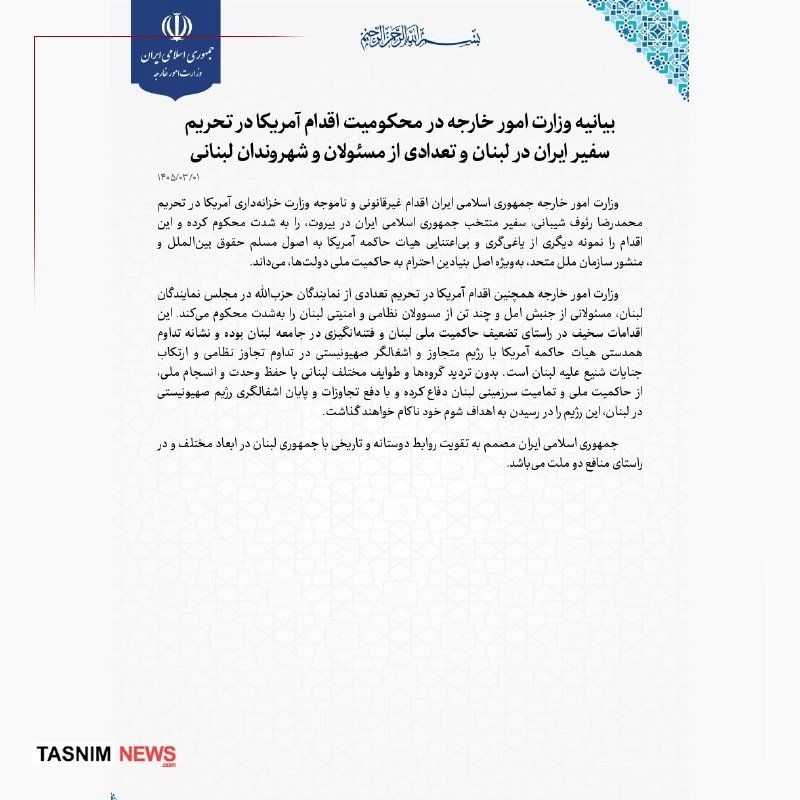
The United States Treasury sanctioned nine individuals on 21 May 2026, including Mohammad Reza Rauf Shibani, Iran's ambassador to Lebanon. The stated reason: impeding Hezbollah's disarmament. The announcement landed as Washington, Jerusalem, and a Western-aligned Lebanese government are nominally aligned on that same goal. The optics are clean. The logic is not.
This publication has watched this particular move before — not with this ambassador, not with this exact constellation, but with sufficient consistency to identify a pattern. Sanctioning a diplomat from a designated adversary, one whose government has deep institutional ties to a non-state armed group, signals resolve to domestic and allied audiences. It does not, by itself, alter the military or political calculus on the ground. What it does do is close a channel. And in Lebanon, channels are precisely what is scarce.
The Disarmament Myth and Its Provenance
The demand that Hezbollah be disarmed is not new. It has been a fixture of United Nations Security Council Resolution 1701, which ended the 2006 Israel-Hezbollah war. That resolution required the militant group to move north of the Litani River and for the Lebanese army to assume security responsibility in the south. Eighteen years later, Hezbollah retains its weapons, its political wing, and its social service infrastructure across Lebanon. The Lebanese Armed Forces have neither the capacity nor the political mandate to compel compliance. This is not speculation — it is the documented outcome of eighteen years of diplomatic engagement, Security Council language, and conditional aid packages tied to compliance.
The current American framing presents a new alignment: Washington, Tel Aviv, and what the Treasury announcement calls "the Western government of Beirut" working in concert. The phrase itself is doing unusual work. It distinguishes a faction — presumably the Lebanese government led by Joseph Aoun — from the broader Lebanese state apparatus, which includes parliamentarians, municipal authorities, and armed factions with their own territorial logic. The sanctioning of an ambassador is the latest iteration of this approach: name a problem, designate an Iranian official, issue a press release.
What Sanctions Actually Do — and Don't
The research literature on sanctions effectiveness is not ambiguous. Targeted financial measures against state actors and their proxies can constrict specific commercial flows, complicate travel for designated individuals, and signal disapproval in ways that carry diplomatic weight. They do not, as a general rule, compel governments or armed groups to surrender weapons. The Islamic Revolutionary Guard Corps and Hezbollah's financial networks have spent four decades developing resilience to exactly this kind of pressure. Shell companies, front organizations, and commodity trade networks that fall outside dollar-denominated systems are not disrupted by adding a name to a Treasury list.
Iranian state media, citing the Fars News Agency, characterized the sanctions as a sign of American desperation — a framing that should be treated with the same skepticism one applies to any government's description of its adversary's motives. But skepticism cuts both directions. The American framing, which presents the sanctions as a meaningful step toward disarming a group that has resisted disarmament for two decades, deserves equal scrutiny. The announcement does not specify what capabilities the nine designated individuals actually control, what weapons programs they fund, or what alternative pathways exist if current channels close. It names a problem and offers a symbolic response.
The Diplomatic Cost of Symbolic Pressure
Ambassador Shibani is not a clandestine operative running a weapons supply chain. He is Iran's officially accredited diplomatic representative in Beirut — a role that, whatever else it entails, includes formal communication with Lebanese state institutions. Removing that channel does not eliminate Iranian influence in Lebanon. It removes the ability of American or allied officials to transmit messages through a known intermediary, to receive information about Lebanese government deliberations, or to manage escalation through back-channel communication.
The history of sanctions on diplomats in conflict zones offers instructive examples. Expelling or designating ambassadors does not typically produce concessions from the state that dispatched them. It more often produces a restructuring of influence — proxies, informal envoys, and commercial intermediaries filling the vacuum left by official channels. The effect is not reduced Iranian presence in Lebanon. It is reduced American visibility into how that presence operates.
What This Publication Finds
The sanctions announcement on 21 May 2026 fits a well-established template: a specific, deniable action that allows the administering government to claim it is confronting an adversary while avoiding the harder work of structural engagement. The harder work, in this case, would require acknowledging that Hezbollah's disarmament is linked to a broader political settlement in Lebanon — one that addresses the security vacuum, economic collapse, and governance failure that make armed groups attractive to large segments of the population. No sanctions package, no diplomatic designation, and no trilateral alignment of foreign governments can substitute for that.
The administration may calculate that symbolic pressure serves a domestic audience, reassures regional partners, and commits nothing in terms of actual resources or political capital. That calculation may be correct. But it should be named for what it is: a posture, not a policy. The ambassador's name on a Treasury list changes the color of the paper the Americans file. It does not change the military balance in southern Lebanon, the political alignment in Beirut, or the willingness of any party to negotiate from genuine weakness. Until the structural questions are addressed — who governs Lebanon, who secures its borders, what political settlement makes armed groups redundant — sanctions of this kind are noise. And the people of Beirut have had enough of that.
Wire provenance
This editorial synthesis draws on the following public wire/social posts:
- https://t.me/farsna/124851
- https://t.me/FarsNewsInt/89234
- https://t.me/FarsNewsInt/89231