Trump Rules Out Escalation With Cuba. The Pentagon, Meanwhile, Is Building Options.
The White House says it is "freeing up Cuba." US intelligence is quietly modelling how Havana might fight back. The contradiction is not subtle.
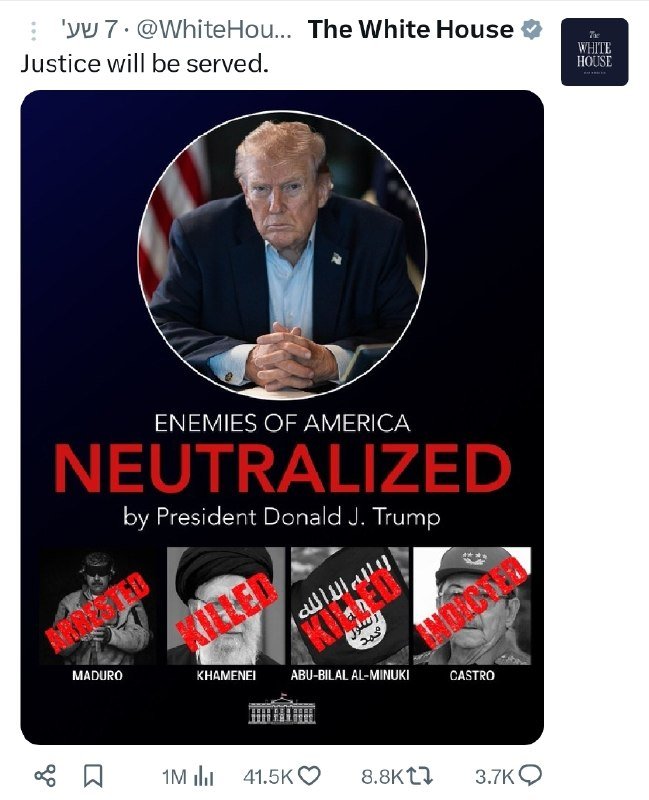
On the evening of 20 May 2026, CBS News broke a story that did not take long to confirm through independent channels. Citing US officials with direct knowledge of the matter, the outlet reported that the Pentagon had begun actively developing military options against Cuba for President Trump — and that the intelligence community was simultaneously modelling how Havana might respond to American military action. By the following morning, 21 May, Trump himself was on the record publicly ruling out escalation.
The gap between those two dispatches — one rooted in the documented work of military planners, the other in a Rose Garden podium statement — raises a question that senior officials and outside analysts have been circling for months: when this administration says it is not escalating, which version of the statement constitutes policy?
What the Sources Actually Report
The CBS News reporting, carried simultaneously across multiple open-source intelligence feeds on the night of 20 May, laid out a clear operational picture. The Pentagon, acting at what the sources described as presidential direction, had begun work on military courses of action against Cuba. The US intelligence community — the group of agencies responsible for assessing adversary behaviour — had been tasked with a separate but related problem: how would the Cuban government, military, and any backing powers actually respond if the United States acted.
Neither outlet described the specific options under consideration. No troop numbers, no target lists, no rules of engagement were in the public record as of this reporting cycle. That absence is itself significant. Military option development is a routine institutional function; the Joint Chiefs and service secretaries generate contingency plans as a matter of course. What is less routine is the signal. The fact that this work is being reported, on the eve of a Castro indictment and within days of a presidential statement disavowing escalation, is not accidental. Someone wanted that signal in the public space.
The Al Jazeera item from the early hours of 21 May captured Trump's public posture precisely: "freeing up Cuba," no escalation expected, the indictment framed as a law-enforcement measure rather than a prologue to military action. That framing is coherent as a standalone statement. It is considerably less coherent sitting alongside reports that the Defence Secretary's staff is actively scoping kinetic options.
The Castro Indictment and the Optics of Restraint
The proximate trigger for the current flux is the US indictment of a figure associated with the Castro family — a political event, not a military one, at least on its face. Indictments of foreign adversaries are a recognised tool of coercive pressure: they create legal exposure for associates, freeze financial networks, and signal seriousness without requiring a single deployment. The Trump administration's public framing leaned hard into that logic. The indictment is the action; escalation is not coming.
But the indictment also sits within a pattern. The current administration has indicted figures associated with Iran, Venezuela, and now Cuba. It has imposed sweeping sanctions on each of those countries in succession. The military option work reportedly underway with respect to Cuba — if the CBS reporting is accurate — suggests that the sanctions-and-indictment track is being run in parallel with, rather than as a substitute for, the option-development track. These are not mutually exclusive approaches. They are, however, in tension with one another when the President publicly rules out the more consequential instrument.
Cuba's own calculus in this moment is not trivial. Havana has long maintained relationships with Russia and China that provide diplomatic cover and limited economic lifelines. A military assessment that factored only Cuban capabilities against US force would be incomplete; any honest assessment would need to model the regional cascade effects, the behaviour of Venezuela as a sympathetic neighbour, and the likelihood of Chinese or Russian statements in the UN Security Council. The intelligence community's work on Cuban response, as described by the sources, almost certainly includes those variables. The political question is whether those calculations constrain the White House or merely sharpen the planning.
The Structural Context: Caribbean Power and the Precedent Problem
Cuba occupies a specific and awkward position in the western hemisphere's strategic architecture. Guantanamo Bay naval base sits at the island's southeastern tip, a physical reminder that the United States has maintained a military foothold on Cuban territory for over a century. Any contingency involving military action against Havana would immediately raise the question of that installation — its defence, its potential evacuation, or its use as a staging point for further operations. That logistical reality means military option development for Cuba is not purely hypothetical; it has a specific geographic and operational anchor.
The precedent set by announcing or leaking military option work while publicly disclaiming escalation is not unique to this administration. Every White House in the post-Cold War era has maintained a publicly visible track of diplomatic pressure alongside a classified track of contingency planning. The difference in this case is the proximity: the public disclaimer comes within hours of the leak, and the indictment that triggered the cycle is recent enough that the planning work, if begun recently, is being disclosed at a very early stage. That timing creates the appearance of incoherence rather than the managed ambiguity that normally characterises dual-track strategies.
The broader structural question is one of signal coherence — a recurring concern with this administration's approach to adversaries. When sanctions, indictments, tariff escalation, and military planning all occur within the same news cycle, and the President simultaneously rules out the most extreme option, the result is not strategic ambiguity. It is noise. Allies struggle to distinguish what is real from what is negotiating posture. Adversaries face the same confusion, which is either a feature — the confusion itself is deterrence — or a bug, if it encourages miscalculation.
What Remains Unresolved
The sources do not establish what triggered the military option development: whether it was ordered in direct response to the Castro indictment, whether it reflects a longer-running contingency review that the indictment merely surfaced in the news, or whether it was already underway before the current crisis and is being disclosed selectively. The distinction matters. If the Pentagon began this work because the White House directed it in response to the indictment, then the public disavowal of escalation is a deliberate fiction — a way of managing domestic and allied audiences while the harder work proceeds. If the work predates the indictment and the news cycle is coincidental, the incoherence is less a calculated signal and more a reflection of institutional planning running ahead of political messaging.
Cuba has not made a public statement responding to the CBS reporting. Havana's state media apparatus has not addressed the military option development, as of this publication cycle. The silence from the target is, in this context, itself a data point — whether it reflects confidence that the US will not act, absorption of the information for internal planning, or simply the bureaucratic lag of a regime that does not operate at the speed of American cable news.
The deeper unresolved question is whether this White House has a coherent theory of deterrence with respect to secondary theatres, or whether it is managing a series of separate crises with separate tools that happen to generate overlapping headlines. The Pentagon plans. The intelligence community models. The President says no escalation. The Castro indictment moves through the courts. None of these facts is false. The difficulty is that together they do not add up to a clear message about where US policy toward Cuba actually sits — or whether the military option, once built, stays in the drawer.
The desk approached this story by treating the contradiction between Trump's public statement and the CBS reporting as the lead rather than the footnote. The wire services covered both data points; this publication found the gap between them more analytically productive than the sum of the parts. The broader structural concern — signal coherence, dual-track management, the precedent problem in the Caribbean — follows from that gap rather than from either source taken alone. Whether the administration intended that gap for strategic effect or generated it through institutional noise is a question the sources do not answer. That absence is worth noting.
Wire provenance
This editorial synthesis draws on the following public wire/social posts:
- https://t.me/osintlive/2847
- https://t.me/insiderpaper/4821
- https://t.me/osintlive/2845