Trump's Wedding Absence and the Architecture of Diplomatic Pressure
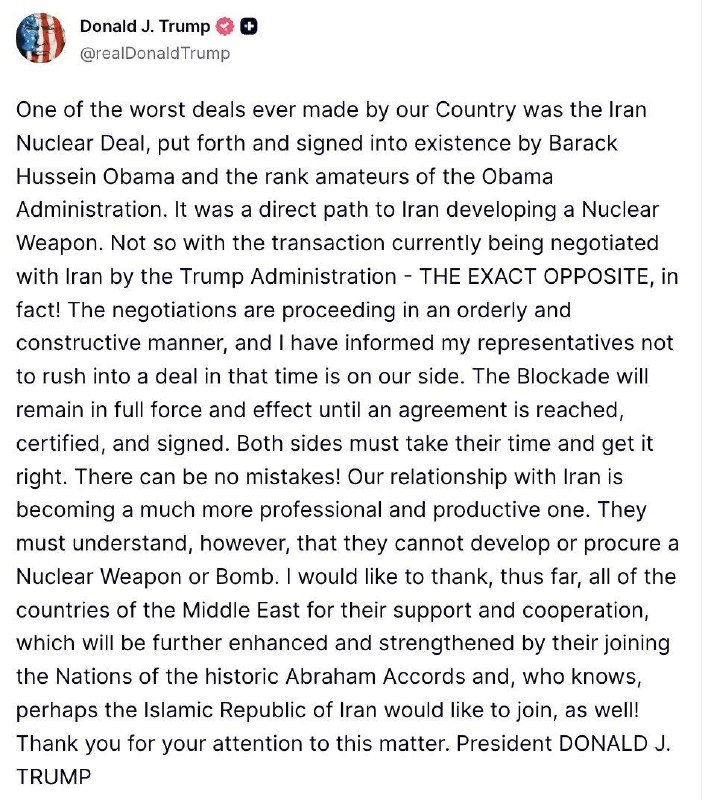
On 22 May 2026, President Trump confirmed he would not attend his son Donald Trump Jr.'s wedding. The stated reason: pressing diplomatic business. Specifics were not offered, but the timing places the absence alongside a renewed Washington push on Iran — a dossier the administration has placed at the centre of its Middle East agenda since taking office. The Gulf capitals of Abu Dhabi, Riyadh, and Doha, per a Wall Street Journal account also carried by the unusual_whales wire aggregate, have each independently urged the White House against restarting hostilities. Trump, meanwhile, told reporters Iran is "dying to make a deal" — language that frames the Islamic Republic not as a negotiating partner with equities to protect, but as a supplicant awaiting American terms.
The convergence of a family occasion and a geopolitical ultimatum would, in most administrations, be handled with more deliberate ambiguity. This one renders the calculus in public. A president's son gets married, and the schedule does not bend. Either the Iran file is genuinely urgent — or it is useful as theatre, demonstrating to domestic audiences and regional partners alike that the Oval Office does not pause. Both readings may be accurate simultaneously.
The Gulf's Quiet Dissent
What is notable about the UAE, Saudi Arabia, and Qatar each issuing separate appeals is not merely the substance — peace, stability, non-escalation — but the form. These are not public statements. They are private signals, relayed through diplomatic channels and later reported, that Gulf capitals want no part of a renewed Iran conflict. That restraint itself communicates. The region has absorbed the costs of the 2019–2020 US-Iran maximum-pressure campaign, which produced neither a new deal nor a capitulated adversary, only a set of calibrated Iranian responses — uranium enrichment steps, proxy pressure, and diplomatic frost that persisted through the Biden administration's attempted rehabilitation. The lesson Riyadh and Abu Dhabi drew, quietly but unmistakably, is that American pressure on Iran generates regional instability regardless of whether it succeeds.
Trump's framing — "Iran is dying to make a deal" — inverts that lesson. It suggests the Islamic Republic's position is weak, its economy constrained, its negotiating need genuine. Whether that assessment reflects current Iranian conditions or is a negotiating posture designed to extract maximum concessions before any talks begin remains genuinely unclear. What is clear is that the Gulf states, by pressing their private objections into the public record, are signalling that they do not share the White House's read of Iranian weakness, or at least do not believe it worth the regional consequences of testing it.
Debt, Growth, and the Diplomatic Carousel
Separately — and this matters — the unusual_whales wire captured a Trump statement that the United States would "grow our way out of debt." The remark was made in the same reporting window as the Iran push and the wedding absence. Fiscally, the arithmetic is contested: mainstream economic analysis has long held that sustained growth rates required to meaningfully reduce a $36 trillion debt burden are well above historical averages, and that structural deficits — driven by entitlement spending and demographic headwinds — do not respond to growth alone. Stylistically, however, the comment fits a pattern: the administration presents its preferred outcome as inevitable, then treats dissenting analysis as defeatism. Whether applied to sovereign debt or nuclear diplomacy, the logic is identical. The numbers are what they are; the will is sufficient.
That bundling of economic optimism and Iran pressure is not coincidental. Both allow the administration to present itself as dynamic, forward-moving, unencumbered by institutional constraints. A president who cannot be bothered to attend his son's wedding — or who chooses not to — is making a claim about where his attention belongs. The claim may be genuine. It may also be a signal to counterparties: deal with me now, on my timeline, because I am not distracted by ordinary life.
The Stakes of Non-Attendance
For Gulf Arab states, the stakes are concrete. A US-Iran military confrontation, even one that stays short of full-scale war, disrupts the shipping lanes, energy infrastructure, and diplomatic relationships that Abu Dhabi and Riyadh have spent a decade carefully cultivating. The Abraham Accords, still nominally alive, depend on a regional environment stable enough for further normalisation. A renewed Iran crisis makes that environment inhospitable. Qatar, whose economy is built on natural gas exports and whoseAl Udeid airbase hosts American forces, has perhaps the most acute exposure of the three. Its quiet diplomacy — urging restraint through back-channels rather than public statements — reflects an awareness that it cannot afford to be seen as blocking American policy, but also cannot afford the alternative.
For Iran, Trump's non-attendance at a wedding may register as trivial; the Islamic Republic has survived maximum pressure before. But the convergence of a "dying to make a deal" posture with absent family ceremony tells a story about American priorities that Tehran will read carefully. An administration that treats a nuclear deal as a domestic scheduling convenience is an administration that may also treat it as disposable once the political calendar shifts. Iranian negotiators, if talks materialise, will factor that unpredictability into every position.
The wedding will proceed without the father of the groom. The Iran negotiations will proceed, perhaps, without a deal. Gulf capitals are hoping, in the interval, that the second outcome does not foreclose the first.
This publication's coverage of the Gulf-Iran dynamic prioritises Arab-Gulf wire reporting and direct attribution to named regional officials over Washington-sourced framing. Where the White House and Tehran disagree on fundamentals, both positions are stated plainly; the reader, not the headline, draws the conclusion.
Wire provenance
This editorial synthesis draws on the following public wire/social posts:
- http://reut.rs/3RDj5LS
- https://x.com/unusual_whales/status/1924187302129058393
- https://x.com/unusual_whales/status/1924163308910592261
- https://x.com/unusual_whales/status/1924131901123456789
- https://x.com/unusual_whales/status/1924034500812345678