Bilbao, the Flotilla, and the Language of Legitimacy
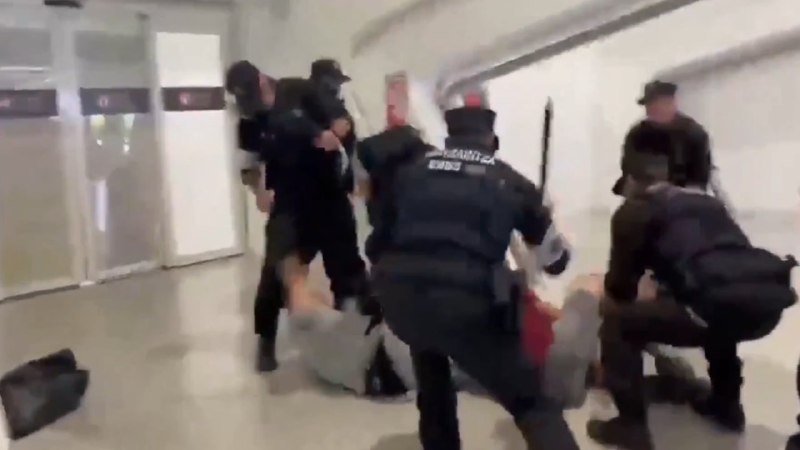
On 23 May 2026, a group of pro-Palestinian activists who had attempted to reach Gaza by sea — intercepted and deported by Israeli authorities — arrived at Bilbao Airport in northern Spain. Within hours, the incident had produced two entirely different accounts of what unfolded on the terminal floor.
One version, relayed by accounts describing the deportees as "terrorists from the flotilla," held that the arrivals "began rioting, as is their custom." Another framing, from accounts presenting the same group as political refugees exercising a right to protest, described a heavy-handed police response to peaceful demonstration. Both accounts cannot be fully accurate simultaneously. Both circulated as verified fact.
This is not a story about who is right. It is a story about the infrastructure of truth-claims — who builds it, who controls it, and what gets lost in the transmission.
The Framing Problem Was Built Into the Caption
The Telegram posts that first aggregated this incident did not wait for corroboration. They tagged the arrivals as "terrorists" in the same breath that they described their conduct. That label — applied not by any court or designated authority but by the uploader — became the frame through which subsequent audiences consumed whatever footage followed.
This is not an isolated practice. When a group is defined by its political destination rather than its conduct, the characterization does analytical work before any facts enter the frame. The word "riot" carries different weight depending on who is doing the rioting and why. A protest by construction workers in Warsaw and a protest by pro-Palestinian advocates in Bilbao are not held to the same linguistic standard by all observers. The same act — raising a flag, refusing to disperse, shouting — gets labelled differently based on whether the observer agrees with the cause.
The result is a situation where the editorial framing precedes the event rather than describing it. Language that would be treated as inflammatory in other contexts becomes a neutral descriptor when applied to a politically inconvenient group.
What the Bilbao Incident Reveals About Spain's Position
Spain's willingness to accept and process the flotilla arrivals places Madrid in an increasingly uncomfortable position among its Western allies. Since the International Court of Justice issued its preliminary ruling on Gaza, several European capitals have recalibrated their public framing — not always their policies — to acknowledge a humanitarian dimension that the United States and Israel continue to dispute.
Sánchez has been attempting to navigate that tension without fully satisfying either camp. He faces domestic pressure from voters who view the government's Gaza positioning as insufficiently critical of Israel, and diplomatic pressure from partners who view any softening of that stance as a concession to forces hostile to Western interests.
The Bilbao incident complicates both pressures simultaneously. Hardliners who want Spain to break more decisively with Israel's government can point to the deportees' treatment as evidence of what that government does to those who challenge its封锁. Western partners who view the flotilla as a deliberate provocation — intended to generate precisely the footage and the diplomatic friction that followed — will read Bilbao as proof that the activists achieved their objective.
Neither reading is wrong. That is the problem.
The Madrid Factor: Protests, Sánchez, and Political Contagion
The Telegram thread also surfaced unverified reports of mass protests in Madrid on the same day, calling for Sánchez's resignation over corruption allegations. While the sources do not provide independent corroboration of scale or composition, the simultaneous occurrence of a volatile airport incident and broader political demonstrations creates conditions for conflation.
Spain has been navigating a fragile coalition environment, with the left-of-centre government under sustained pressure from both the far right and from sections of its own parliamentary base. When an incident involving deportees from a politically charged context coincides with domestic anti-government mobilisation, the risk of instrumentalisation runs in multiple directions simultaneously.
Critics of the government's Gaza positioning can use Bilbao to argue that Spain is becoming a destination for radicalised actors. Supporters of that positioning can use the same images to argue that Israel is exporting its conflict to European soil. Both framings serve political actors who need the images more than they need the truth.
What remains unclear from the available sources is whether the deportees' conduct at Bilbao Airport constituted a genuine public order threat or whether the police response was calibrated to a political rather than a security objective. That distinction matters enormously, and the sources currently available do not resolve it.
The Stakes of Unresolved Framing
The immediate consequence of this incident is diplomatic rather than legal. Israel will note that Spain processed the arrivals and may draw conclusions about Madrid's willingness to accommodate what it characterises as hostile political theatre. The European Union will observe the incident and file it under the broader question of how member states manage arrivals linked to third-country political conflicts. Spanish opposition figures will use footage of the airport confrontation to argue that the government's foreign policy positions carry domestic security costs.
The longer-term consequence is less visible but more consequential: each incident of this kind normalises a version of the truth-claims infrastructure in which a political faction's characterisation becomes the default public record. Once a group is labelled in the initial frame, every subsequent piece of information is processed through that label. Correcting the record requires more effort than building it in the first place — and most audiences do not make that effort.
What Remains Unresolved
Several factual questions from this incident cannot be answered from the current source material. The deportees' legal status upon arrival — whether they entered as tourists, political asylum seekers, or some other designation — is not specified. The Spanish government's formal response to the arrivals has not been independently reported in the available thread. The specific conduct that prompted the police response remains contested between the two framing narratives. And the relationship, if any, between the Bilbao arrivals and the Madrid protests described in the same thread is not established.
These are not trivial omissions. They are the difference between a story about exercising the right to protest and a story about political violence. Until independent verification supersedes the framing contests currently driving the narrative, the Bilbao Airport incident remains a case study in the fragility of factuality under conditions of intense political competition — not a settled account of what happened.
Desk note: Monexus relied on Telegram-sourced aggregation for this incident, as no wire-service headline had landed at time of drafting. The Telegram accounts in the thread used language that this publication would not employ independently — specifically, the designation of deportees as "terrorists" based on their political destination. That framing is noted as part of the story, not adopted as editorial fact.
Wire provenance
This editorial synthesis draws on the following public wire/social posts:
- https://t.me/englishabuali/3842
- https://t.me/englishabuali/3841
- https://t.me/abualiexpress/2109