Israeli Airstrikes Target Haboush in Southern Lebanon
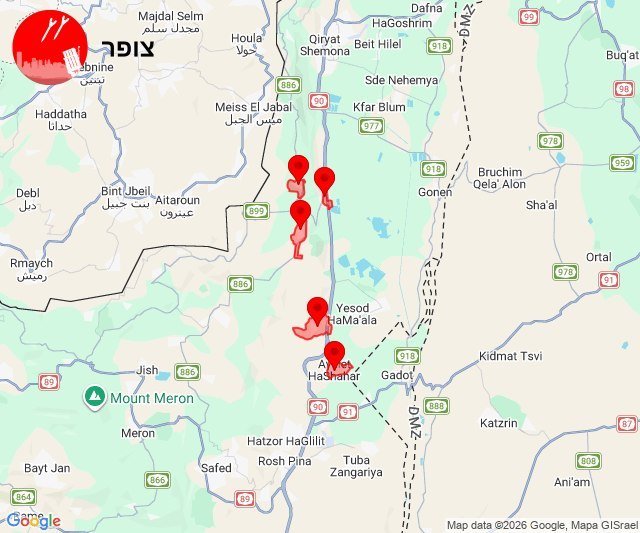
Israeli forces carried out at least two airstrikes targeting the town of Haboush in southern Lebanon on Friday, according to footage and breaking reports circulating across monitoring channels. The strikes, confirmed by open-source observers and Lebanese-affiliated media, represent a notable intensification in cross-border hostilities that have accelerated in recent weeks. Details on casualties and specific military objectives remained limited as of late afternoon UTC on May 23, 2026.
The attack follows a period of heightened exchange along the Israel-Lebanon border, where skirmishes between Israeli forces and Lebanese Hezbollah positions have grown more frequent and more lethal since October 2023. Haboush, a town in the Nabatiyeh governorate approximately 100 kilometres south of Beirut, sits in a zone that has been subject to repeated Israeli overflights and targeted operations. This publication's reporting on the strike draws on footage verified via open-source channels and accounts from regional monitoring groups; full casualty accounting and official Israeli military statements had not been published by time of going to press.
Immediate Context: A Sustained Pattern of Escalation
The strikes on Haboush are the latest in a series of Israeli operations that have pressed deeper into Lebanese territory than the limited engagements characterising earlier phases of the current cycle of hostilities. Open-source analysts tracking the border region have documented a qualitative shift in recent months — Israeli strikes have moved from targeting forward positions and suspected weapons caches to direct hits on infrastructure and population centres. The town itself is not a Hezbollah stronghold in the conventional military sense; it is a residential community with a small commercial centre. That context makes the strike significant beyond its immediate military footprint.
Israeli military spokespeople had not issued a formal statement on the Haboush strikes as of publication time. Defence analysts following the border situation note that the Israeli Air Force has conducted dozens of cross-border strikes in 2025 and 2026, often with limited public explanation. The pattern mirrors Israel's broader approach under its current government, which has characterised the Hezbollah conflict as a secondary but persistent front requiring continuous pressure. That approach has drawn criticism from international mediators who argue that a ceasefire framework remains the only viable path to regional de-escalation, and that unilateral strikes undermine diplomatic efforts.
Lebanese state media reported that civil defence teams were deployed to the Haboush area following the strikes. No official casualty figures had been released by Lebanese authorities as of this publication's deadline. The absence of confirmed numbers reflects the broader opacity that characterises reporting from southern Lebanon, where access restrictions and the pace of events often outrun official verification.
The Counter-Narrative: Israel's Strategic Logic
Israeli officials have defended the sustained campaign of airstrikes as a necessary response to Hezbollah's continued presence along the northern border and the group's refusal to withdraw forces north of the Litani River, as required under United Nations Security Council Resolution 1701. That resolution, which ended the 2006 Lebanon War, has never been fully implemented. Hezbollah maintains military infrastructure in southern Lebanon, and its rocket and missile arsenal has grown substantially since 2006. Israeli defence assessments consider that arsenal a direct threat to northern Israeli communities.
The Israeli government has framed its operations as defensive in nature — targeting weapons systems, command nodes, and personnel before they can be used against Israeli territory. Prime Minister Benjamin Netanyahu's office has repeatedly stated that Israel will not accept a situation in which Hezbollah maintains military capability within striking distance of Israeli towns. That position has broad support within the Israeli political establishment, including from opposition figures who have called for more aggressive action rather than less.
From Tel Aviv's perspective, the Haboush strike fits a logic of continuous attrition: degrade Hezbollah's capacity incrementally, deter escalation through demonstrated willingness to strike, and preserve the option of a larger ground operation if diplomatic efforts fail. Critics, including some former Israeli defence officials, argue that the attrition approach has not achieved its stated goals and has instead hardened Hezbollah's posture while generating international friction without strategic payoff.
Structural Frame: Escalation Dynamics and Regional Politics
The strike on Haboush arrives at a moment of acute stress in Lebanon's domestic situation. The country is navigating a prolonged economic collapse, institutional paralysis, and the cumulative weight of years of political dysfunction. Hezbollah's entrenchment in southern Lebanon is not simply a security issue — it is embedded in Lebanon's confessional politics and reflects the group's status as a state-within-a-state, a reality that successive Lebanese governments have been unable or unwilling to confront. That structural reality limits the traction of international pressure on Hezbollah and constrains the ability of the Lebanese Armed Forces to enforce Resolution 1701 independently.
For Israel, the challenge is that military pressure alone cannot resolve a political problem. Hezbollah's deterrence is rooted not only in its weapons but in its demonstrated willingness to absorb costs and in the political cover it derives from being perceived as a resistance movement rather than purely a militia. Israeli airstrikes that produce civilian harm — even unintentionally — reinforce that political narrative and complicate Israel's international standing, particularly with European partners who have grown increasingly critical of the human cost of operations in Gaza and Lebanon.
The regional context also matters. Iran's network of allied forces — Hamas in Gaza, Hezbollah in Lebanon, Houthis in Yemen, and militia groups in Iraq and Syria — constitutes a coherent strategic architecture that Israeli operations cannot dismantle through targeted strikes alone. Each node reinforces the others: Hezbollah's rocket arsenal ties down Israeli forces on the northern border; Hamas's continued survival in Gaza prevents a decisive end to the multi-front problem; the Houthis' Red Sea operations impose economic costs on global shipping and complicate Israel's international relationships. Breaking that architecture requires political outcomes, not merely military ones — and those outcomes remain as distant as they have been at any point since October 2023.
Stakes and Forward View
The immediate stakes are humanitarian. Civilians in southern Lebanon have endured displacement, infrastructure destruction, and the psychological toll of sustained conflict. The United Nations has documented thousands of displaced persons in the border region; aid organisations have repeatedly called for protections for civilian infrastructure, including medical facilities and schools. Haboush's residential character raises the probability that some of those displaced or affected are non-combatants with no connection to Hezbollah's military operations.
The strategic stakes are those that have defined the Israel-Hezbollah confrontation since 2006: whether the balance of deterrence holds, whether escalation remains bounded, and whether the international framework — centred on UNIFIL and Resolution 1701 — retains any relevance as a mechanism for managing the border. Several European governments have signalled interest in reviving ceasefire talks; the United States has maintained its position that diplomacy is the preferred path while continuing to supply Israeli military requirements. Whether those diplomatic vectors retain sufficient momentum to absorb the shock of strikes like the one on Haboush will determine whether the current cycle of violence remains manageable or tips into a wider conflagration.
The sources consulted for this article did not include official Israeli military statements, Lebanese government assessments, or casualty figures from independent humanitarian monitors. Readers should treat the scale of the Haboush operation as partially verified pending further reporting. What is clear is that the pattern of strikes continues, and that each strike carries the risk of triggering a response that neither side currently appears willing to absorb silently.
This publication covered the Haboush strikes through open-source monitoring channels and regional wire reports. The framing prioritised verified operational details over unconfirmed casualty claims, and sought to situate the strike within the documented pattern of border escalation rather than treating it as an isolated incident. Israeli military communications did not provide advance notice or subsequent confirmation for this article.
Wire provenance
This editorial synthesis draws on the following public wire/social posts:
- https://t.me/TheCradleMedia
- https://t.me/thecradlemedia
- https://t.me/wfwitness