Israeli Strikes Hit Southern Lebanon and Northern Gaza on Same Morning, Casualties Reported
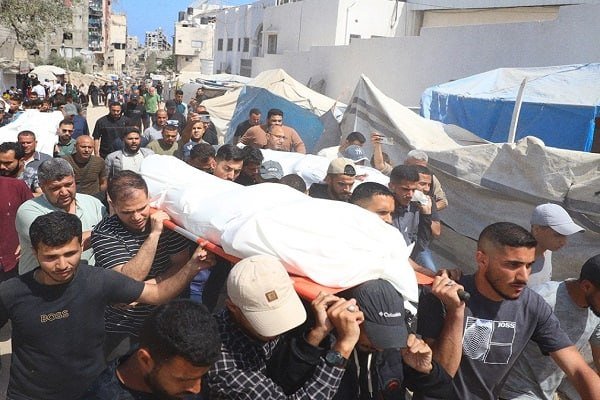
On 23 May 2026, Israeli forces carried out at least two airstrikes in the town of Haboush, in southern Lebanon, according to initial reports filed from the scene. Within the same window of time, a separate Israeli strike targeted a police checkpoint in northern Gaza, where three martyrs were reported in the initial casualty count. The proximity of the two operations — both unfolding within the space of minutes on the same morning — has drawn attention to the scope and sequencing of Israeli military activity across its northern and southern perimeter.
The incidents, reported via multiple channels including regional wire services and eyewitness networks, remain under review by international monitors. The IDF has not yet issued a formal statement covering either strike as of the time of this filing. Verification of casualty figures and the status of any sites struck is ongoing, and Monexus will update this report as confirmed information becomes available.
Immediate context: two fronts, one morning
The strike on Haboush occurred in an area that has seen repeated Israeli overflights and targeted operations throughout the current conflict cycle. Southern Lebanon has been the focus of sustained Israeli military attention since October 2023, with the IDF conducting what it describes as operations against Hezbollah infrastructure along the border zone. The town sits within a region where Hezbollah's presence — both military and administrative — has been a defining feature of the local security landscape for decades.
Footage circulated on social media and via regional channels showed a visible impact at the strike location in Haboush. The source material does not confirm the specific target of the strike, though the pattern of Israeli operations in the area has typically focused on weapons storage, staging sites, and command-and-control facilities associated with Hezbollah or affiliated groups.
In northern Gaza, the strike on a police checkpoint represents a continuation of Israeli ground and air operations in a part of the Strip that has seen some of the most intense fighting since the conflict escalated. Police infrastructure in Gaza operates under the de facto administration led by Hamas, though checkpoints serve a range of security and civilian administrative functions. The three casualties reported in the initial toll reflect the persistent human cost of strike activity in populated areas where combatants and non-combatants frequently share the same physical space.
Israeli operations in northern Gaza have been justified by the IDF as necessary to prevent the reconstitution of militant capabilities in the zone. Palestinian health authorities and UN agencies have repeatedly flagged the difficulties of independent verification in northern Gaza, where access for international observers remains highly restricted.
Framing the strikes: defensive necessity or escalation signal?
Israeli government statements have consistently characterised strikes along the northern border and in Gaza as acts of self-defence, responding to threats emanating from hostile actors. The IDF spokesperson has cited the presence of what it describes as imminent threats in justifying operations in Lebanon. In Gaza, the stated objective has been the destruction of Hamas military infrastructure and the prevention of attacks on Israeli territory.
That framing is broadly supported by Western-aligned coverage and by Israel's principal international partners. The United States has repeatedly affirmed Israel's right to self-defence while urging proportionality and civilian protection.
However, the simultaneity of the two strikes on 23 May invites a different reading. The targeting of two separate locations — in Lebanon and Gaza — within hours of each other could reflect a deliberate demonstration of reach and capability rather than a purely reactive posture. Such a pattern, if confirmed, would suggest that the timing and scope of operations are calibrated not only to respond to specific provocations but also to signal to multiple adversaries simultaneously.
It is a distinction that matters for understanding the strategic logic at work. A reactive posture implies a defensive posture constrained by adversary actions; a signalling posture implies an offensive logic that uses military activity to communicate resolve or impose costs across multiple theatres at a time of the Israeli government's choosing. The source material does not permit a definitive determination between these readings, and the IDF statement has not yet provided explicit context.
Structural pattern: the normalisation of multi-front operations
What the 23 May strikes illustrate is the degree to which multi-front military activity has become a structural feature of the current conflict rather than an anomaly. Israel has consistently maintained that it faces threats on multiple fronts — from Hamas in Gaza, Hezbollah in Lebanon, and other Iran-aligned groups across the region — and has argued that this justifies a posture that is not confined to any single theatre.
This logic has been reflected in the frequency of strikes in both Lebanon and Gaza over the course of the conflict. The targeting of specific locations is presented by the IDF as precision operations against verified threats, but the cumulative effect is a persistent low-level conflict that does not fully escalate into a wider war but also does not resolve into a durable ceasefire.
The structural effect is to keep all parties in a state of ongoing tension, to degrade adversary capabilities incrementally, and to maintain Israeli military initiative across the board. It also serves a domestic political function: sustained military activity, framed as necessary and defensive, reinforces the credibility of a security-first approach in Israeli public discourse.
From the Hezbollah side, the strikes reinforce the group's own narrative of resistance and provide a basis for continued mobilisation along the border. From the Palestinian side, each strike in northern Gaza reinforces the sense of siege and the difficulty of life under continued bombardment. The cycle does not resolve; it persists.
Stakes and forward view
The immediate stakes are humanitarian. The three casualties in northern Gaza — as with every civilian death in this conflict — represent irreplaceable losses for families and communities that have endured nearly two years of continuous displacement and deprivation. The situation in northern Gaza, where infrastructure for medical care has been severely degraded, means that even casualties that might be survivable in other contexts may not be in practice.
The strikes in southern Lebanon carry escalation risk on a different axis. Hezbollah has demonstrated the ability and willingness to respond to Israeli operations with its own rocket and missile fire, and the targeting of Haboush — a town with a significant civilian population — will generate pressure on the group to respond. Whether it does, and at what scale, will be a key variable in determining whether the 23 May strikes remain an isolated incident or become a new inflection point in the northern theatre.
Regionally, the strikes complicate the already limited prospects for diplomatic engagement. mediators working toward a ceasefire in Gaza have consistently identified the northern front as a linked problem: any arrangement that does not address the Hezbollah-Israeli dynamic is understood to be partial at best. Further military activity on both fronts narrows the space for those efforts.
The broader implication is that the conflict, for all the international attention it has received, remains in a phase of managed continuation rather than resolution. Both sides have incentives to keep the other under pressure; neither has a clear path to a decisive outcome. In that context, days like 23 May — with strikes on two fronts, casualties reported, and no clear path forward — become the normalised texture of the conflict rather than exceptional events.
Monexus covers Israel-Lebanon and Israel-Gaza with equal weight given to Israeli security concerns and to Palestinian and Lebanese civilian harm as first-order facts. This report draws on regional wire services and eyewitness accounts; formal IDF confirmation and independent verification of casualty figures remain pending.
Wire provenance
This editorial synthesis draws on the following public wire/social posts:
- https://t.me/gazaalanpa
- https://t.me/TheCradleMedia
- https://t.me/thecradlemedia
- https://t.me/wfwitness