Trump's Iran Pivot Is Less Diplomacy Than Delayed Transaction
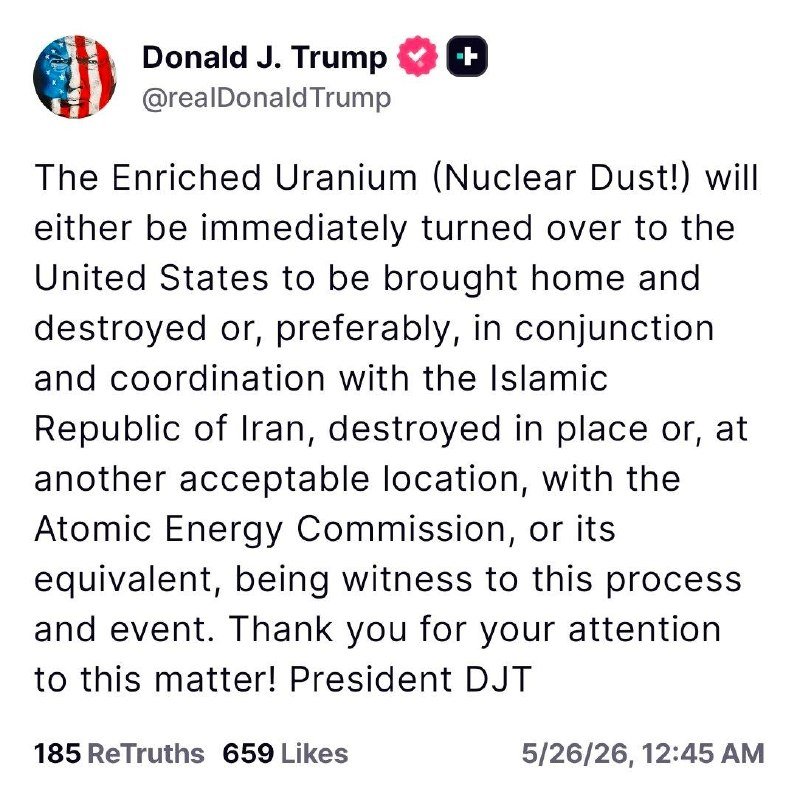
There is a difference between pausing a negotiation and understanding one. The Wall Street Journal reported on 22 May 2026 that Donald Trump told aides at a Friday meeting that he wants to give Iran diplomacy more time. CNN, in its own reporting that same week, described a presidency focused on personal interests, with a confusing seven-day stretch in which the concept of unity was reshaped and reshuffled to fit whatever occasion demanded it. Taken together, these two accounts describe something more familiar than it does transformative: a leader reaching for the instrument he reaches for first.
That instrument is delay dressed as strategy. The White House has not announced a new Iran policy. The Islamic Republic has not suspended its uranium enrichment programme. What has happened is a recognition—quietly circulated to journalists via official sources—that pressure without resolution is a cost, not a win. Trump reportedly told aides he wants more time. That is not a concession to Tehran. It is a recognition that his own leverage has a half-life.
The Confusion Is the Point
CNN's characterisation of Trump's week as confusing is not a media invention. When a president publicly redefines what unity means within the span of days—embracing multilateral language on Monday, reverting to nationalist framing by Thursday—the confusion is structural, not accidental. It reflects an administration that has not decided what it wants from Iran and has therefore not decided what it will accept.
The original maximum-pressure posture was built on a theory: suffocate the Islamic Republic financially, force capitulation, extract a better deal than the one Barack Obama signed in 2015. That theory failed. Sanctions reduced Iranian oil exports dramatically, but Tehran did not collapse. It adapted—deepening ties with China, accelerating enrichment, and waiting for a Western political class it calculated would eventually tire of the cost. That calculation, however cynical, turned out to be correct in outline if not in timeline.
What the Journal now describes is an administration that has arrived at the same conclusion through a different route: not that maximum pressure failed, but that the deal it wants cannot be struck at the speed the White House initially preferred. Patience, in this reading, is not diplomacy. It is the recalibration of a deadline.
Tehran's Position Has Not Changed
The Iranian side has given no public indication that it views this moment as an opening. President Masoud Pezeshkian has maintained the positions his predecessor held: sanctions relief in return for verified nuclear约束, no preconditions for talks, and a firm line on enrichment levels Iran considers its sovereign right. Iranian state media has covered the American shift with scepticism, framing it as internal American pressure forcing a tactical adjustment rather than a genuine change of position.
That framing is self-serving, but it is not unreasonable. The Islamic Republic has watched American presidents oscillate between engagement and confrontation for forty-six years. It has survived sanctions, cyberattacks, the assassination of Qasem Soleimani, and the collapse of the 2015 nuclear deal under Trump himself. Institutional patience is not a virtue Tehran cultivates by choice—it is a structural feature of a regime that has no electoral accountability forcing urgency onto decision-making. Tehran can outlast an American administration that changes direction every news cycle.
The asymmetry matters. Washington operates on electoral time; Tehran operates on generational time. A decision to extend diplomatic timelines by months—or by a term—may be experienced as patience in the White House and as confirmation of established Iranian assumptions in Tehran.
The Deal That Could Be Struck
The substantive shape of a US-Iran understanding is not mysterious. A verified freeze on enrichment above five percent, intrusive IAEA monitoring, and sanctions relief structured in tranches tied to compliance—this is the architecture that produced the Joint Comprehensive Plan of Action in 2015 and it remains the outline any serious negotiator would start from. Whether Trump wants that deal, wants a different deal, or simply wants a deal to point to as evidence of his negotiating prowess are three different questions with very different implications.
The danger is not that diplomacy fails. Negotiations routinely fail before they succeed. The danger is that an administration frames extension as progress because the alternative—admitting the original posture was wrong—costs more politically than admitting it needs more time. Iranian negotiators understand this dynamic intimately. They have navigated American domestic politics as a variable in every round of talks since 2001.
What This Moment Requires
The sources do not tell us whether Trump has genuinely recalibrated his theory of the Iran file or whether he is managing a difficult week. Both readings are consistent with the public record. What the record does not support is treating the reported desire for more time as evidence of strategic coherence.
Diplomacy requires a clear-eyed picture of what the other side wants and what it will accept. The current administration appears to be working toward the former while remaining undecided about the latter. That is a recognisable starting position. It is not, by itself, a policy.
The Iranian nuclear programme continues. The sanctions architecture remains largely intact. The IAEA has not been granted the access it needs to certify Iran's programme as exclusively peaceful. Whether the next few months produce a breakthrough, a breakdown, or simply more time is a question the available reporting cannot answer. What this publication can say is that the confusion CNN identified is not behind us. It may be the defining condition of whatever comes next.
Wire provenance
This editorial synthesis draws on the following public wire/social posts:
- https://t.me/JahanTasnim/11234
- https://t.me/JahanTasnim/11233
- https://t.me/alalamarabic/14892