The Deal or the War Room: Trump's Iran Moment Tests the Limits of Leverage
With markets pricing a 70% chance of a breakthrough and Trump oscillating between deal-maker and war commander, the next 48 hours will determine whether Tehran's calculus has genuinely shifted — or whether this is a negotiating position dressed up as a diplomatic moment.
The telegraph lines between Washington and Tehran are running hotter than at any point since the January strikes. Polymarket traders — never a reliable political barometer, but an honest record of crowd sentiment — have priced a 70 percent probability that the United States lifts its Hormuz blockade before the end of May. That is not a small bet. It reflects something specific: a genuine belief among informed participants that the deal Trump has been threatening is actually closer than the war he has also been threatening.
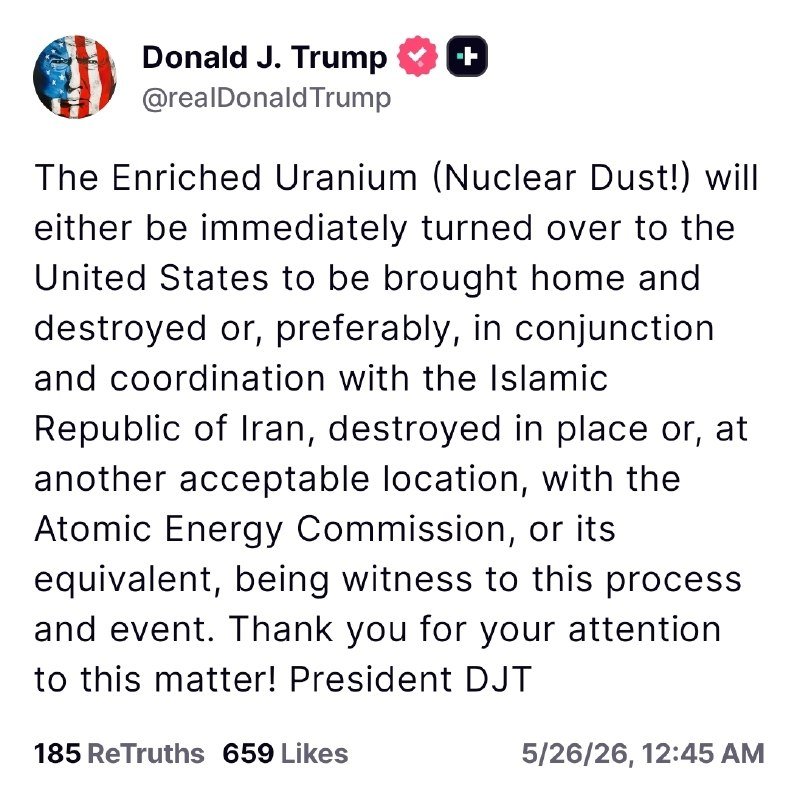
The signal from the White House itself has been characteristically contradictory. Trump told reporters on 23 May that his conversation with Israeli Prime Minister Benjamin Netanyahu "went very well," and that a peace deal would be announced shortly. The same day, he described the Iran question as a "solid 50/50" — either a deal or a return to military operations. Hours before, he had posted an image of the US flag planted over Iranian territory and cancelled his weekend plans to remain in the War Room. The simultaneous dispatch of diplomatic openness and military readiness is a messaging strategy that keeps both options viable for as long as possible.
The diplomatic window that pressure created
The Polymarket consensus did not emerge from thin air. Reporting on the afternoon of 23 May indicated that US and Iranian officials were expecting to announce a draft peace framework by the following afternoon — 24 May — a timeline that would represent one of the faster diplomatic turnarounds in recent Middle East history. If the announcement lands, it will come after weeks of escalating rhetoric, two carrier strike group deployments, and the near-completion of an encirclement strategy around the Strait of Hormuz. The question is whether Tehran blinked, or whether it simply found a more advantageous moment to talk.
The Hormuz blockade is the load-bearing pressure point of the entire confrontation. Iran generates the majority of its export revenue from oil and gas; a sustained disruption to that flow erodes the financial foundations of both the IRGC's regional operations and the civilian government's capacity to manage domestic discontent. That does not mean the Iranian leadership caved — it means that a regime built on strategic patience recognized a moment when the cost of talking was lower than the cost of continued resistance. Negotiation under pressure is still negotiation. The terms that emerge from the next 48 hours will reveal how much the United States actually extracted versus how much it merely re-labelled the status quo.
The optics of the War Room
The image Trump shared on 23 May — US flag over Iran, weekend cancelled, War Room mode activated — is doing double duty. Domestically, it signals strength to an audience that rewards decisiveness and punishes hesitation. Internationally, it serves as a pressure signal to Tehran: the military option is not rhetorical, and the window for accepting it narrows by the hour. But the War Room posture also carries a risk that the administration may not have fully priced: a leader who positions himself as both the dealmaker and the war commander needs both tracks to remain plausible simultaneously. If the deal falls apart, the war framing has been telegraphed. If the deal succeeds, the war framing becomes evidence of coercive success — either way, the optics reinforce the President's preferred narrative. That is not diplomacy; that is narrative management with diplomatic consequences.
The call with Netanyahu complicates the picture further. Israel's red lines on Iranian nuclear capacity, regional missile infrastructure, and proxy networks are not identical to Washington's. A deal that satisfies Trump's desire for a signature diplomatic achievement may leave significant Israeli concerns unaddressed — and the "went very well" framing raises the question of whether those concerns were genuinely resolved or merely set aside for later. Middle East peace processes have a long history of interim agreements that paper over contradictions, which then resurface as crises.
What the 70 percent actually tells us
Prediction markets are useful because they aggregate information from people with different incentives and different access. A 70 percent probability on a specific near-term outcome is not a certainty — it is a market saying that the bulk of informed participants see this as more likely than not. It is not a forecast. It is a consensus with a confidence interval. What it does tell us is that the scenario space has narrowed: either a deal by end of month or the breakdown of negotiations and a return to kinetic escalation. The 50/50 framing Trump offered is, in this context, somewhat inconsistent with the market's higher probability — which suggests either that Trump is shading pessimistic to maintain leverage, or that the Polymarket consensus is pricing a deal that involves significant face-saving for both sides rather than a substantive resolution.
The distinction matters. A face-saving deal — one that allows both Tehran and Washington to declare victory while leaving the structural issues (nuclear programme, regional influence, sanctions architecture) partially intact — is a different object from a comprehensive framework. It would reduce the immediate risk of escalation and give both sides time to reassess. Whether that counts as success depends entirely on what one thinks the original objective was. If the goal was a managed de-escalation, the 70 percent odds are plausible. If the goal was a fundamental restructuring of Iranian behaviour, those odds look optimistic.
The stakes beyond the headline
What happens in the next 48 hours will shape the strategic environment across the Middle East for years. A successful deal — even a partial one — reopens the question of whether the US-Iran confrontation is a permanent feature of the region or a containable phase. It affects Saudi calculation on oil policy, Israeli security doctrine, and the broader positioning of Gulf states who have been watching the Hormuz standoff with growing anxiety. A breakdown, conversely, locks in a confrontational framework that will define the remainder of this decade.
There is also a structural point worth making. The willingness to negotiate — on both sides — suggests that the cost-benefit calculations have shifted for actors who spent years insisting negotiation was impossible. That shift did not happen in a vacuum. It happened because the Hormuz disruption created enough economic friction that both Washington and Tehran found reasons to move. Leverage works, but it works by changing incentives, not by eliminating them. The deal that emerges will be a product of those changed incentives. Whether it produces durable change depends on whether the underlying structural pressures that produced this crisis remain — or whether the next administration inherits a region that has already reset to a new equilibrium.
The markets are pricing optimism. The War Room is keeping its options open. Tehran's response, when it comes, will tell us which signal to believe.
Wire provenance
This editorial synthesis draws on the following public wire/social posts:
- https://x.com/Polymarket/status/1923456789012345678
- https://x.com/Polymarket/status/1923445567887654321
- https://x.com/Polymarket/status/1923429988776543210
- https://x.com/Polymarket/status/1923398765432109876