Israel Issues Fresh Displacement Orders Across Southern Lebanon and Western Bekaa
Israel's military issued expanded evacuation warnings on Saturday covering at least nine municipalities in south Lebanon and the western Bekaa valley, the third such mass-order in five weeks and a signal that bombardment operations are set to intensify along a front that has shown no sign of stabilising.
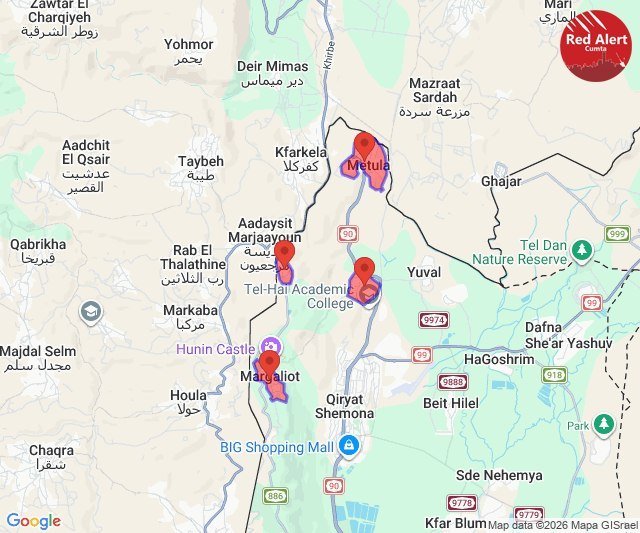
Israel's military issued expanded evacuation warnings on Saturday covering at least nine municipalities in south Lebanon and the western Bekaa valley, the third such mass-order in five weeks and a signal that bombardment operations are set to intensify along a front that has shown no sign of stabilising since the Gaza war began in October 2023.
The Israel Defense Forces ordered residents of Mashghara, Deir Zahrani, Sharqieh, Doueir, Qlaya, Sahmar, Zibdine, and Nabatieh al-Tahta to immediately evacuate, according to postings from witness accounts and regional monitoring feeds on 24 May 2026. The affected areas span Nabatieh governorate in the south and the western Bekaa districts adjacent to the border zone. The IDF communication, distributed via standard military channels and picked up by wire services, listed no timeline for the anticipated strikes and gave residents hours to clear.
The orders land as cross-border exchanges between Israeli forces and Hezbollah — still the dominant armed actor on the Lebanese side despite a months-long truce negotiation that has repeatedly stalled — have continued at near-daily intensity. Israeli strikes have hit targets across the southern belt and, on multiple occasions, extended into the eastern corridor. Hezbollah has responded with rocket and drone salvos aimed at Israeli population centres in the north. Neither side has declared a full-scale ground operation, but the pattern of strikes, counter-strikes, and now repeated displacement orders has produced a humanitarian cadence that residents and relief agencies describe as a slow-motion clearance.
A pattern, not an incident
Saturday's directive follows two earlier waves of forced displacement orders issued in April. On each occasion the IDF cited the presence of Hezbollah infrastructure — weapons storage, observation posts, tunnel networks — as justification for pre-strike civilian clearance. The military framing holds that removing non-combatants from the blast radius is a proportionality measure under the laws of armed conflict. Critics, including Human Rights Watch and several UN-mandated bodies, have noted that the cumulative effect of repeated orders across the same geographies functions less like a surgical warning and more like an administrative tool for depopulating contested territory permanently. The IDF has rejected that characterisation, stating that orders are localised and reviewable, and that civilians may return once operations conclude.
The nine municipalities named in Saturday's order sit at varying distances from the demarcation line — some as close as two kilometres, others further north in the Bekaa foothills. The population of Nabatieh governorate alone was estimated at roughly 300,000 before the current hostilities escalated. Displacement figures compiled by UNHCR indicate that more than 90,000 people have moved north and into Beirut since October 2023, though the rate has slowed in recent months as some families returned in the absence of large-scale ground incursions. The new orders threaten to reverse that trend and push additional civilians into an already strained urban housing market in the capital.
The Hezbollah dimension
Hezbollah's military posture along the southern belt has not materially changed in the several months since the most recent US-brokered ceasefire framework was circulated. The group retains command and control over its rocket arsenal, its precision missile programme, and its tunnel infrastructure. Israeli intelligence assessments, cited in Western wire reporting over the past year, have consistently identified the southern belt — and Nabatieh in particular — as the highest concentration zone for Hezbollah's long-range strike capability. That assessment underlies the IDF's operational logic for targeted bombardment and, by extension, for the civilian evacuation orders that precede those strikes.
From Hezbollah's perspective, the orders are an extension of a pressure campaign designed to break the political will of a Lebanese state that has no functioning government capable of negotiating the group's disarmament or redeployment. The group has not publicly responded to Saturday's orders, as is its practice with tactical military communications. Regional analysts tracking the group note that its leadership has signalled continued adherence to the ceasefire conditions as it interprets them — meaning no offensive operations against Israel — while reserving the right to respond to what it classifies as Israeli violations of the same terms. The IDF orders, from that vantage, represent a systematic erosion of the enemy's territorial presence without triggering the escalation ladder that would draw the group into a full exchange.
What a full-ground alternative would look like
The Biden administration and, by extension, the Macron-led French diplomatic track have repeatedly argued that a negotiated buffer zone and Hezbollah's phased withdrawal north of the Litani River remains the only durable solution. That framework has made no progress in six months. Israel's alternative — persistent targeted strikes and eviction orders — has preserved the momentum of the military pressure without triggering the international fallout of a large-scale invasion that would displace hundreds of thousands in a matter of days and create a second humanitarian catastrophe that the Western coalition is not politically positioned to absorb.
The logic of targeted bombardment with displacement orders is therefore not merely operational; it is political. It keeps the initiative with the IDF while allowing political leadership in Jerusalem to assert that it is conducting precision operations rather than a ground occupation. That framing holds domestic political value in Israel, where the northern evacuation of some 60,000 residents — many of whom have been in temporary housing for over a year — creates durable pressure on the government to demonstrate progress on the security question. It also keeps Hezbollah in a defensive posture without giving the group the provocation it needs to justify abandoning its ceasefire discipline.
The cost is borne almost entirely by civilians. Lebanese municipal authorities in the affected areas have warned that infrastructure — water, electricity, municipal administration — is reaching collapse in towns that have been partially evacuated repeatedly. The World Food Programme has flagged supply chain pressures in the Bekaa region, where host communities absorbing displaced families from the south have limited absorption capacity. The UN Special Coordinator for Lebanon has called for an immediate cessation of expansion orders, a call that carries no enforcement mechanism.
The next 30 to 60 days
The trajectory appears set for continued low-intensity bombardment anchored by periodic displacement orders. Hezbollah is unlikely to change its calculus while the Gaza phase of the conflict remains unresolved — the group has linked its own posture to a broader Axis-of-resistance framework that remains politically active even where it has temporarily moderated militarily. Israel, for its part, has demonstrated willingness to escalate on the northern front when strategic conditions warrant, as it did in the weeks preceding the October 7 events and again during periods of heightened tension in mid-2024. The current interval — sustained but not dramatic — is the most dangerous in some ways, because it normalises the gradual clearance while the international attention is on Gaza, on Iran nuclear negotiations, and on ceasefire architecture that has repeatedly failed to materialise.
For the residents of Mashghara and Deir Zahrani and Nabatieh al-Tahta, the immediate question is not strategic architecture. It is whether the evacuation window provided by the IDF — measured in hours — is sufficient for a family to load a vehicle, notify neighbours, secure livestock, and move north on roads that are themselves subject to intermittent IDF surveillance. The IDF has offered no transport assistance. The municipal authorities in the affected areas have, in previous rounds, issued their own guidance noting that residents who remain cannot be considered combatants and therefore retain civilian protection under international humanitarian law. That guidance has no enforcement mechanism either.
This report was compiled from wire-service postings distributed via monitoring feeds on 24 May 2026. Monexus cross-referenced the IDF order listings against regional municipal channels and UNHCR displacement tracking.
Wire provenance
This editorial synthesis draws on the following public wire/social posts:
- https://t.me/thecradlemedia/12542
- https://t.me/wfwitness/8847
- https://t.me/thecradlemedia/12539