Turkish Police Storm Main Opposition Party Headquarters in Ankara
Turkish riot police stormed the headquarters of the main opposition Republican People's Party in Ankara on May 24, deploying riot control weapons after a court ruling reinstated former chairman Kemal Kılıçdaroğlu, in a move that critics say marks a deepening of the ruling party's control over opposition structures.
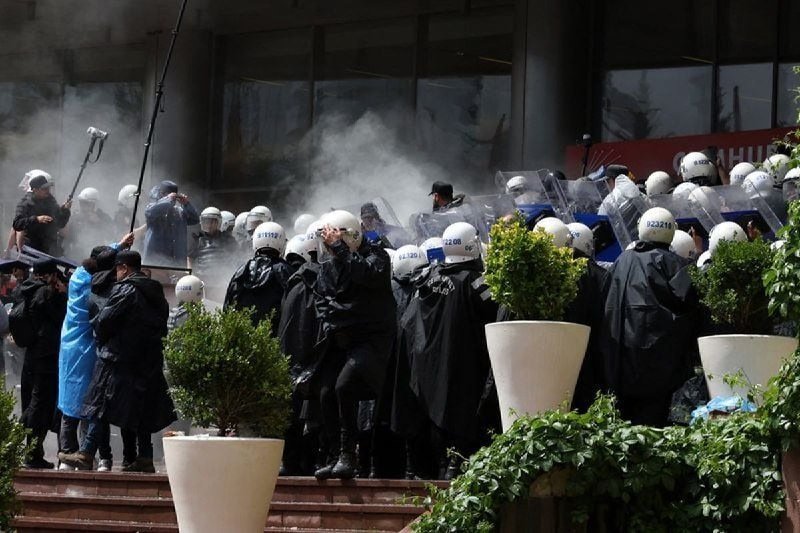
Turkish riot police entered the headquarters of the Republican People's Party, Turkey's main opposition formation, in Ankara on the morning of May 24, deploying pepper gas, tear gas, and plastic bullets to force entry after a court ruling reinstated former chairman Kemal Kılıçdaroğlu and stripped the current leadership of its authority. The operation, which began shortly before 12:00 UTC, saw officers tow vehicles blocking access to the building and seal off surrounding roads before moving inside, according to reports from eyewitnesses and regional monitoring channels. Protesters inside responded by barricading interior doors with furniture, prolonging the standoff as enforcement officers worked to remove them.
The confrontation crystallises a running dispute over the CHP's internal governance that has intensified since Kılıçdaroğlu's departure from the chairmanship. Turkish courts have issued competing rulings on the party's leadership in recent weeks, creating a legal ambiguity that the current leadership — installed after Kılıçdaroğlu's exit — has resisted honouring. Monday's police action was the state's first direct enforcement of a court order in favour of the former chairman's reinstatement, and it played out in front of the party's national headquarters as staff and supporters gathered outside.
The disputed court ruling
The immediate trigger for Monday's operation was a court decision that found the removal of Kılıçdaroğlu from the CHP chairmanship earlier this year to have been procedurally flawed. According to the ruling, the party leadership that expelled him lacked the quorum required under CHP statutes to call such a vote. Kılıçdaroğlu, who led the party for thirteen years and ran unsuccessfully against President Recep Tayyip Erdoğan in three consecutive presidential elections, had been replaced by a successor after announcing he would step aside. He subsequently challenged that replacement, arguing it was engineered by rivals within the party apparatus who opposed his more confrontational stance toward the government.
The current CHP leadership, aligned with party figures who have advocated a less adversarial approach to the governing Justice and Development Party, argued that Kılıçdaroğlu's departure was final and that the court had been misled about internal party procedures. They petitioned a higher court to overturn the reinstatement order, calling it an improper intervention in the party's autonomy. That petition was still pending when police moved on the headquarters on May 24.
The government has maintained a public posture of non-interference, insisting that courts are acting independently and that the dispute is an internal CHP matter. But critics note that Turkish courts have delivered rulings favourable to the governing party with consistent regularity over the past decade, raising questions about their independence in politically sensitive cases. The opposition has pointed to a pattern in which judicial decisions on election law, municipal authority, and party registrations have uniformly advantaged the AKP and its allies.
The resistance inside
What distinguished Monday's operation from previous enforcement attempts was the response from party members already inside the building. Rather than submit to eviction orders from security personnel, supporters and staff closed interior doors and wedged them with furniture, forcing officers to breach the entrances physically before they could reach the contested offices. The standoff continued for at least two hours after the initial breach, with officers deploying riot control agents to clear each successive barrier.
Videos from the scene showed protesters outside the building chanting slogans in support of Kılıçdaroğlu as riot vans surrounded the perimeter. Several people were reported to have been struck by plastic bullets, though a precise casualty count was not immediately available from the sources reviewed. The CHP issued a statement condemning the operation as an act of state violence against a legitimate political party, calling it a direct assault on democratic opposition.
The episode recalls previous incidents in which Turkish security forces have moved against opposition party premises, particularly after the 2016 coup attempt, when dozens of civil society organisations and media outlets were shuttered under emergency decree authority. While Monday's operation was framed as enforcement of a civil court order, the scale of the police deployment — including riot units and vehicles not typically used for routine legal enforcement — drew comparisons to more confrontational phases of the Erdoğan government's relationship with organised opposition.
A pattern beyond one party
The broader context matters. Turkey's political space has narrowed significantly over the past decade, as changes to electoral law, media ownership, and municipal governance have concentrated power in the hands of the ruling alliance. The CHP, as the largest opposition party, has faced particular obstacles in reaching voters: its candidate in the 2023 presidential election, Kemal Kılıçdaroğlu himself, found that large portions of the media landscape either ignored or actively disparaged his platform. Social media platforms faced throttling during critical campaign periods, a phenomenon documented by digital rights researchers.
The party has also been stripped of municipal control in several cities following court decisions that validated electoral fraud allegations — in some cases, only after the municipal governments had already delivered popular services and infrastructure improvements that challenged the governing party's narrative. Each reversal was framed as judicial enforcement of electoral law, but critics argued the timing and selection of which results to challenge suggested a pattern that favoured the AKP.
Monday's confrontation in Ankara is, in one reading, a legal dispute within a political party. It is also, in a structural reading, an illustration of how the formal apparatus of democratic institutions — courts, police, regulatory bodies — can be deployed selectively to alter the terms of political competition without visibly crossing any bright-line threshold. The CHP was not banned. No law was suspended. A court issued an order; police enforced it. The effect, however, was to bring the physical headquarters of Turkey's main opposition under state control in a moment of internal leadership crisis.
Stakes for Turkish opposition
The outcome of this episode will shape the CHP's capacity to function as an organised opposition in the medium term. If Kılıçdaroğlu's reinstatement holds, the party faces a choice between a more combative leadership that has proven electorally competitive — Kılıçdaroğlu nearly won the presidency in 2023, forcing a run-off — and a faction that has preferred managed engagement with the governing structure. That internal tension has been present for years; Monday's events have brought it to a physical confrontation.
For Turkey's broader political landscape, the episode is a test of whether the formal protections available to opposition parties — the ability to seek judicial review, to occupy headquarters, to hold internal elections — retain substantive meaning when the state apparatus moves decisively in contested cases. The sources reviewed do not establish whether the court's reinstatement order will hold, whether the current leadership will appeal, or how the party's parliamentary contingent will position itself in the meantime. What is clear is that the state has shown it will deploy riot police to enforce court orders in politically sensitive party governance disputes — a signal that the formal rules of Turkish opposition politics operate within defined limits the ruling establishment is willing to defend with force.
This publication's coverage of the Ankara operation foregrounds the physical enforcement dimension and the CHP's characterisation of state overreach, a framing that appeared less prominently in the wire reports that emphasised the court ruling as the primary trigger.
Wire provenance
This editorial synthesis draws on the following public wire/social posts:
- https://t.me/wfwitness/12458
- https://t.me/wfwitness/12457
- https://t.me/wfwitness/12456
- https://t.me/alalamarabic/9872
- https://t.me/alalamarabic/9873
- https://t.me/GeoPWatch/4521