California Burning: When Industrial Incidents Become Oil Market Theatre
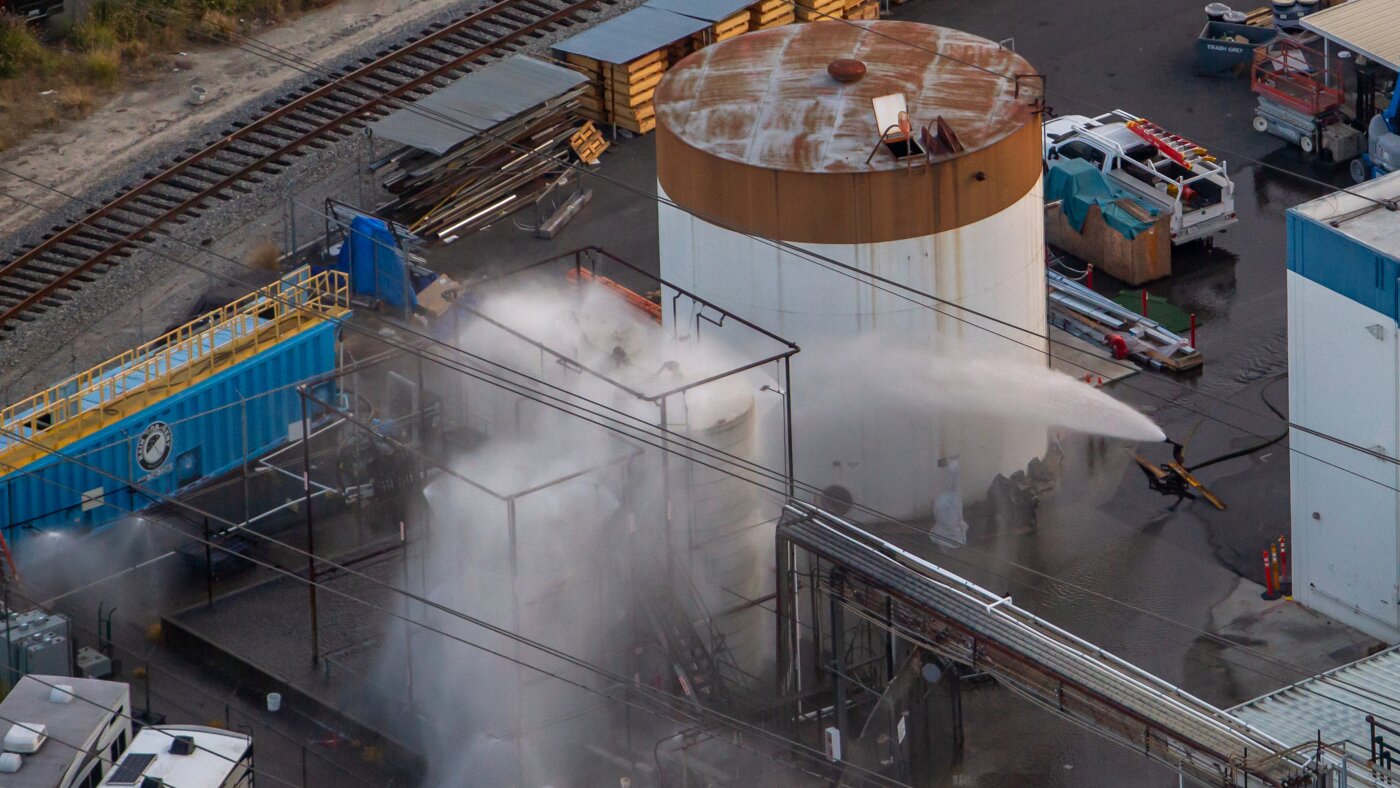
Forty thousand people. That is the number the world reached for on the morning of 24 May 2026, when a cracking chemical tank at a California aerospace plant triggered a state of emergency and evacuation orders that emptied an entire town. The tank was overheating. It could leak. It could explode. Those are the facts as initially reported, and they are alarming enough without embellishment.
What happened next was more familiar than the emergency itself: Brent crude opened the week four percent lower. The connection was tenuous, speculative, and instant. Something burned somewhere in America, and somewhere in London or Singapore, a trader read that as a reason to adjust a position in oil futures. This is the way modern energy markets process information — not through systematic risk assessment, but through pattern-matching and algorithmic reflexes that treat a California industrial accident as a signal about global supply.
The Anatomy of an Overreaction
The oil market's immediate response to the California incident was, on its face, rational. Any large industrial fire in a major economy raises questions about demand disruption, regulatory response, and supply chain effects. But four percent in a single session, on the basis of an emergency that had not yet produced any confirmed casualties and was still being contained, reflects something closer to algorithmic overreaction than sober analysis.
This is not a new phenomenon. Markets have long processed geopolitical and weather-related disruptions with disproportionate sensitivity. A hurricane in the Gulf of Mexico produces outsized price moves before it makes landfall; a terrorist incident sends aviation fuels lower before anyone has assessed the actual impact on travel demand. The pattern is consistent: uncertainty produces volatility, and volatility produces trading opportunities for those positioned to profit from it.
What changes, over time, is the framing. A decade ago, a California industrial emergency would have been covered as a domestic safety story. Today, it is immediately contextualised — by some outlets — as an energy market event. The subject of the coverage shifts from the people evacuated to the barrels of oil not consumed.
Whose Emergency, Whose Narrative
The Telegram wire services, including Tasnim News English, framed the California fire alongside oil market data as though the two were naturally related. For an English-language service aligned with a particular geopolitical perspective, there is a clear editorial logic to juxtaposing an American industrial failure with a negative oil market open. The implication is not subtle: even as things go wrong inside the United States, the energy order that Washington built is itself under pressure.
That framing is not wrong, exactly. The global energy market is under genuine structural pressure from the transition away from fossil fuels, from the reshoring of industrial capacity, and from the continued concentration of upstream production in a handful of geopolitical flashpoints. But using a localised industrial accident as evidence for that proposition is a category error. The tank cracked because tanks crack, sometimes, under thermal stress. That is a maintenance and engineering question. It is not a geopolitical argument.
Western wires, for their part, showed their own framing tendencies. Coverage of the California emergency focused on the evacuation, the emergency response, and the aerospace context — all legitimate angles. What was less visible was any sustained examination of why a chemical tank at an aerospace facility was allowed to reach a state of thermal instability, or what oversight mechanisms failed. The emergency was news; the conditions that produced it were not.
What the Market Got Wrong — and Right
Four percent down on Brent is not nothing. If sustained, it represents a meaningful shift in input costs for airlines, chemical manufacturers, and transport logistics firms. It will show up in fuel price adjustments within days. For consumers at the pump, the California incident will be invisible as a cause; they will simply see prices move and attribute them to whatever geopolitical anxiety is most prominent in the news cycle at the time.
But the move also revealed something about market structure. The California emergency produced a directional signal — prices fell — because the default assumption of algorithmic trading systems is that disruption reduces demand. That assumption has been reinforced through a decade of analysis of COVID-19 lockdowns, Gulf of Oman incidents, and Russian supply disruptions. The model is: something bad happens, people move less, oil is worth less. It is a reasonable prior. It is not the only prior that fits the data.
A fire at a petrochemical facility can also mean that feedstock supply tightens. An explosion at a refinery can take processing capacity offline. The emergency in California, if it had spread to adjacent chemical storage, could have constrained production rather than consumption. The market priced the lower-probability, higher-impact scenario first, and that tells us something about who is driving price discovery in the current environment: not the physical traders who will ultimately clear the market, but the algorithmic actors who move first.
The Stakes, Set Out Plainly
Forty thousand people were told to leave their homes on the basis of a tank failure that engineers were still assessing. Some of them will return within days. Some will not. Some will find structural damage to their property. Some will face questions about whether the facility that caused the emergency should have been permitted to operate so close to residential areas in the first place.
Those stakes are concrete, local, and human. They do not require the international energy market to validate them. The fact that traders moved oil futures on the basis of the same news item — the same dispatch from the same wire service, carrying the same photographs — is not evidence that the market is sophisticated. It is evidence that financial markets have become a kind of secondary processor of disaster, converting human emergencies into price signals that then ripple back into the real economy as cost changes that no voter ever voted on.
That is the uncomfortable structural fact that the California emergency and the oil market reaction together expose. The energy system is not managed by those it affects most directly. It is managed by algorithms, traders, and geopolitical actors, all of whom processed the same evacuation order and drew their own conclusions. Some of those conclusions were right. Most were not. The market will correct, as markets always do. The people who left their homes on 24 May 2026 will not be made whole by a four percent Brent correction.
The question worth sitting with is not whether the oil market responded to the emergency, but whether it should have been expected to respond to anything else. Industrial accidents in advanced economies are not, by themselves, energy market events. They are made into energy market events by the speed of modern information systems and the incentives of actors who profit from volatility. That is a design choice embedded in the architecture of how markets process news. It is not natural, inevitable, or necessarily desirable. It is simply the arrangement we have — and the California emergency is a reminder that the arrangement serves some interests more reliably than it serves others.
This publication covered the California emergency primarily as an infrastructure and industrial safety story, contextualising the oil market response as a secondary signal rather than the primary frame. The thread context reflects how different wire services assigned different weights to the same event.
Wire provenance
This editorial synthesis draws on the following public wire/social posts:
- https://t.me/tasnimnews_en/
- https://t.me/tasnimnews_en/
- https://t.me/tasnimnews_en/